


Enterprise architecture is often described as the blueprint for digital transformation. Yet, many initiatives stall or drift into technical debt because the foundational documentation lacks coherence. A primary culprit in these failures is not the data itself, but the lens through which that data is presented. In the context of the ArchiMate modeling language, this lens is defined as the Viewpoint.
Without the correct Viewpoints, a model may technically adhere to the metamodel rules, yet remain useless to the stakeholders it is intended to serve. This article dissects why Viewpoints are the backbone of effective architecture documentation, exploring the mechanics of alignment, consistency, and communication. We will examine how the absence of structured Viewpoints leads to fragmentation and how proper definition ensures clarity across business, technology, and strategy layers.
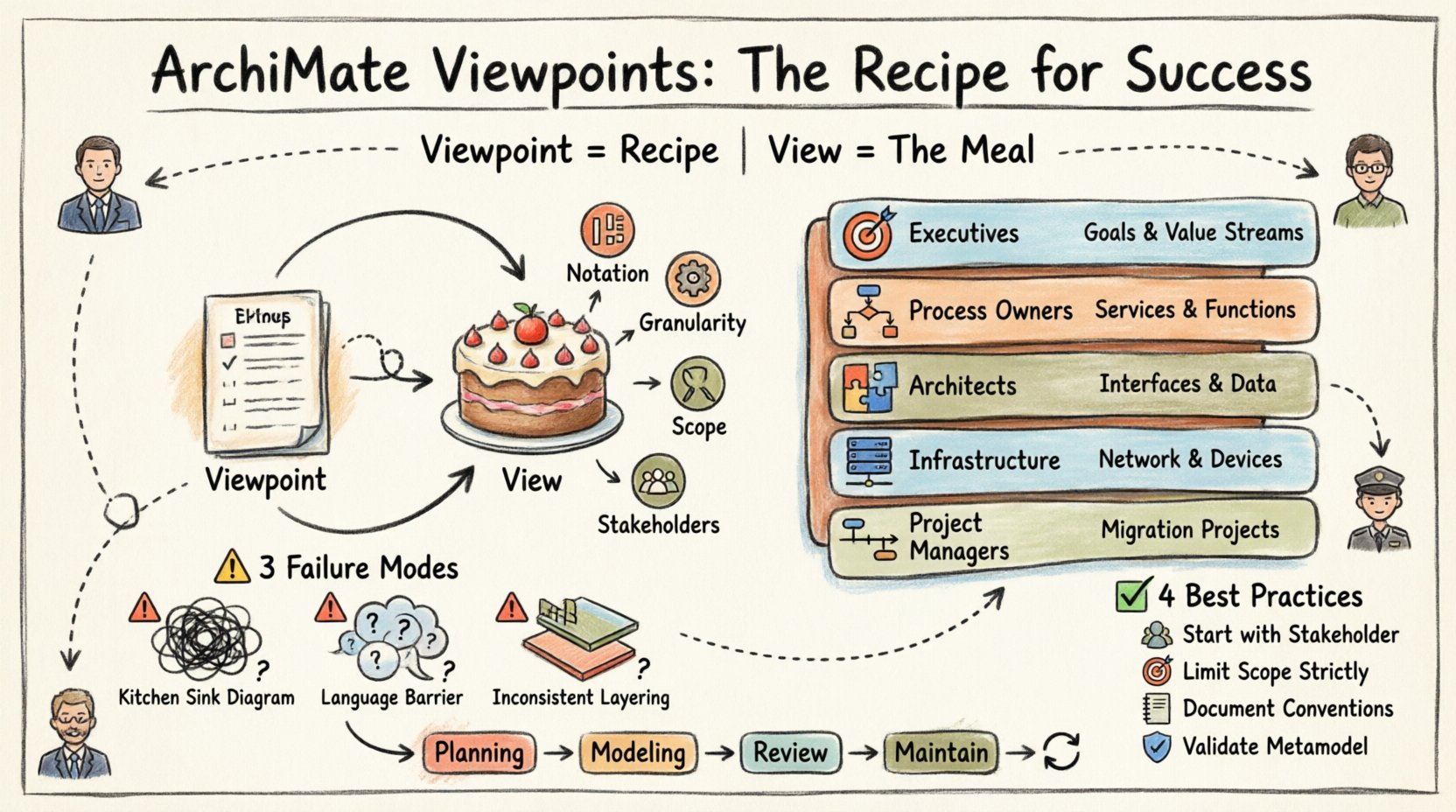
Understanding the Core Distinction: View vs. Viewpoint 👁️
To grasp why models fail, one must first distinguish between a View and a Viewpoint. These terms are frequently used interchangeably, but in rigorous enterprise architecture, they serve distinct functions.
- Viewpoint: A specification of the conventions for the construction and use of a view. It defines the language, the layer, the stakeholders, and the concerns.
- View: The representation of a set of related models from a specific perspective. It is the actual diagram or artifact produced.
Think of a Viewpoint as a recipe and a View as the meal. You cannot bake the cake without the recipe. If you lack the Viewpoint specification, you might produce a diagram that looks correct visually but fails to address the specific concerns of the audience. This mismatch is the root of many communication breakdowns.
The Role of Viewpoints in Standardization
Viewpoints enforce consistency. When a team agrees on a standard Viewpoint, they agree on:
- Notation: Which symbols and shapes are permitted.
- Granularity: How much detail is required for a specific layer.
- Scope: Which parts of the enterprise are in scope.
- Stakeholders: Who is expected to consume this information.
Without this standardization, one architect might produce a high-level strategy map while another produces a detailed deployment diagram, leaving the stakeholders confused about the relationship between the two. The Viewpoint bridges this gap by defining the contract between the modeler and the reader.
Common Failure Modes in Architecture Documentation 🚫
When Viewpoints are ignored or poorly defined, specific patterns of failure emerge. Recognizing these patterns is the first step toward correction.
1. The “Kitchen Sink” Diagram
This occurs when an architect attempts to show everything in a single diagram. By ignoring Viewpoint constraints regarding scope and granularity, the model becomes cluttered. Stakeholders cannot find the information relevant to their role.
- Impact: Critical relationships are lost in noise.
- Consequence: Decisions are delayed because the diagram is too complex to interpret.
2. The Language Barrier
Using technical ArchiMate concepts without mapping them to business language creates a disconnect. A Viewpoint for the C-Suite must focus on value streams and capabilities, whereas a Viewpoint for developers must focus on components and interfaces.
- Impact: Business stakeholders do not recognize their processes in the model.
- Consequence: Lack of buy-in and support for the architecture.
3. Inconsistent Layering
Archimate defines distinct layers: Strategy, Business, Application, Technology, and Physical. Mixing these layers within a single Viewpoint without justification violates the principle of separation of concerns.
- Impact: Dependencies become unclear.
- Consequence: Impact analysis fails, leading to unexpected outages or integration issues.
Selecting the Right Viewpoint for the Audience 🎯
The success of a model depends on matching the Viewpoint to the audience’s needs. Below is a breakdown of common Viewpoint categories and their specific utility.
| Viewpoint Category | Primary Audience | Key Focus Area | Typical Deliverable |
|---|---|---|---|
| Strategy Viewpoint | Executive Leadership | Goals, Principles, Value Streams | Strategic Roadmap Diagram |
| Business Viewpoint | Process Owners | Business Services, Functions, Actors | Process Flow Map |
| Application Viewpoint | System Architects | Application Services, Data Objects, Interfaces | System Landscape Diagram |
| Technology Viewpoint | Infrastructure Teams | Network, Devices, System Software | Deployment Diagram |
| Implementation Viewpoint | Project Managers | Implementation & Migration Projects | Project Dependency Graph |
Using a Strategy Viewpoint for a technical deployment review will confuse the infrastructure team. Conversely, using a Technology Viewpoint for a budget approval meeting will fail to demonstrate business value. The Viewpoint dictates the vocabulary and the depth of the model.
Ensuring Model Consistency Across Layers 🔗
One of the greatest strengths of ArchiMate is its ability to trace relationships across layers. However, this power is only unlocked when Viewpoints are structured to support cross-layer traceability. A Viewpoint must explicitly define how elements from one layer relate to another.
The Traceability Chain
A robust architecture model links a business goal to a specific technology component. To achieve this, the Viewpoint must specify:
- Association Types: Which relationships are valid between layers (e.g., serving, realizing).
- Navigation: How a user moves from a business process to the supporting application.
- Constraint Rules: Which elements must exist for a relationship to be valid.
Without these rules, the model becomes a collection of silos. You might have a perfect Business Layer model and a perfect Technology Layer model, but no clear path connecting them. This lack of connectivity makes impact analysis impossible.
Stakeholder Engagement and Viewpoint Alignment 🤝
Architecture is a social activity. It requires communication between diverse groups. Viewpoints serve as the common ground for these conversations.
Defining Concerns
Each stakeholder group has specific concerns. A Viewpoint addresses these concerns by filtering the model. For example:
- Security Officers: Need a Viewpoint highlighting security services and authentication mechanisms.
- Finance Officers: Need a Viewpoint highlighting cost centers and investment projects.
- Developers: Need a Viewpoint highlighting APIs and data flows.
If a single Viewpoint is used for all these groups, the result is a dilution of information. The security officer misses the controls; the finance officer misses the costs. Tailoring Viewpoints ensures that each stakeholder receives the precise data they need to make decisions.
The Cost of Poor Viewpoint Management 💸
Ignoring Viewpoint definitions incurs tangible costs. These are not just theoretical issues; they affect timelines and budgets.
- Rework Cycles: Diagrams must be redrawn to suit different audiences, wasting modeling time.
- Decision Latency: Stakeholders request clarification because the diagram is ambiguous.
- Loss of Context: New architects join the team and cannot understand the existing model due to inconsistent Viewpoints.
- Governance Gaps: Compliance audits fail because the model does not show the required relationships for regulatory checks.
Best Practices for Defining Viewpoints 📝
To avoid the pitfalls mentioned above, follow these structured practices when defining Viewpoints for your enterprise architecture.
1. Start with the Stakeholder
Do not start with the tool or the diagram. Start with the person who will read it. Ask:
- What decisions do they need to make?
- What level of detail do they require?
- What terminology do they understand?
2. Limit Scope Strictly
A Viewpoint should not try to solve every problem. Define a clear scope. If a Viewpoint is meant to cover “Application Interfaces,” do not include business processes in it. Keep the focus narrow to ensure clarity.
3. Document the Conventions
Create a standard document that describes the Viewpoint. Include:
- Allowed ArchiMate elements.
- Allowed relationships.
- Color coding standards.
- Layout conventions.
This document becomes the rulebook for the architecture team, ensuring that every diagram produced follows the same logic.
4. Validate Against the Metamodel
Ensure that the Viewpoint adheres to the ArchiMate metamodel rules. For instance, a Business Service cannot directly connect to a Physical Device without an intervening Application or Technology layer. The Viewpoint should enforce these logical constraints during the modeling process.
Integrating Viewpoints into the Workflow ⚙️
Viewpoints should not be an afterthought. They must be integrated into the architecture workflow from the beginning.
Phase 1: Planning
Before modeling begins, identify which Viewpoints are required for the project. Create a Viewpoint Matrix that maps project phases to required diagrams.
Phase 2: Modeling
Modelers should work within the context of specific Viewpoints. If a Viewpoint is not defined, the modeler should pause and request one. Do not proceed with ad-hoc diagrams.
Phase 3: Review
During architecture review boards, evaluate the Viewpoints, not just the diagrams. Is the diagram answering the right question? Is it using the right notation? This shifts the conversation from aesthetics to utility.
Maintaining Viewpoints Over Time 🔄
Enterprise architecture is dynamic. As the business changes, Viewpoints may need to evolve. A Viewpoint that was relevant five years ago might no longer address current concerns.
Periodic Review
Conduct a periodic review of existing Viewpoints. Ask:
- Are these Viewpoints still being used?
- Do they still meet the needs of the stakeholders?
- Are there new concerns that require new Viewpoints?
Version Control
Just like the model, Viewpoints should be versioned. If a Viewpoint changes, document the change. This ensures that historical models remain interpretable and future models are consistent with the new standard.
The Technical Implications of Viewpoints 🛠️
While Viewpoints are primarily communication tools, they have technical implications for how the model is stored and queried.
Query Optimization
When exporting data from a modeling environment, Viewpoints often define the query filters. A well-defined Viewpoint ensures that the exported data is clean and structured, allowing for better integration with other IT systems.
Automated Reporting
Consistent Viewpoints enable automation. If every Viewpoint follows the same naming convention and structure, scripts can be written to generate reports automatically. This reduces manual effort and the risk of human error in reporting.
Addressing Complexity Through Abstraction 🧩
One of the main benefits of Viewpoints is the ability to manage complexity through abstraction. Not every stakeholder needs to see every detail.
Layering Detail
Use Viewpoints to create a “zoomable” model. A high-level Viewpoint shows the landscape. A detailed Viewpoint shows the components. This allows the same underlying data to serve multiple purposes without duplication.
Focus on Relevance
Abstraction is not about hiding information; it is about hiding irrelevant information. By using Viewpoints, you ensure that the model remains relevant to the specific task at hand. This keeps the architecture agile and responsive to change.
Conclusion on Architecture Clarity 🎓
The integrity of an enterprise architecture model relies heavily on the structure of its Viewpoints. Without them, models become disjointed collections of diagrams that fail to communicate value. By defining clear Viewpoints, organizations can ensure that their architecture serves its primary purpose: enabling informed decision-making.
Focusing on the correct Viewpoints allows architects to bridge the gap between strategy and execution. It transforms the model from a static artifact into a dynamic tool for governance and planning. As the enterprise evolves, so too must the Viewpoints that support it. Continuous refinement of these specifications is essential for maintaining a viable and valuable architecture.
Adopting a disciplined approach to Viewpoint selection and maintenance pays dividends in reduced rework, clearer communication, and faster project delivery. It is the foundation upon which successful digital transformation is built.