


Enterprise Architecture is a discipline defined by complexity. It requires bridging the gap between high-level business strategy and the concrete technical infrastructure that supports it. When dealing with the ArchiMate modeling language, the sheer volume of concepts and relationships can easily lead to confusion. The solution lies not in creating more diagrams, but in applying the right structure. This means understanding how to use ArchiMate Viewpoints effectively to slice the architecture into manageable pieces.
Layering is the fundamental mechanism that keeps this structure intact. Without it, models become tangled webs of interconnections that stakeholders cannot parse. This guide explores the methodology of layering, how to define viewpoints that serve specific audiences, and how to maintain clarity throughout the architecture lifecycle.
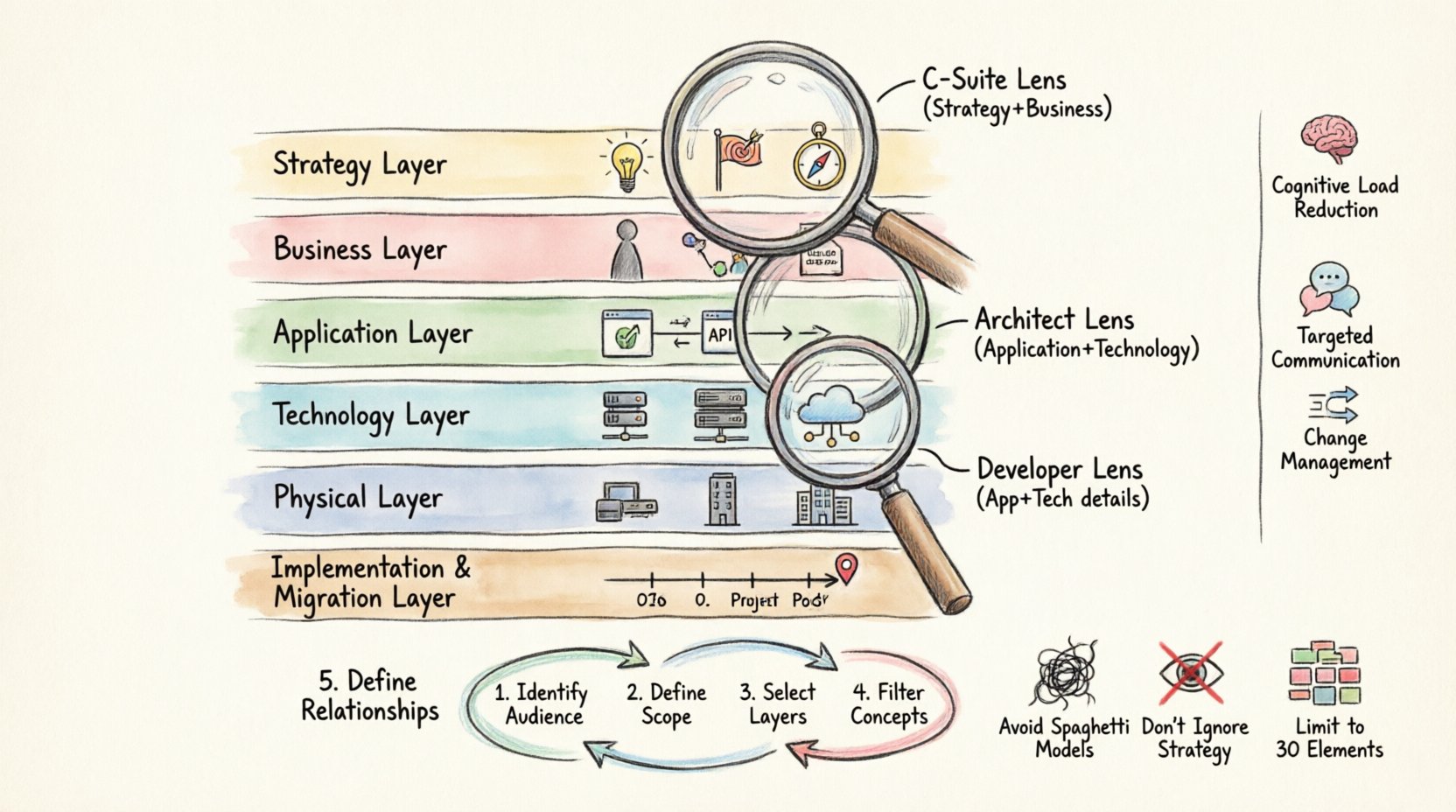
🧩 Understanding the Core: Layers and Viewpoints
Before diving into the mechanics of creation, it is essential to distinguish between two critical concepts: Layers and Viewpoints. While they often work in tandem, they serve different purposes within the architecture framework.
What are the Layers?
Layers represent the abstraction levels within the architecture. They organize concepts based on their function and relationship to the business. ArchiMate defines six primary layers:
- Strategy Layer: Focuses on the motivation for change. This includes principles, goals, drivers, and assessments.
- Business Layer: Describes the business domain. It covers business actors, roles, processes, services, objects, and events.
- Application Layer: Details the software systems. This includes application components, functions, services, and interfaces.
- Technology Layer: Describes the IT infrastructure. It covers nodes, devices, communication networks, paths, and artifacts.
- Physical Layer: Focuses on the hardware and physical environment where software runs.
- Implementation & Migration Layer: Manages the transition from the current state to the target state. It includes projects, phases, and assignments.
Each layer contains specific elements. A Business Process belongs in the Business Layer. An Application Component belongs in the Application Layer. Mixing these layers without a clear viewpoint leads to cognitive overload.
What is a Viewpoint?
A Viewpoint defines the perspective from which a model is viewed. It specifies which layers, concepts, and relationships are visible to a specific audience. Think of a viewpoint as a lens. A developer might use a lens that zooms in on the Application Layer, while a CIO uses a lens that focuses on the Business and Strategy layers.
Creating a viewpoint involves:
- Identifying the Stakeholder: Who is looking at this?
- Defining the Purpose: What question are they trying to answer?
- Selecting the Content: Which layers and concepts are relevant?
- Setting the Abstraction Level: How detailed should the information be?
📊 Why Layering Matters in Enterprise Architecture
When architecture documentation becomes unstructured, it loses value. Stakeholders lose trust in the data because they cannot find what they need. Layering provides a logical framework that reduces complexity. Here is why this approach is critical for success.
1. Cognitive Load Reduction
Human brains process information better when it is categorized. Showing a developer every business process in the organization is overwhelming and irrelevant. Showing a business analyst every server node is equally useless. Layering allows you to filter information based on relevance.
2. Targeted Communication
Different stakeholders speak different languages. The Board of Directors talks about value and risk. The Engineering Team talks about APIs and latency. A layered approach allows you to tailor the message without changing the underlying data.
3. Change Management
When a change occurs, you need to know the impact. If you update a technology node, you need to trace its effect up through the application layer to the business service. Layering establishes these vertical connections clearly, making impact analysis straightforward.
🛠️ Designing Viewpoints for Specific Stakeholders
Not every stakeholder needs the same view. A robust architecture framework includes a catalog of viewpoints tailored to specific roles. Below is a breakdown of common viewpoints and what they should contain.
| Stakeholder Role | Primary Focus | Key Layers | Key Concepts |
|---|---|---|---|
| C-Suite / Executives | Strategic alignment, ROI, Risk | Strategy, Business | Goals, Drivers, Business Services, Capabilities |
| Business Analysts | Process efficiency, Requirements | Business | Processes, Actors, Roles, Objects |
| Application Architects | System integration, Data flow | Application, Business | Application Components, Interfaces, Business Services |
| Infrastructure Architects | Deployment, Performance, Security | Technology, Physical | Nodes, Devices, Networks, Artifacts |
| Developers | Implementation details, APIs | Application, Technology | Functions, Interfaces, Communication Networks |
| Project Managers | Migration, Timeline, Resources | Implementation & Migration | Projects, Phases, Assignments |
By mapping roles to specific layers, you ensure that every diagram serves a purpose. If a diagram does not fit a specific viewpoint definition, it is likely too broad or redundant.
🔄 The Process of Creating a Viewpoint
Creating a viewpoint is a deliberate process. It requires analysis before modeling. Follow these steps to ensure your viewpoints are robust and useful.
Step 1: Identify the Audience
Who will consume this information? Is it a technical team or a management committee? The audience dictates the vocabulary and the depth of detail.
- Technical Audience: Can handle complex relationships and detailed interfaces.
- Management Audience: Needs high-level summaries and clear cause-and-effect relationships.
Step 2: Define the Scope
What is the boundary of the view? Are you looking at the entire enterprise or a specific division? A scope that is too broad dilutes the value. A scope that is too narrow misses the context.
Step 3: Select the Relevant Layers
Choose the layers that answer the stakeholder’s questions. Do not include every layer just because it exists. If the question is about business process efficiency, the Technology Layer is likely unnecessary detail.
Step 4: Filter Concepts
Within the selected layers, choose specific concepts. For example, in the Business Layer, focus on Processes and Services rather than Objects unless data flow is the specific concern.
Step 5: Define Relationships
Which connections matter? Use association, flow, and serving relationships selectively. Too many lines make a diagram unreadable. Use colors or grouping to indicate importance.
🚧 Common Pitfalls in Layering and Viewpoints
Even experienced practitioners make mistakes when designing architecture models. Recognizing these traps early can save significant time and effort.
1. Mixing Layers Indiscriminately
One of the most common errors is placing concepts from different layers on the same diagram without a clear rationale. While cross-layer relationships are valid, overusing them creates a “spaghetti model” that is hard to trace. Ensure that cross-layer connections are essential to the narrative of the view.
2. Ignoring the Motivation Layer
Many models focus heavily on structure (Business, Application, Technology) but neglect the Strategy Layer. Without principles, goals, and drivers, the architecture lacks context. Why is this system being built? What value does it deliver? Always connect structural elements to motivational elements.
3. Creating Too Many Viewpoints
While variety is good, having fifty different viewpoints for the same data creates maintenance nightmares. Consolidate similar views. If two viewpoints serve the same purpose for different stakeholders, consider using a single view with annotations or filters.
4. Overloading the Diagram
Every diagram should have a single purpose. Do not try to show everything. If a diagram contains more than 30 elements, it is likely too complex. Split it into multiple views.
5. Neglecting the Implementation Layer
Architecture is not just about the target state; it is about the journey. The Implementation & Migration Layer is often ignored. Without it, stakeholders do not know how to get from the current state to the future state. Ensure projects and phases are mapped to the architectural changes they drive.
📐 Best Practices for Maintaining Clarity
Maintaining a clean architecture model requires discipline. Here are actionable strategies to keep your layering effective over time.
- Standardize Notation: Use consistent shapes and colors for every concept across all viewpoints. This reduces the learning curve for new stakeholders.
- Use Grouping: Use containers to group related elements. This visually separates concerns without hiding data.
- Version Control: Treat your model like code. Maintain versions of viewpoints to track evolution. This helps in auditing changes.
- Documentation: Every viewpoint should have a description. Explain what the diagram shows, who it is for, and when it was last updated.
- Regular Reviews: Schedule periodic reviews of the viewpoint catalog. Remove outdated views and update existing ones to reflect current business needs.
🌐 Integrating Layers with Stakeholder Needs
The relationship between layers and stakeholders is dynamic. As the business evolves, so do the needs of the stakeholders. This means the viewpoints must evolve as well.
Strategic Shifts
If the organization shifts from a cost-center model to a value-driven model, the Strategy Layer becomes more prominent. Viewpoints must be adjusted to highlight value streams and business outcomes rather than just operational efficiency.
Technical Debt
When addressing technical debt, the Technology and Application layers become critical. Viewpoints should focus on technical relationships, dependencies, and risks. The Business Layer is still relevant to show the impact of the debt on services.
Agile Transformation
In agile environments, the Implementation & Migration Layer becomes more granular. Sprints and iterations map to phases in the model. Viewpoints must be flexible enough to show short-term progress while maintaining the long-term target architecture.
🛡️ Security and Compliance in Layering
Security and compliance are cross-cutting concerns that span all layers. They should not be hidden in a single security diagram. Instead, integrate them into the relevant layers.
- Business Layer: Identify compliance requirements and legal drivers.
- Application Layer: Map security controls to application functions.
- Technology Layer: Define network security zones and hardware encryption.
This ensures that security is treated as a first-class citizen in the architecture, not an afterthought. Viewpoints for security auditors should aggregate these elements across layers to provide a holistic view of risk.
📈 Measuring the Success of Your Viewpoints
How do you know if your layering strategy is working? Look for these indicators of success.
- Adoption Rate: Are stakeholders actually using the diagrams in their meetings?
- Clarity Feedback: Do stakeholders report that the architecture is easier to understand?
- Decision Speed: Is decision-making faster because the impact of changes is clear?
- Maintenance Cost: Is the cost of keeping the model up to date reasonable?
If stakeholders are constantly asking for “more detail” or “less detail,” the abstraction level is off. Adjust the viewpoint definitions accordingly.
🚀 Moving Forward with Your Architecture
The journey of architecture modeling is continuous. The landscape changes, technology advances, and business goals shift. The structure you build today must be resilient enough to accommodate tomorrow’s changes. By adhering to the principles of layering and viewpoint design, you create a foundation that supports these shifts.
Remember that a model is a tool for communication, not a work of art. Its value is measured by its utility. Keep your viewpoints focused, your layers distinct, and your stakeholders in mind. This disciplined approach ensures that your enterprise architecture remains a strategic asset rather than a documentation burden.
Start by auditing your current models. Identify which viewpoints are used most and which are ignored. Refine the layers to match the actual flow of information in your organization. Over time, this practice will lead to a clearer, more effective architecture that drives real business value.