


Enterprise architecture is not merely about drawing boxes and lines. It is a discipline of communication, governance, and strategic alignment. As organizations mature, the initial setup of ArchiMate Viewpoints often becomes insufficient for the complexity of the business environment. Moving from basic compliance to strategic value requires a deeper understanding of how views are constructed, maintained, and consumed by diverse stakeholders.
This guide explores advanced methodologies for scaling your architecture practice. We move past the foundational definitions to examine how to structure information architecture for maximum impact. The goal is not just to model, but to inform decision-making at every level of the organization.
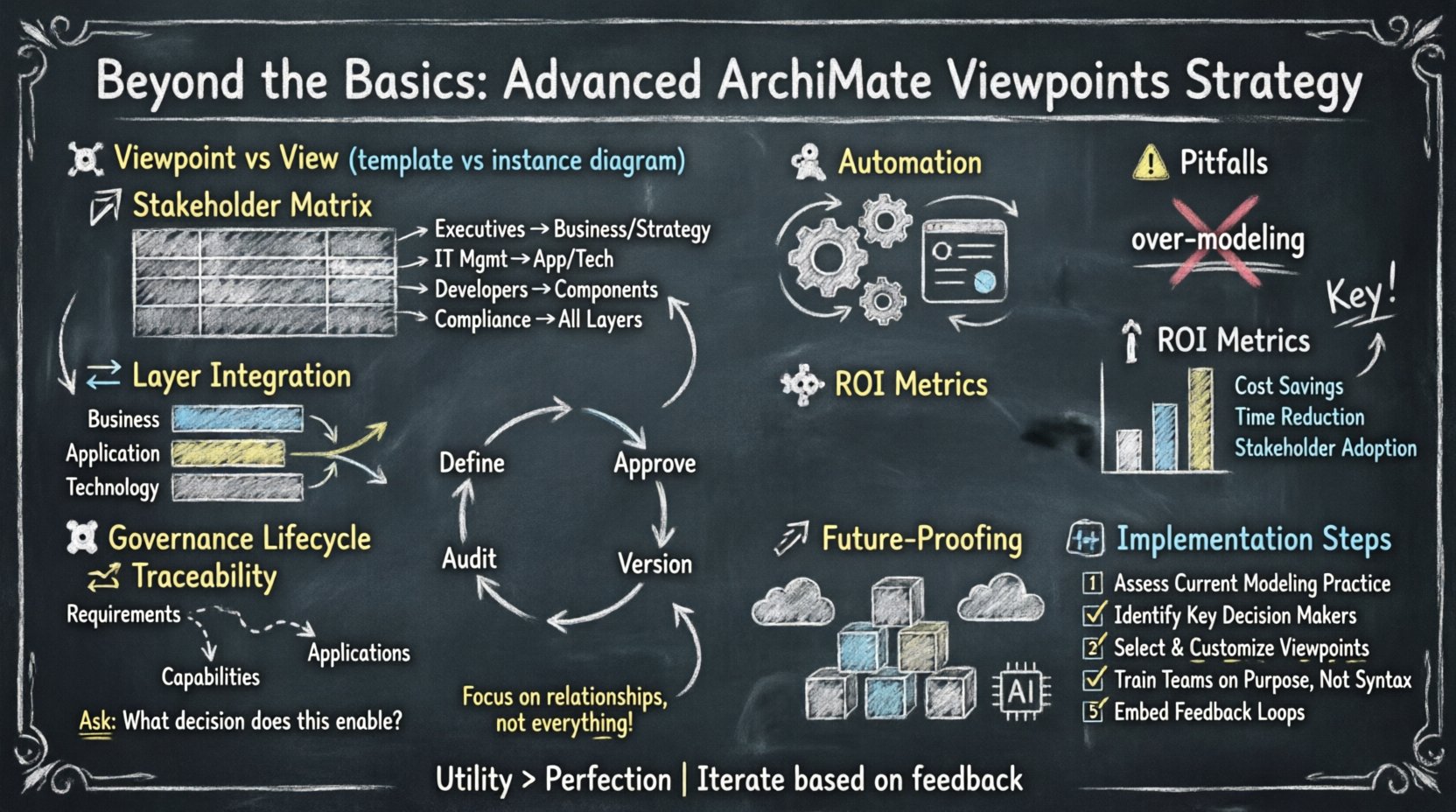
1. Distinguishing Viewpoints from Views 🧩
Before implementing advanced strategies, it is crucial to solidify the distinction between a Viewpoint and a View. This distinction is the backbone of a scalable architecture practice.
- Viewpoint: A specification of conventions for constructing views. It defines the language, notation, and scope suitable for a specific set of stakeholders.
- View: The actual representation of the system or enterprise for a specific stakeholder, constructed according to a Viewpoint.
Many practitioners confuse these two concepts, leading to cluttered models that try to serve everyone. An advanced strategy begins by rigidly enforcing this separation. When a new requirement arises, you do not modify the model to show it to everyone. You create a new Viewpoint specification, and then derive a View from that specification.
2. Strategic Stakeholder Mapping 🎯
Advanced use of ArchiMate involves mapping specific viewpoints to specific stakeholder groups with high precision. Generic views fail to resonate with technical teams or executive boards equally. You need a matrix that dictates which architectural layers and perspectives are relevant to each group.
The Stakeholder-Viewpoint Matrix
| Stakeholder Group | Primary Focus | Recommended Layers | Key Viewpoint Type |
|---|---|---|---|
| Executive Leadership | Business Value & Strategy | Business, Strategy | Strategy & Business Viewpoint |
| IT Management | Integration & Infrastructure | Application, Technology | Technology & Application Viewpoint |
| Developers | Component Details & Interfaces | Application, Technology | Software Architecture Viewpoint |
| Compliance Officers | Risk & Regulatory Alignment | All Layers | Risk & Compliance Viewpoint |
When defining these matrices, consider the following advanced criteria:
- Abstraction Level: Executives need high-level abstraction, while developers need granular detail.
- Time Horizon: Strategic views cover 3-5 years, while operational views cover immediate execution cycles.
- Decision Context: What decision does this view enable? Is it budget approval, technical selection, or risk mitigation?
3. Integrating Layers and Perspectives Seamlessly 🔄
One of the most common challenges in advanced modeling is managing the complexity of cross-layer relationships. A view that attempts to show every relationship between business processes and physical servers often becomes unreadable. Advanced strategies involve defining strict rules for layer integration.
Rules for Layer Integration
- Focus on Interaction: Do not show every object. Show the relationships that matter for the decision at hand. For example, a security view might focus on how data flows between applications, ignoring the underlying hardware topology.
- Abstraction Consistency: Ensure that if you show a Business Process in a view, the corresponding Application Function and Technical Service are represented at a similar level of detail.
- Contextual Relevance: Use the Internal and External perspectives of ArchiMate to filter noise. A view for an external auditor requires a different set of internal nodes than a view for internal developers.
By enforcing these rules, you prevent the “model sprawl” that occurs when architects try to capture everything in a single diagram.
4. Governance and Lifecycle Management 📅
Once a set of Viewpoints is established, governance becomes critical. Without governance, viewpoints drift, become outdated, or contradict one another. Advanced architecture programs implement a lifecycle for these definitions.
Key Governance Activities
- Definition Approval: New Viewpoints should not be created ad-hoc. They must undergo a review process to ensure they align with the overall architectural framework.
- Version Control: Viewpoints evolve. A strategy that worked two years ago may not fit the current cloud-native environment. Versioning the Viewpoint specification ensures traceability of changes.
- Usage Auditing: Monitor which views are actually being used. If a specific Viewpoint is never referenced in decision-making, it is a candidate for retirement or consolidation.
This governance loop ensures that the architecture repository remains a source of truth rather than a graveyard of unused diagrams.
5. Traceability and Requirement Alignment 🔗
Advanced use of ArchiMate goes beyond static modeling. It requires linking architectural elements to business requirements and compliance mandates. This traceability provides the “why” behind the “what”.
- Requirement-to-Element Linkage: Every critical business goal should be traceable to specific business capabilities and the applications supporting them.
- Gap Analysis: Use the model to identify gaps between the current state and the target state. Advanced views can highlight these gaps visually, showing where investments are needed.
- Impact Analysis: When a requirement changes, the model allows you to trace the impact through the layers. If a business rule changes, which applications are affected? Which technologies need updating?
This level of connectivity transforms the architecture from a documentation exercise into a dynamic planning tool.
6. Automation and Tooling Integration 🤖
While the specific software tools vary, the principles of automation remain consistent. In mature environments, the creation of views is often automated based on the underlying data model. This ensures consistency and reduces manual error.
Automation Strategies
- Template Generation: Define standard templates for common Viewpoints. When a new project starts, the relevant templates are instantiated automatically.
- Validation Rules: Implement automated checks to ensure that models adhere to the defined Viewpoint rules. For example, ensuring that no external entities are connected directly to internal processes without a gateway.
- Export and Reporting: Automated pipelines can generate PDF or interactive reports from the model data, tailored to the specific Viewpoint requirements of a stakeholder group.
This reduces the administrative burden on architects, allowing them to focus on strategic design rather than diagram formatting.
7. Common Pitfalls in Scaling Viewpoints ⚠️
As you grow, several traps can undermine the effectiveness of your architecture practice. Awareness of these pitfalls is essential for long-term success.
- Over-Modeling: Trying to model every detail leads to analysis paralysis. Focus on the elements that influence decisions.
- Ignoring the Human Element: A perfect model is useless if stakeholders cannot understand it. Ensure the language used in the Viewpoint matches the stakeholder’s domain.
- Static Snapshots: Architecture is dynamic. Avoid creating views that are only valid at a single point in time. Use time-based perspectives where possible.
- Siloed Views: Ensure that different viewpoints can be reconciled. A technology view should not contradict the business view regarding capacity or performance.
8. Measuring Value and ROI 📊
How do you know if your advanced Viewpoint strategy is working? You must define metrics that reflect the utility of the architecture.
- Decision Velocity: Does the availability of specific views speed up decision-making? Measure the time from request to decision.
- Model Accuracy: How often does the model need to be updated to reflect reality? High accuracy indicates a healthy maintenance process.
- Stakeholder Satisfaction: Survey the users of the architecture. Do they find the views relevant and actionable?
- Reuse Rate: How many times are existing views reused or referenced in new projects? High reuse indicates strong standardization.
9. Future-Proofing Your Architecture 🚀
The landscape of enterprise architecture is constantly shifting. Cloud computing, AI, and microservices are changing how systems are built. Your Viewpoint strategy must be adaptable.
- Modularity: Design Viewpoints that can be easily extended. If a new technology layer emerges, the Viewpoint structure should accommodate it without breaking existing views.
- Interoperability: Ensure your data can be exchanged with other frameworks and tools. Open standards facilitate this flexibility.
- Continuous Learning: Encourage the architecture team to stay updated on modeling standards and industry best practices. The field evolves rapidly.
10. Practical Implementation Steps 🛠️
To move from theory to practice, follow these actionable steps to refine your ArchiMate Viewpoint strategy.
- Step 1: Audit Existing Views. Review all current diagrams and categorize them by Viewpoint. Identify redundancies and gaps.
- Step 2: Define Stakeholder Personas. Create detailed profiles of the key decision-makers and map their specific information needs.
- Step 3: Standardize Notation. Ensure that symbols and colors are consistent across all Viewpoints to reduce cognitive load.
- Step 4: Establish Governance. Create a review board responsible for approving new Viewpoints and retiring old ones.
- Step 5: Pilot and Iterate. Select a pilot domain to test the new advanced Viewpoint structure. Gather feedback and refine before rolling out globally.
By following this structured approach, you ensure that your architecture practice remains robust, relevant, and valuable as the organization evolves.
Conclusion
Advanced use of ArchiMate Viewpoints is about precision, governance, and strategic alignment. It moves the practice from a documentation exercise to a critical enabler of business success. By distinguishing views from viewpoints, mapping stakeholders accurately, and enforcing strict governance, you create an architecture function that delivers tangible value.
Remember that the goal is not perfection, but utility. A model that is 80% complete but answers the right questions is far more valuable than a perfect model that answers the wrong ones. Continuously refine your approach based on feedback and changing business needs. The architecture landscape is dynamic, and your Viewpoint strategy must be equally agile to support the organization through its transformation journey.