


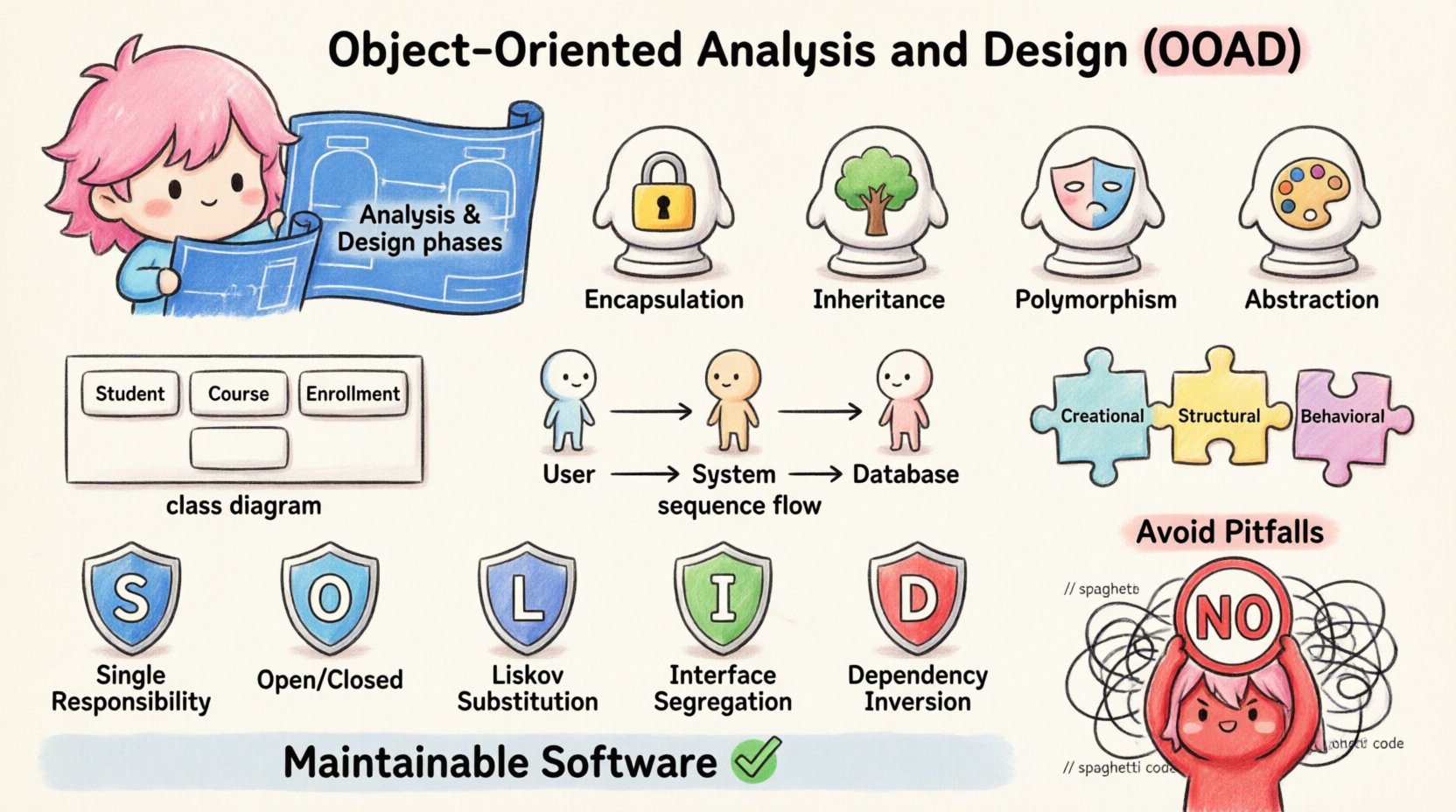
Object-Oriented Analysis and Design (OOAD) stands as a cornerstone in modern software architecture. It provides a structured approach to transforming abstract requirements into concrete, maintainable systems. By focusing on objects that contain both data and behavior, developers can build complex applications that are easier to understand and modify over time. This guide explores the fundamental principles, methodologies, and practices that define this discipline.
Understanding the Foundation of OOAD 🏗️
At its core, OOAD is a methodology used to analyze and design software systems. It treats data and the methods that operate on that data as a single unit, known as an object. This contrasts with procedural programming, where logic and data are often separated. The goal is to model real-world entities within the digital environment.
The Two Phases: Analysis and Design
While often used together, there is a distinct difference between the analysis phase and the design phase. Understanding this separation helps teams manage complexity.
- Analysis: Focuses on the what. It involves gathering requirements, understanding business rules, and defining the problem space without worrying about technical implementation details.
- Design: Focuses on the how. It involves creating the architecture, defining class structures, and determining how data flows through the system to solve the identified problems.
By separating these concerns, teams can ensure that the solution actually meets user needs before investing time in technical specifics.
Key Building Blocks: Classes and Objects 🔨
To implement OOAD, one must understand the two primary constructs: classes and objects.
1. Classes
A class acts as a blueprint or template. It defines the properties and behaviors that objects created from that class will possess. For instance, a Vehicle class might define properties like color and speed, and behaviors like accelerate and brake.
2. Objects
An object is a specific instance of a class. If a class is the blueprint for a house, an object is the actual house built from that blueprint. Each object has its own state (data) but shares the same structure (code) defined by its class.
| Concept | Definition | Analogy |
|---|---|---|
| Class | A template defining structure and behavior | Recipe for a cake |
| Object | An instance of a class with specific data | The actual cake baked |
| Attribute | A property or characteristic of an object | Flavor of the cake |
| Method | A function or action an object can perform | Baking the cake |
The Four Pillars of Object-Oriented Programming 🧱
OOAD relies heavily on four fundamental concepts that dictate how objects interact and organize within a system. These pillars ensure code remains modular and robust.
1. Encapsulation 🔒
Encapsulation is the practice of bundling data and methods together while restricting direct access to some of an object’s components. This prevents accidental modification of data and enforces data integrity.
- Visibility Control: Data can be marked as private, protected, or public. Private data is accessible only within the class itself.
- Interfaces: Public methods act as a controlled interface for interacting with the internal data.
2. Inheritance 🌳
Inheritance allows a new class to derive properties and behaviors from an existing class. This promotes code reusability and establishes a hierarchy.
- Parent Class: The class being inherited from (superclass).
- Child Class: The new class that inherits (subclass).
- Benefit: Common logic is written once in the parent and reused across multiple children, reducing redundancy.
3. Polymorphism 🎭
Polymorphism allows objects to be treated as instances of their parent class rather than their actual class. This enables flexibility in how code interacts with different types.
- Compile-time: Achieved through method overloading.
- Runtime: Achieved through method overriding, where a child class provides a specific implementation of a method defined in the parent.
4. Abstraction 🎨
Abstraction hides complex implementation details and shows only the necessary features of an object. It simplifies the complexity of the system for the user.
- Interface: Defines a contract of what a class must do, without saying how it does it.
- Simplification: Users interact with the object without needing to know the internal logic.
SOLID Principles for Robust Design 📐
While the four pillars form the basis of the paradigm, specific design principles guide the creation of maintainable systems. These are collectively known as SOLID.
Single Responsibility Principle (SRP)
A class should have one, and only one, reason to change. This means a class should do one thing well. Mixing unrelated concerns leads to fragile code.
Open/Closed Principle (OCP)
Software entities should be open for extension but closed for modification. New functionality should be added by creating new classes rather than altering existing code.
Liskov Substitution Principle (LSP)
Objects of a superclass should be replaceable with objects of its subclasses without breaking the application. Subclasses must honor the contract established by the parent.
Interface Segregation Principle (ISP)
Clients should not be forced to depend on interfaces they do not use. It is better to have many specific interfaces than one general-purpose one.
Dependency Inversion Principle (DIP)
High-level modules should not depend on low-level modules. Both should depend on abstractions. This decouples the system and allows for easier testing and swapping of components.
Modeling with Diagrams 📊
Visualizing the system structure is crucial for communication among stakeholders. While specific tools exist, the modeling techniques remain consistent regardless of the platform.
Class Diagrams
These depict the static structure of the system. They show classes, their attributes, methods, and the relationships between them (inheritance, association, aggregation).
Sequence Diagrams
These illustrate how objects interact over time. They are useful for understanding the flow of messages between objects during a specific operation.
Use Case Diagrams
These capture the functional requirements from the perspective of the user. They show actors and the actions they can perform within the system.
Common Design Patterns 🧩
Patterns are proven solutions to recurring problems. They are not code to copy, but templates to adapt.
- Creational Patterns: Focus on object creation mechanisms (e.g., Factory, Singleton).
- Structural Patterns: Deal with class and object composition (e.g., Adapter, Composite).
- Behavioral Patterns: Focus on communication between objects (e.g., Observer, Strategy).
Pitfalls to Avoid 🚫
Even with a solid understanding of theory, practical application can lead to issues if caution is not exercised.
- Over-Engineering: Creating complex hierarchies for simple problems. Start simple and refactor only when necessary.
- God Objects: Classes that know too much or do too much. This violates the Single Responsibility Principle.
- Tight Coupling: When classes depend heavily on each other’s internal details. This makes testing and changing the system difficult.
- Premature Optimization: Designing for performance before ensuring the architecture is correct and readable.
The Impact on Maintainability 🔄
The primary advantage of OOAD is the longevity of the software. Systems built with these principles are easier to debug because issues are isolated within specific objects. They are also easier to extend. When new requirements arise, developers can add new classes that adhere to existing interfaces without rewriting the core logic.
Furthermore, clear separation of concerns allows multiple developers to work on different parts of the system simultaneously without stepping on each other’s toes. This scalability is vital for large-scale enterprise applications.
Conclusion on Best Practices ✅
Adopting Object-Oriented Analysis and Design requires discipline. It is not just about writing code; it is about modeling the problem space accurately. By adhering to the pillars of encapsulation, inheritance, polymorphism, and abstraction, and by following SOLID principles, teams can build systems that are resilient and adaptable. Regular refactoring and clear documentation ensure that the design remains relevant as requirements evolve.
Remember that OOAD is a tool, not a magic wand. It should be applied judiciously based on the context of the project. Simple scripts may not need complex hierarchies, while large systems benefit immensely from the structure OOAD provides.