


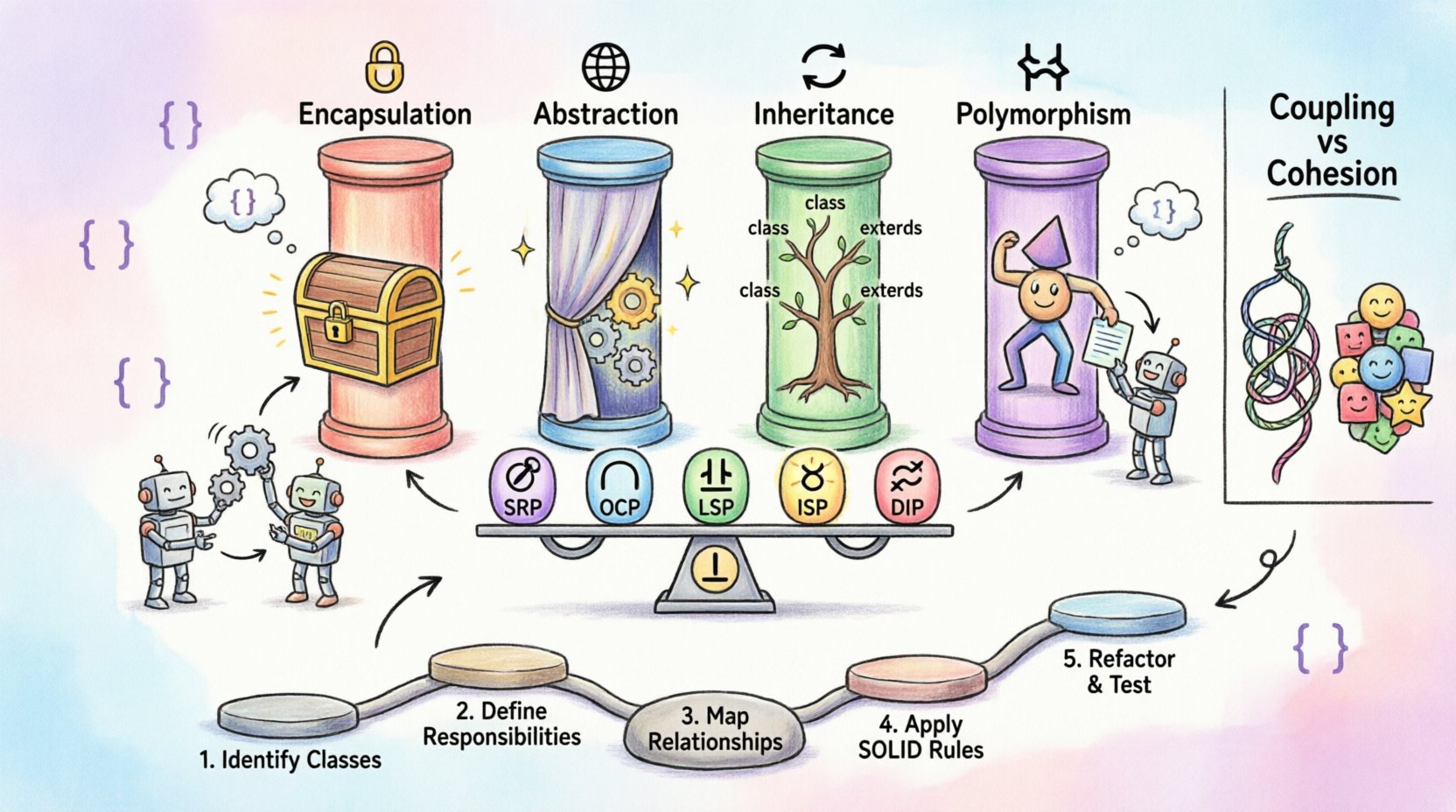
Object-Oriented Design (OOD) serves as the backbone of modern software architecture. It is not merely a set of rules but a mindset for structuring complex systems. When developers approach a problem, they must consider how data and behavior interact within a cohesive unit. This approach ensures that software remains maintainable, extensible, and robust over time. Without a solid grasp of these concepts, systems tend to become fragile, difficult to debug, and expensive to modify.
The journey begins with understanding the fundamental pillars that support this paradigm. These concepts dictate how objects communicate, how they store state, and how they evolve. Ignoring these foundations often leads to code that is tightly coupled and rigid. By prioritizing these principles early, teams can create systems that adapt to changing requirements without requiring a complete rewrite.
The Four Pillars of Object-Oriented Design 🧱
Before diving into advanced patterns, one must internalize the core mechanisms that define the paradigm. These four concepts work in tandem to create a flexible environment for code.
1. Encapsulation 🔒
Encapsulation is the practice of bundling data and the methods that operate on that data within a single unit. It restricts direct access to some of an object’s components, which is a standard method of preventing accidental interference. By exposing only necessary interfaces, the internal state remains protected.
- Protection: Prevents external code from setting invalid states.
- Modularity: Allows changes to internal implementation without affecting external users.
- Clarity: Reduces the cognitive load on developers who use the class.
2. Abstraction 🌐
Abstraction involves hiding complex implementation details and showing only the essential features of an object. It allows developers to focus on what an object does rather than how it does it. This separation of interface from implementation is critical for managing complexity in large systems.
- Interface Definition: Defines contracts that different implementations must follow.
- Complexity Management: Hides logic that is not immediately relevant to the user.
- Decoupling: Reduces dependencies between different parts of the system.
3. Inheritance 🔄
Inheritance allows new classes to be derived from existing ones. This mechanism promotes code reuse and establishes a natural hierarchy. The derived class, or subclass, inherits attributes and methods from the base class, or superclass. This reduces redundancy and creates a logical structure for related entities.
- Code Reuse: Avoids rewriting common functionality.
- Polymorphism Support: Enables treating derived objects as base objects.
- Hierarchy: Creates a clear taxonomy of relationships.
4. Polymorphism 🎭
Polymorphism allows objects of different types to be treated as instances of the same general type. This capability enables the same interface to be used for different underlying forms. It is the mechanism that makes inheritance truly powerful in design.
- Dynamic Binding: Resolves method calls at runtime based on the actual object type.
- Flexibility: Allows new types to be added without changing existing code.
- Extensibility: Supports adding features without modifying the core logic.
Applying the SOLID Principles ⚖️
While the four pillars provide the syntax for OOD, the SOLID principles provide the guidelines for writing high-quality design. These five rules were introduced to improve software maintainability and ensure that the design supports future changes.
Single Responsibility Principle (SRP) 🎯
A class should have one, and only one, reason to change. This principle dictates that a class should do one thing well. When a class handles multiple responsibilities, it becomes difficult to test and modify. If one requirement changes, the class might break functionality unrelated to that change.
Open/Closed Principle (OCP) 🚪
Software entities should be open for extension but closed for modification. This means you can add new behavior to a system without changing the existing source code. Achieving this typically involves using interfaces and abstract classes. New features are added via new classes that implement existing interfaces.
Liskov Substitution Principle (LSP) ⚖️
Subtypes must be substitutable for their base types. If code is written to use a base class, it should work correctly with any subclass. Violating this principle occurs when a subclass changes the expected behavior of the parent, leading to runtime errors or unexpected logic failures.
Interface Segregation Principle (ISP) 🔌
Clients should not be forced to depend on methods they do not use. Large, monolithic interfaces are often a source of fragility. Instead, many smaller, specific interfaces are better. This ensures that a class only implements the methods relevant to its specific function.
Dependency Inversion Principle (DIP) 🔄
High-level modules should not depend on low-level modules. Both should depend on abstractions. This principle reduces coupling between modules. When high-level logic relies on concrete implementations, refactoring becomes difficult. Relying on interfaces or abstract classes allows for easier swapping of underlying technologies.
Coupling and Cohesion ⚙️
Two critical metrics for evaluating design quality are coupling and cohesion. Understanding the balance between these two is essential for creating systems that are both flexible and understandable.
| Concept | Definition | Goal | Impact on System |
|---|---|---|---|
| Coupling | The degree of interdependence between software modules. | Minimize | Low coupling allows independent changes to modules. |
| Cohesion | The degree to which elements within a module belong together. | Maximize | High cohesion makes modules focused and easier to understand. |
| Low Coupling | Modules have few dependencies on each other. | Desirable | Improves testability and reduces ripple effects. |
| High Cohesion | Module elements are strongly related. | Desirable | Improves reusability and clarity of purpose. |
High coupling creates a web of dependencies where changing one part of the system risks breaking another. Low coupling ensures that modules can be developed, tested, and deployed independently. Conversely, high cohesion ensures that a class is doing exactly what it is supposed to do. A class with low cohesion tries to do too many unrelated things, making it hard to maintain.
Common Pitfalls in Design 🚧
Even with knowledge of principles, developers often fall into traps that degrade design quality. Awareness of these common errors helps in avoiding them during the analysis and design phases.
- God Objects: A class that knows too much and does too much. This violates the Single Responsibility Principle and creates a bottleneck for changes.
- Feature Creep: Adding functionality that is not strictly required. This increases complexity and reduces clarity.
- Premature Optimization: Optimizing code before understanding the requirements. This often leads to complex structures that are hard to read.
- Over-Engineering: Creating complex solutions for simple problems. Simplicity is often the best design choice.
- Tight Coupling: Relying on concrete implementations instead of abstractions. This makes swapping technologies difficult.
Practical Steps for Analysis 🛠️
Translating theoretical principles into practice requires a structured approach. The following steps guide the process of moving from requirements to a robust design.
- Identify Entities: Look at the problem domain and identify the key nouns. These often translate to classes.
- Define Relationships: Determine how these entities interact. Use associations, aggregations, or compositions.
- Apply Abstraction: Create interfaces for behaviors that might vary across implementations.
- Refactor Continuously: Design is not a one-time event. Refactor the code as understanding of the problem deepens.
- Review Design: Regularly assess the design against SOLID principles and coupling metrics.
Iterative Refinement 🔄
Design is an iterative process. Initial models are rarely perfect. As the system grows and requirements evolve, the design must adapt. This adaptability is the primary benefit of a strong object-oriented foundation. It allows the system to grow organically rather than requiring a complete overhaul.
When reviewing a design, ask specific questions about the current state. Does this class have too many responsibilities? Are the dependencies concrete or abstract? Is the interface too broad? These questions guide the refactoring process. The goal is always to reduce complexity and increase clarity.
Documentation plays a role here as well. While code should be self-explanatory, diagrams and notes help communicate the intent of the design. Use diagrams to visualize relationships and data flow. This aids in communication among team members and ensures everyone shares a common understanding of the architecture.
Conclusion on Longevity 📈
A well-designed system stands the test of time. It absorbs changes without breaking. It accommodates new features without becoming a tangled mess. The effort invested in learning and applying these principles pays dividends in reduced maintenance costs and increased developer productivity. By adhering to the core tenets of object-oriented design, developers create software that is not just functional, but resilient.