

🏗️ The Foundation of Object-Oriented Analysis
In the discipline of Object-Oriented Analysis and Design (OOA&D), the accuracy of the system model hinges on the quality of the entities identified during the initial phases. Real-world entities represent the core building blocks of the software solution. They are the objects that carry state, behavior, and relationships within the domain. When these entities are defined correctly, the resulting architecture is robust, maintainable, and aligned with business operations. Conversely, misidentifying entities can lead to complex coupling, redundant data structures, and a system that struggles to adapt to changing requirements.
Effective modeling requires a shift from viewing data as isolated tables or variables to seeing them as active participants in a business process. The goal is to capture the essence of the domain without introducing unnecessary complexity. This process involves scrutinizing requirements, engaging with subject matter experts, and applying rigorous analytical techniques to distinguish between significant entities, value objects, and transient attributes.
📝 Techniques for Entity Extraction
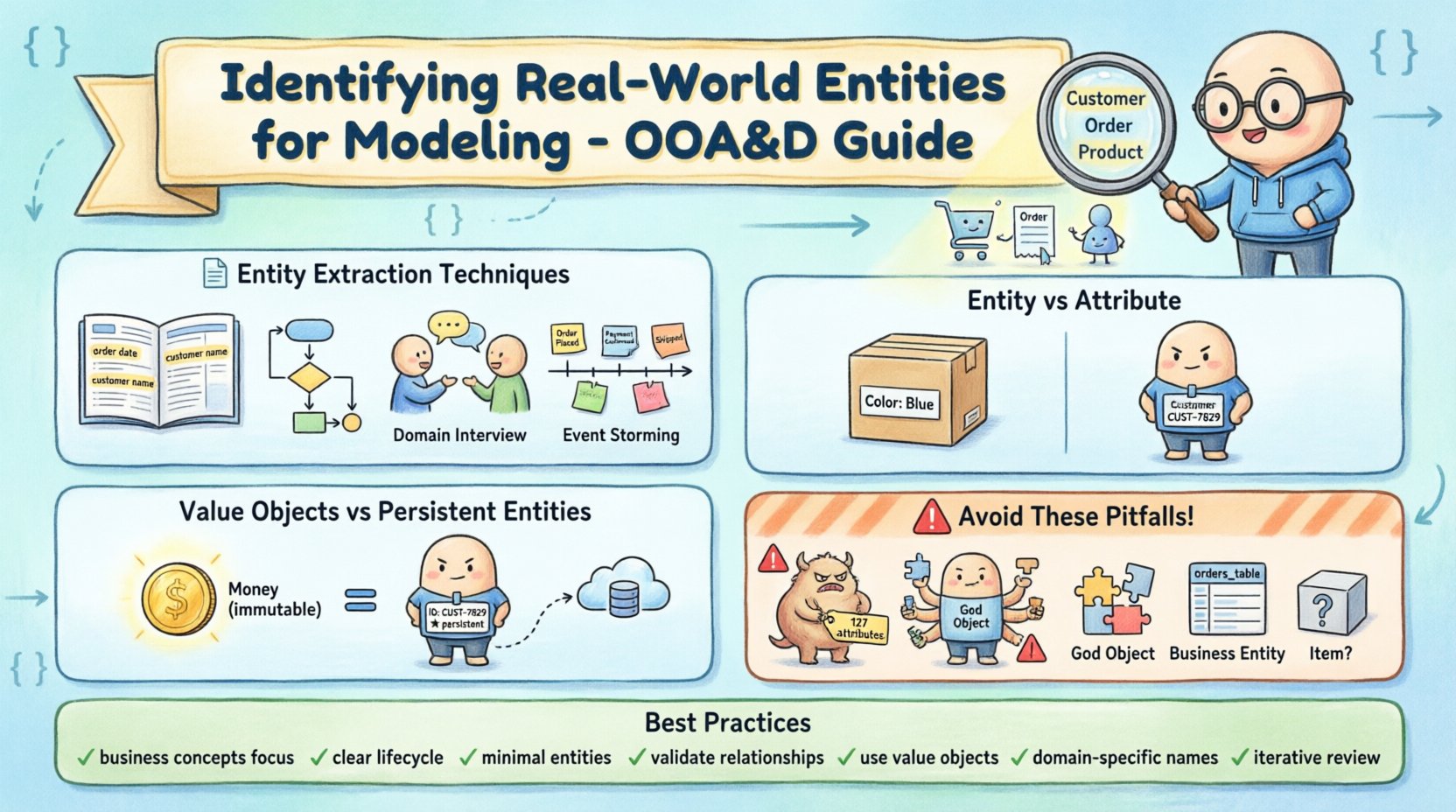
Several proven methods exist for extracting potential entities from raw information. These techniques help transform vague business needs into concrete modeling candidates.
- Noun Phrase Analysis: One of the most common approaches involves reading through requirement documents and user stories. Analysts highlight nouns and noun phrases that appear frequently. For example, in a logistics system, terms like “package,” “driver,” and “warehouse” emerge naturally. However, not every noun is an entity. Terms like “handling” or “shipping” often describe actions or relationships rather than standalone objects.
- Use Case Scenarios: Examining use cases provides context for how data is consumed. If a user interacts with a specific object in multiple scenarios, it is a strong candidate for an entity. For instance, if a user logs in, views a dashboard, and edits a profile, the “User” object is central to the system.
- Domain Knowledge Interviews: Talking to stakeholders reveals the vocabulary they use daily. This helps identify entities that might not be explicitly written in technical specifications but are crucial to the business logic. Stakeholders often refer to objects by their functional names rather than technical identifiers.
- Event Storming: This collaborative technique involves mapping out business events on a timeline. Each event often implies the existence of an entity that triggered it or was affected by it. This visual approach helps uncover relationships that text-based analysis might miss.
🔍 Distinguishing Entities from Attributes
A common challenge in modeling is determining whether a concept should be an independent entity or merely an attribute of another entity. The decision impacts the granularity of the model and the complexity of queries.
An attribute describes a property of an entity. It typically has no identity of its own. For example, a “Color” attribute on a “Product” entity describes the look of the product. It does not exist independently outside of the product.
An entity, however, has its own identity and lifecycle. It can exist without being attached to a specific parent instance in certain contexts, and it often possesses its own relationships. Consider the difference between “Address” and “City”. In some models, “Address” is a complex attribute containing “Street”, “City”, and “Zip Code”. In others, “City” is a distinct entity with properties like “Population” and “Region”, linked to multiple “Address” records.
| Criterion | Attribute | Entity |
|---|---|---|
| Identity | No unique identifier | Has a unique identifier |
| Complexity | Simple data type (String, Number) | Can have multiple attributes and behaviors |
| Reusability | Used only within one context | Can be shared across multiple contexts |
| Lifecycle | Exists only as long as parent exists | Has an independent lifecycle |
💎 Value Objects vs. Persistent Entities
Not all entities require persistence in a database. Distinguishing between Value Objects and Persistent Entities is critical for performance and architectural integrity.
Value Objects are objects that define characteristics but do not have a distinct identity. They are defined by their attributes. If you change an attribute, the object is considered different. A classic example is “Money”. Two instances of money with the same value and currency are considered equal. You do not need a unique ID for a specific dollar amount.
Persistent Entities require a unique identifier to distinguish them from other instances, even if their attributes are identical. A “Customer” entity, for example, must have a Customer ID. Two customers might have the same name and address, but they are different people.
Using Value Objects reduces complexity in the domain model by removing unnecessary database overhead. It allows the model to focus on identity only where it is truly necessary.
⚠️ Common Modeling Pitfalls
Even experienced analysts can fall into traps during the identification phase. Recognizing these pitfalls helps refine the model.
- Over-Modeling: Creating entities for concepts that are rarely used or do not add significant value. This leads to a bloated model that is difficult to navigate.
- Under-Modeling: Grouping too many concepts into a single entity. This often results in “God Objects” that are hard to maintain and violate single-responsibility principles.
- Ignoring Relationships: Focusing solely on objects without defining how they interact. An entity without relationships is isolated and often useless in a connected system.
- Technical Bias: Naming entities based on database table names or programming constraints rather than business concepts. The model should reflect the domain, not the infrastructure.
- Abstracting Too Early: Creating generic entities like “Item” or “Object” before understanding specific requirements. Specificity often reveals necessary details that generic models hide.
🔄 Validation and Refinement Process
Identification is not a one-time event. It is an iterative process that requires constant validation against the business reality.
1. Walkthroughs with Stakeholders
Present the initial model to domain experts. Ask them to verify if the entities represent their reality. Do they recognize the relationships? Are any critical objects missing? This feedback loop ensures the model remains grounded in business needs.
2. Scenario Testing
Run specific business scenarios through the model. If a user needs to generate a report that involves multiple entities, check if the relationships support this query efficiently. If the model requires complex joins or workarounds, the entity structure may need adjustment.
3. Consistency Checks
Ensure naming conventions are consistent. If you use “User” in one section and “Client” in another for the same concept, confusion will arise. Standardize terminology across the entire domain model.
4. Boundary Identification
Define the boundaries of the system. Some entities exist outside the software system but interact with it. These are external entities. Distinguishing between internal and external entities helps manage dependencies and integration points.
📊 Summary of Best Practices
To ensure high-quality modeling, adhere to the following checklist during the identification phase.
- ✅ Focus on business concepts, not technical implementation.
- ✅ Ensure every entity has a clear purpose and lifecycle.
- ✅ Minimize the number of entities to reduce complexity.
- ✅ Validate relationships before finalizing attributes.
- ✅ Use Value Objects for data types without identity.
- ✅ Keep names descriptive and domain-specific.
- ✅ Review the model iteratively as requirements evolve.
🚀 The Impact of Accurate Modeling
The effort invested in identifying real-world entities accurately pays dividends throughout the software lifecycle. A precise model reduces the need for refactoring later. It clarifies communication between developers and business stakeholders. It serves as a blueprint that guides database design, API definition, and user interface structure.
When entities are modeled correctly, the system becomes more flexible. Adding new features often requires modifying existing entities rather than restructuring the entire foundation. This stability allows the organization to respond to market changes without being hindered by technical debt.
Ultimately, the goal is to create a living model that reflects the business truth. This requires patience, deep understanding, and a commitment to clarity. By avoiding shortcuts and adhering to rigorous analysis techniques, the resulting system will stand the test of time and change.
🔗 Next Steps in the Modeling Journey
Once entities are identified, the focus shifts to defining their behaviors and relationships. This involves creating state diagrams, sequence diagrams, and class diagrams. The entities identified here serve as the nodes in these broader diagrams. Ensuring they are solid before moving forward prevents cascading errors in the design phase.
Continuous learning and adaptation are essential. As the business domain evolves, the model must evolve with it. Regular reviews keep the identification process relevant and effective. This dynamic approach ensures the software solution remains aligned with the organization’s goals.