


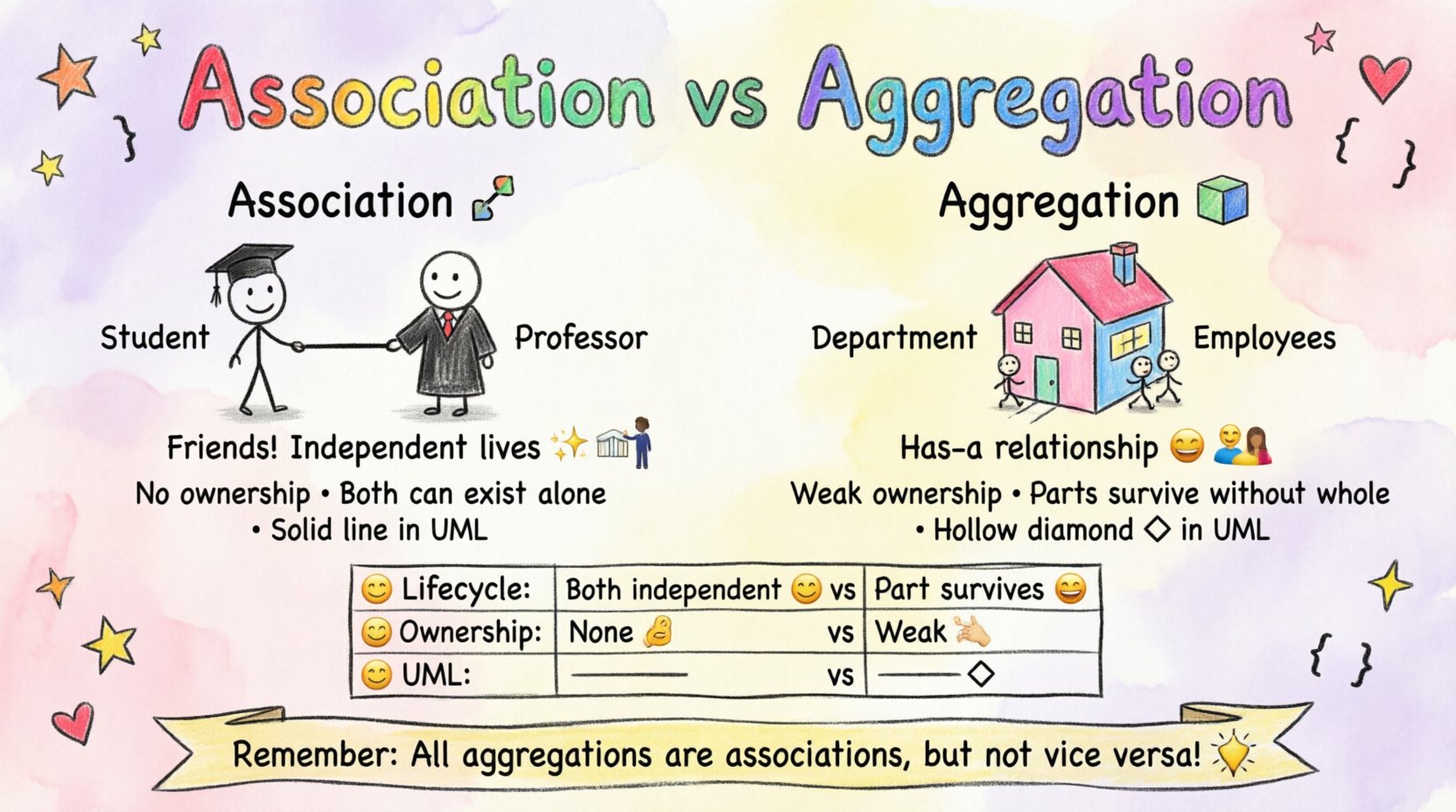
In the discipline of Object-Oriented Analysis and Design (OOAD), the structural integrity of a system relies heavily on how classes relate to one another. These relationships define the architecture, determine how data flows, and dictate the lifecycle of objects within a runtime environment. Two of the most frequently discussed concepts are association and aggregation. While they may appear similar on a diagram, the semantic implications differ significantly regarding ownership, dependency, and memory management.
Understanding the nuance between these relationships is critical for building maintainable, scalable systems. This guide explores the technical distinctions, lifecycle implications, and design patterns associated with structural modeling in object-oriented programming.
Understanding Structural Relationships 🏗️
Before diving into specific relationship types, it is essential to recognize that objects rarely exist in isolation. They interact to perform complex tasks. These interactions are modeled as links between class instances. In Unified Modeling Language (UML), these links are visualized as lines connecting class boxes. The nature of the line—solid, dashed, hollow, or filled—indicates the type of relationship.
The three primary structural relationships are:
- Association: A general link between classes.
- Aggregation: A specific type of association representing a “whole-part” relationship with weak ownership.
- Composition: A stronger form of aggregation where the part cannot exist independently of the whole.
For this discussion, the focus remains on the distinction between Association and Aggregation, as these are often the most ambiguous for developers and architects.
Association Explained 🔗
An association represents a structural relationship where objects of one class are connected to objects of another class. It describes how one class knows about another and can communicate with it. This is the most fundamental building block of object interactions.
Key Characteristics of Association
- General Connectivity: It implies that instances of Class A can access instances of Class B.
- Directionality: Associations can be unidirectional (one-way navigation) or bidirectional (two-way navigation).
- Multiplicity: This defines how many instances of one class relate to another. Common notations include one-to-one (1:1), one-to-many (1:N), and many-to-many (N:N).
- No Ownership Implied: By default, an association does not imply that one class owns the other. Both objects can exist independently.
Examples in Design
Consider a scenario involving Students and Professors. A professor teaches multiple students, and a student can be taught by multiple professors. This is a classic many-to-many association.
- A Student object holds a reference to a Professor object to access lecture details.
- A Professor object holds a list of Student objects to manage grades.
- Neither the Student nor the Professor ceases to exist if the other is removed from the relationship.
Another example involves a Driver and a Car. A driver drives a car, but the car continues to exist even if the driver steps away. The relationship is functional but not possessive in a strict lifecycle sense.
Navigation and Responsibility
When modeling associations, developers must decide who initiates the interaction. If the relationship is unidirectional, only one class holds the reference to the other. This reduces coupling and simplifies garbage collection logic. If bidirectional, both classes must manage the reference to maintain consistency.
Aggregation Defined 📦
Aggregation is a specialized form of association. It represents a “has-a” relationship, implying that a whole object contains a part object. However, the crucial distinction lies in the lifecycle and ownership.
The Concept of Weak Ownership
In an aggregation relationship, the part object can exist independently of the whole object. If the whole object is destroyed, the part object remains valid. This is often described as a shared ownership scenario.
- Whole Object: The container or manager.
- Part Object: The component or entity being managed.
- Independence: The part has its own lifecycle separate from the whole.
Examples in Design
Consider a Department and Employees. A department consists of employees. However, if the department is dissolved, the employees do not cease to exist; they may simply be reassigned to another department or leave the organization.
- The Department class holds a collection of Employee objects.
- The Employee object does not depend on the Department for its core existence.
- The relationship is often visualized with a hollow diamond on the “Whole” side in UML.
Another example is a Library and Books. A library contains books. If the library building is demolished, the books still exist; they can be moved to a new location. The books are not created by the library, nor do they die with it.
Implementation Nuances
In code, aggregation is typically implemented via references or pointers. The container class does not instantiate the part class internally; the part is often passed in via a constructor or setter method.
- Constructor Injection: The part is provided when the whole is created.
- Setter Injection: The part is assigned to the whole after creation.
- No Destruction: The whole class does not explicitly destroy the part when the whole is destroyed.
Composition vs Aggregation ⚖️
To fully understand Aggregation, it is necessary to briefly contrast it with Composition. Composition is often the point of confusion. While Aggregation implies weak ownership, Composition implies strong ownership.
- Aggregation: The part can exist without the whole. (Example: House and Windows).
- Composition: The part cannot exist without the whole. (Example: Order and LineItems).
In Composition, the lifecycle of the part is bound to the lifecycle of the whole. If the whole is garbage collected, the parts are also destroyed. In Aggregation, the part survives the destruction of the whole.
Key Differences at a Glance 📊
The following table summarizes the structural and semantic differences between Association and Aggregation to aid in quick reference.
| Feature | Association | Aggregation |
|---|---|---|
| Relationship Type | General link between classes | “Has-a” relationship (Whole-Part) |
| Ownership | No ownership implied | Weak ownership |
| Lifecycle | Independent lifecycles | Part can exist without Whole |
| UML Notation | Solid line | Solid line with hollow diamond |
| Code Implementation | Reference or pointer | Reference or pointer (no internal creation) |
| Dependency | Low to Moderate | Moderate |
Lifecycle and Memory Management 💾
The distinction between these relationships has tangible effects on memory management. In languages that utilize manual memory management or explicit garbage collection, understanding who owns whom is vital to prevent memory leaks or dangling pointers.
Memory Allocation
- Association: Both objects allocate their own memory. The link is merely a pointer from one address to another. Destroying one object does not affect the memory of the other.
- Aggregation: The container holds a reference. It does not “own” the memory of the part. When the container is destroyed, the runtime does not automatically reclaim the memory of the parts.
Garbage Collection Implications
In managed runtime environments, objects are collected when they are no longer reachable. If an Association or Aggregation creates a circular reference, specific garbage collection strategies are required to detect and clean up these cycles.
- Circular References: Class A references Class B, and Class B references Class A. Without proper handling, neither may be collected.
- Weak References: In some designs, weak references are used in associations to break cycles and allow garbage collection to proceed.
Designing Robust Systems 🛡️
Choosing the correct relationship type impacts the coupling and cohesion of the software. High coupling makes systems brittle and difficult to test. High cohesion ensures that modules have a single, well-defined purpose.
Reducing Coupling
Aggregation often reduces coupling compared to Composition. Since the part is not created by the whole, the whole is less dependent on the specific implementation of the part. This allows for easier substitution of components.
- Dependency Injection: Passing objects into a constructor (Aggregation style) allows the container to function without knowing the concrete implementation of the part.
- Interface Segregation: The whole can interact with the part through an interface, further decoupling the relationship.
Cohesion and Responsibility
Every class should have a clear responsibility. Aggregation helps clarify that the “Whole” is responsible for managing the collection, while the “Part” is responsible for its own internal state.
- Whole Responsibility: Managing the list, ensuring uniqueness, or enforcing business rules on the collection.
- Part Responsibility: Handling its own data validation and internal logic.
Common Modeling Pitfalls ⚠️
Even experienced architects can make mistakes when defining relationships. Being aware of common pitfalls helps maintain model accuracy.
- Overusing Aggregation: Sometimes, a relationship is modeled as aggregation when it is actually just a simple association. If there is no “whole” concept, aggregation is incorrect.
- Ambiguous Lifecycle: If it is unclear whether a part should survive the destruction of the whole, the relationship type is undefined. Documenting the intent is essential.
- Navigation Confusion: Assuming bidirectional navigation where only unidirectional is needed adds unnecessary complexity and potential for data inconsistency.
- Confusing Association with Aggregation: All aggregations are associations, but not all associations are aggregations. The “has-a” test is the key differentiator.
Best Practices for Implementation ✅
To ensure clarity and maintainability, follow these guidelines when implementing structural relationships in code.
1. Be Explicit with Naming
Method and variable names should reflect the relationship. Use terms like owner, parent, or collection for aggregation, and link, partner, or reference for general associations.
2. Document Lifecycle Intent
Comments or documentation should explicitly state whether the part object is expected to outlive the whole object. This prevents future developers from accidentally deleting shared resources.
3. Enforce Multiplicity
Ensure the code enforces the multiplicity defined in the model. If a relationship is one-to-many, the collection in the code should reflect that. Do not allow nulls where a relationship is required.
4. Avoid Deep Nesting
While relationships can be nested, deep chains of associations (A connects to B, B to C, C to D) can make navigation difficult. Flatten the structure where possible to improve readability and performance.
5. Test Boundary Conditions
When the whole object is destroyed, verify that the parts remain intact if the relationship is Aggregation. Conversely, verify that parts are cleaned up if the relationship is Composition.
Conclusion on Structural Design 🎯
The choice between Association and Aggregation is not merely a syntactic decision; it is a semantic one that affects the architecture of the system. By correctly modeling these relationships, developers ensure that the system’s lifecycle management is predictable and that dependencies are managed effectively.
Association provides the flexibility for general connectivity, while Aggregation offers a structured way to manage collections of independent entities. Both are essential tools in the toolkit of Object-Oriented Analysis and Design. Mastering their application leads to systems that are easier to understand, test, and evolve over time.
When designing the next generation of software, take the time to analyze the nature of the relationships between your classes. Ask whether the part can exist without the whole. If the answer is yes, Aggregation is likely the correct choice. If the connection is merely functional without containment, Association is the appropriate path.