


Every successful initiative begins with a vision and ends with a delivered outcome. Bridging the gap between these two points requires a structured approach. The project management lifecycle provides the framework necessary to guide work from conception to completion. Understanding these stages ensures that resources are allocated efficiently, risks are mitigated, and objectives are met without unnecessary friction.
This guide breaks down the five standard phases of project management. It covers the essential activities, key deliverables, and stakeholder interactions required at each stage. Whether you are managing a small team or coordinating complex cross-functional efforts, adhering to this lifecycle brings order to complexity. Let us explore the mechanics of delivering value systematically.
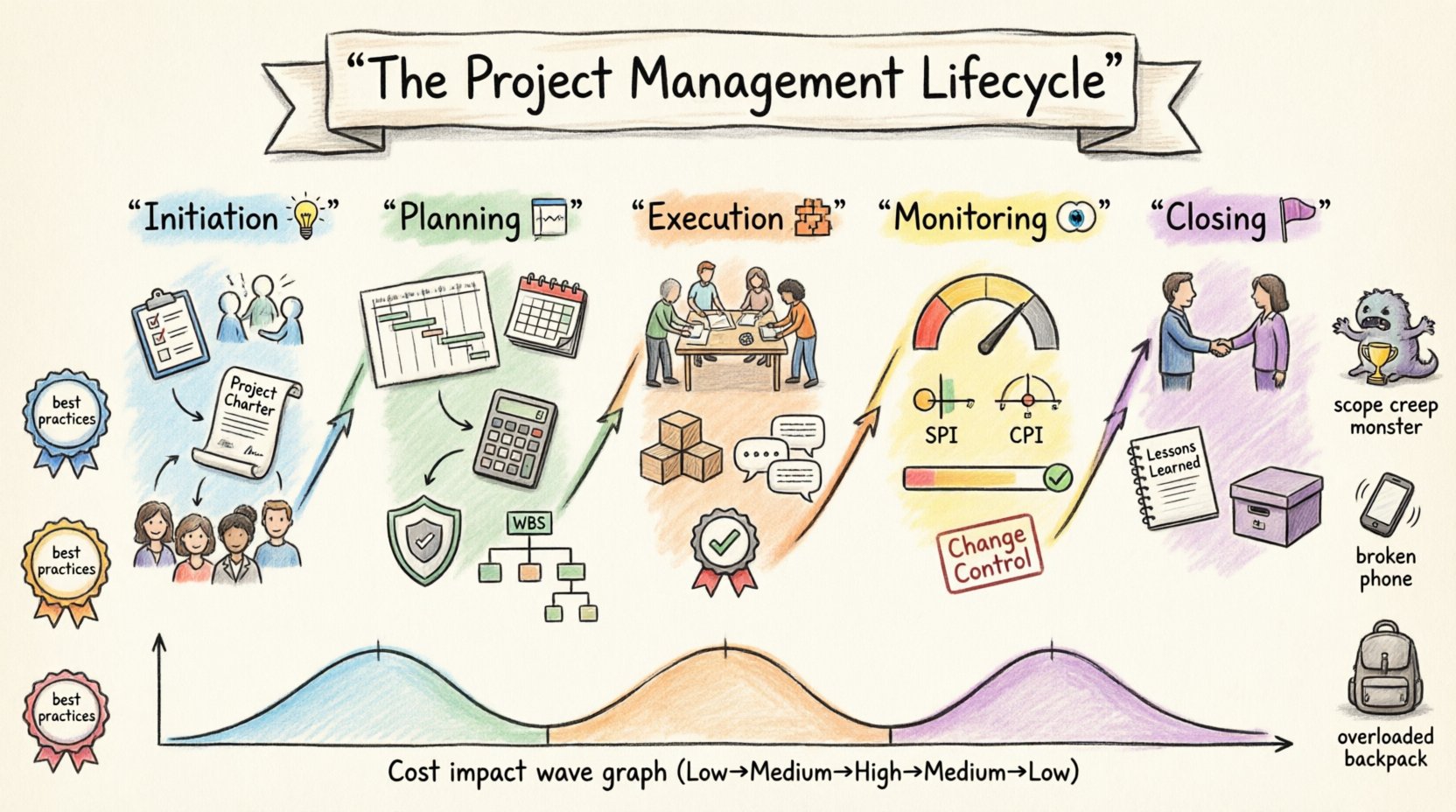
1. Project Initiation: Defining the Foundation 🚀
The initiation phase sets the stage for the entire endeavor. This is where the project is defined at a high level. The primary goal here is not to plan every detail, but to determine if the project is viable and worth pursuing. Without a solid foundation here, subsequent efforts often lead to wasted resources.
Key Activities
Identify the Business Need: Understand why the project is being proposed. Is it to solve a specific problem, seize a market opportunity, or comply with new regulations?
Conduct Feasibility Studies: Evaluate technical, financial, and operational feasibility. Can the team actually deliver this with available resources?
Define High-Level Objectives: Establish clear goals that align with organizational strategy.
Identify Stakeholders: Determine who has an interest in the outcome. This includes sponsors, clients, and end-users.
Key Deliverables
Project Charter: A document that formally authorizes the project. It grants the project manager the authority to apply organizational resources.
Stakeholder Register: A list of all individuals or groups affected by the project, including their roles and influence levels.
Business Case: A document outlining the justification for the project, including cost-benefit analysis.
During this phase, the project manager acts as a facilitator. The focus is on alignment. If the project charter is not signed off, the project technically does not exist. This document serves as the reference point for all future decisions regarding scope and authority.
2. Project Planning: Mapping the Route 📝
Once initiated, the project moves into the planning phase. This is often the most critical stage for setting expectations. Planning transforms the vision into a actionable roadmap. It involves defining what needs to be done, how it will be done, who will do it, and when it will be finished.
Core Components of the Plan
Scope Management: Create a Work Breakdown Structure (WBS). This decomposes the project into smaller, manageable work packages. It prevents scope creep by clearly defining what is in and out of bounds.
Schedule Development: Sequence activities and estimate durations. Use techniques like Critical Path Method (CPM) to identify tasks that directly impact the finish date.
Budgeting: Estimate costs for labor, materials, equipment, and overhead. Establish a cost baseline to track spending against.
Risk Management: Identify potential threats and opportunities. Develop strategies to avoid, mitigate, transfer, or accept risks.
Communication Plan: Define how information will be shared. Who needs to know what, when, and through which channel?
Planning Tools and Techniques
Effective planning relies on structured analysis. Teams often use Gantt charts to visualize timelines and dependencies. Resource histograms help balance workloads across the team. It is essential to involve the people who will do the work in the estimation process. Their input leads to more accurate timelines and increased commitment to the schedule.
A robust plan is not static. It serves as a baseline. As the project progresses, variances will occur. The plan allows the manager to measure performance against the original intent. Without a baseline, progress is impossible to quantify objectively.
3. Project Execution: Bringing the Plan to Life 🏗️
Execution is where the actual work happens. This phase consumes the most resources and time. The project manager shifts from planning to leading. The focus is on coordinating people and resources to complete the tasks defined in the plan.
Primary Responsibilities
Team Management: Assign tasks, manage performance, and resolve conflicts. A motivated team is the single biggest predictor of project success.
Quality Assurance: Ensure that the deliverables meet the defined standards. Implement processes for testing and review.
Information Distribution: Execute the communication plan. Ensure stakeholders are informed of progress and issues.
Procurement Management: If external vendors are involved, manage contracts and relationships to ensure timely delivery of goods or services.
During execution, change is inevitable. Scope changes, resource shifts, and external market conditions may require adjustments. The project manager must manage these changes formally. Ad-hoc changes often lead to chaos. Every request for change should be evaluated against its impact on time, cost, and scope.
Collaboration and Coordination
Successful execution requires seamless collaboration. Teams need clear channels for feedback. Regular stand-up meetings or status updates help keep everyone aligned. The project manager acts as the central hub, removing blockers and ensuring the team has what they need to succeed.
4. Monitoring and Controlling: Tracking Progress 👀
Monitoring and controlling runs parallel to execution. While the team works on the tasks, the project manager tracks performance. This phase ensures that the project stays on track. It involves measuring actual performance against the project management plan.
Key Performance Indicators
Schedule Variance: Are we ahead of or behind schedule?
Cost Variance: Are we under or over budget?
Schedule Performance Index (SPI): A ratio of earned value to planned value.
Cost Performance Index (CPI): A ratio of earned value to actual cost.
Control Processes
When variances are detected, corrective actions are required. If the project is running late, the manager might crash the schedule by adding resources or fast-track by performing activities in parallel. If costs are rising, the manager might negotiate better rates or reduce scope.
Change control is a vital part of this phase. A Change Control Board (CCB) may be established to review and approve or reject change requests. This formalizes the decision-making process and prevents unauthorized scope expansion.
Reporting
Status Reports: Provide updates on milestones reached and upcoming tasks.
Issue Logs: Track problems that arise and their resolution status.
Risk Registers: Update the status of identified risks and add new ones.
Transparency is key. Stakeholders need to know the true state of the project, including bad news. Hiding issues until the end creates a crisis rather than a manageable situation.
5. Project Closing: Finalizing the Work 🏁
The closing phase marks the formal end of the project. It involves handing over the final product to the client or end-users. This phase is often rushed, but it is crucial for organizational learning and legal closure.
Essential Closing Activities
Final Delivery: Obtain formal acceptance of the deliverables from the customer.
Contract Closure: Settle all agreements with vendors and suppliers. Ensure all payments are processed.
Resource Release: Release team members and equipment back to the organization or other projects.
Documentation: Archive all project documents, including plans, logs, and reports.
Post-Project Review: Conduct a “lessons learned” session. Discuss what went well and what could be improved.
Closing ensures that the organization captures knowledge for future use. It prevents the loss of critical data and ensures that the project is legally and administratively complete.
Comparison of Project Phases
The table below summarizes the distinct characteristics of each phase. This helps in visualizing the flow of effort and focus.
Phase | Primary Focus | Key Output | Cost Impact |
|---|---|---|---|
Initiation | Feasibility & Authorization | Project Charter | Low |
Planning | Scheduling & Budgeting | Project Management Plan | Medium |
Execution | Building & Delivering | Deliverables | High |
Monitoring | Tracking & Correcting | Status Reports | Medium |
Closing | Handover & Review | Final Report | Low |
Common Challenges Across the Lifecycle
Even with a structured lifecycle, projects face obstacles. Awareness of these common pitfalls helps in preparing mitigation strategies.
Scope Creep
This occurs when the scope of the project grows without adjustments to time, cost, or resources. It usually happens due to a lack of change control. Stakeholders add features informally. The solution is strict adherence to the change management process.
Communication Gaps
Information silos can lead to rework and confusion. Teams may work on outdated requirements. Regular communication rituals and a central repository for information prevent this.
Resource Constraints
People and equipment are often shared across multiple projects. Over-allocation leads to burnout and delays. Resource leveling techniques help balance the load.
Unrealistic Expectations
Stakeholders may expect perfection within a tight deadline. Managing expectations early through realistic planning and clear communication is vital. It is better to under-promise and over-deliver.
Best Practices for Success
To navigate the lifecycle effectively, consider adopting these practices.
Adapt to Context: Not all projects are the same. A construction project differs from software development. Adjust the rigor of the lifecycle to fit the complexity of the work.
Engage Stakeholders Early: Involve end-users in the planning phase. Their feedback reduces the risk of building the wrong solution.
Focus on Value: Prioritize tasks based on the value they deliver to the business. Do not get lost in administrative tasks at the expense of core work.
Document Everything: Keep a clear audit trail. This protects the team and aids in future audits or reviews.
Celebrate Milestones: Acknowledge progress. This maintains morale and keeps the team motivated during long projects.
Methodologies and the Lifecycle
While the five-phase lifecycle is standard, the approach to moving through them varies. Different methodologies organize these phases differently.
Waterfall Approach
In a Waterfall model, phases are sequential. You must finish planning before starting execution. This is suitable for projects with fixed requirements and low uncertainty. It relies heavily on the accuracy of the initial plan.
Agile Approach
Agile methods iterate through the lifecycle in short cycles called sprints. Initiation and Planning happen continuously. Execution and Monitoring occur within each sprint. Closing happens at the end of the project, though incremental value is delivered throughout. This approach is better for projects where requirements are expected to change.
Hybrid Approach
Many organizations use a hybrid model. They might plan the high-level lifecycle in a Waterfall style but execute specific work streams using Agile techniques. This allows for flexibility while maintaining overall control.
Final Thoughts on Lifecycle Management
Managing the project lifecycle is about balance. It requires structure to provide direction and flexibility to handle change. Each phase builds upon the previous one. Skipping steps often leads to technical debt or operational failure later.
By understanding the nuances of initiation, planning, execution, monitoring, and closing, organizations can consistently deliver results. The lifecycle is not just a set of rules; it is a framework for thinking about work. It encourages foresight, discipline, and continuous improvement.
Success is not an accident. It is the result of deliberate actions taken at each stage of the journey. Apply these principles to your next initiative to increase the probability of a positive outcome. Focus on the process, and the results will follow.
Related posts:
 Project Management 101: A Beginner’s Quick Start Guide to Leading Projects with Confidence
 What Project Managers Actually Do: A Real-World Component Breakdown for Aspiring Leaders
 7 Common Project Management Mistakes That Derail Teams (And How to Avoid Them)
 Project Management vs. Task Management: A Clear Comparison for New Coordinators