


Saying no is one of the most difficult tasks in project management. It feels like a rejection of the person asking, rather than a boundary for the work. Yet, the ability to decline requests is not a sign of weakness. It is a fundamental skill for protecting the team, the budget, and the project timeline. When a project manager says yes to everything, they eventually say no to quality, burnout, and deadlines.
This guide explores how to manage boundaries with authority and empathy. We will look at the psychology behind scope creep, the frameworks for decision-making, and the specific language that maintains relationships while protecting the project.
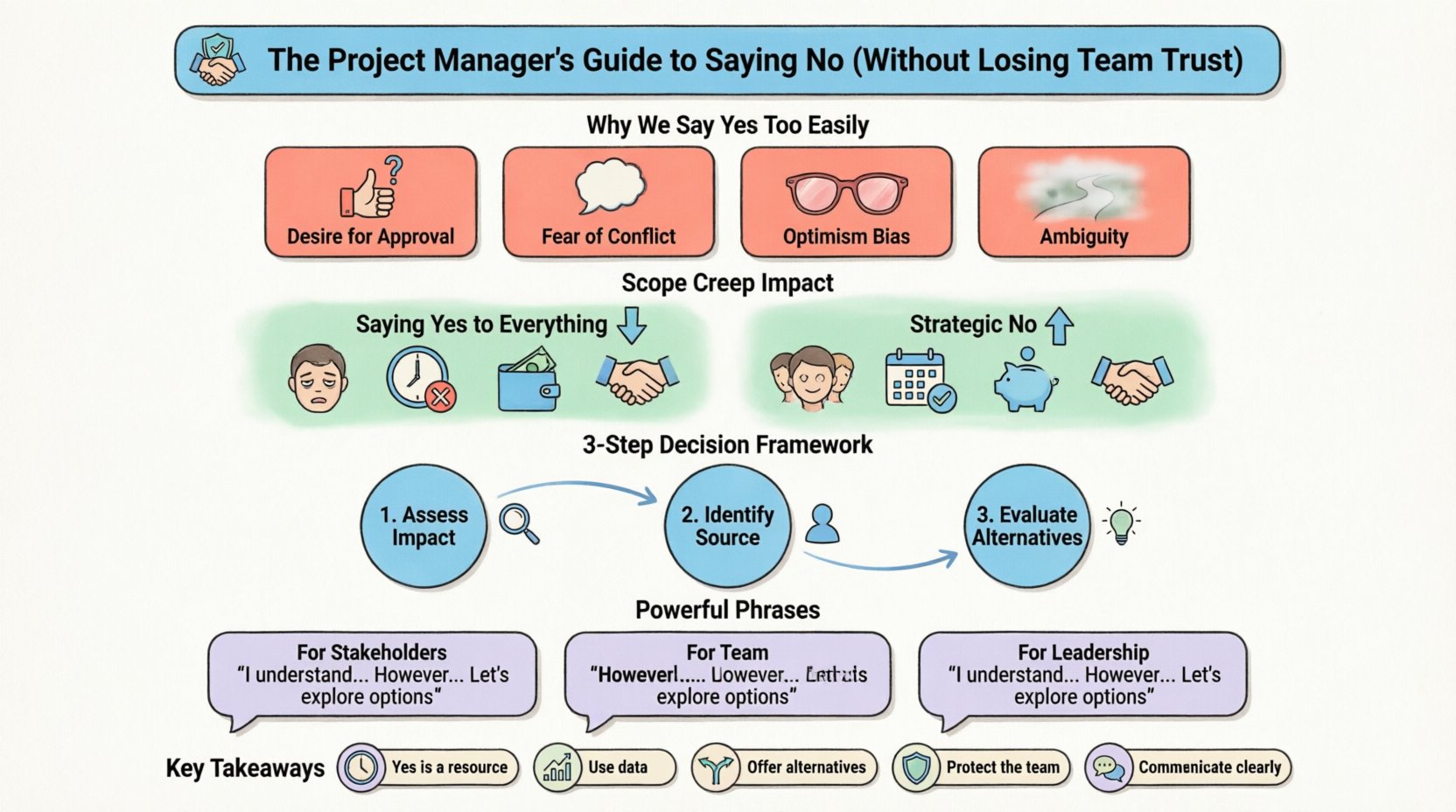
🧠 The Psychology of the “Yes” Trap
Many project managers agree to requests because they want to be helpful. They fear conflict or believe that a simple “yes” is the path to harmony. This mindset often stems from a misunderstanding of their role. You are not an order taker. You are a steward of resources.
When you agree to a request without assessing the impact, you create a hidden debt. This debt is paid later through overtime, reduced quality, or missed deliverables. The team pays the price for this “yes” in the form of stress and exhaustion. The stakeholder pays the price with a delayed product.
Why People Say Yes Too Easily
Desire for Approval: Managers often seek validation from leadership or clients. A polite refusal can feel like a risk to that standing.
Fear of Conflict: It is easier to add a small task than to have a difficult conversation about capacity.
Optimism Bias: Believing that “we can make it work” often ignores the reality of current constraints.
Ambiguity: If a request is vague, it is tempting to say yes and figure it out later. This is a recipe for failure.
Recognizing these drivers is the first step to changing the behavior. You must shift from being a passive recipient of tasks to an active manager of scope.
📉 The Cost of Scope Creep
Scope creep is the silent killer of projects. It happens when requirements grow without corresponding adjustments to time, budget, or resources. It is rarely malicious; it is usually incremental. A new feature here, a small change there.
Without the ability to say no, scope creep becomes structural. Over time, the project becomes unmanageable. Here is how unchecked growth affects different parts of the organization:
Area | Impact of Saying “Yes” to Everything | Impact of Strategic “No” |
|---|---|---|
Team Morale | Burnout, resentment, high turnover | Clear priorities, sustainable pace |
Delivery | Missed deadlines, quality issues | Reliable timelines, high quality |
Budget | Overspend, reduced ROI | Cost control, predictable spending |
Trust | Broken promises to stakeholders | Consistent delivery builds credibility |
The goal is not to be rigid. It is to be realistic. A strategic no protects the integrity of the commitment you did make.
🛡️ A Framework for Decision Making
Before you respond to a request, pause. Use a structured approach to evaluate the request against your current reality. This removes emotion from the equation and replaces it with data.
1. Assess the Impact
What is the cost of this new task? Does it require existing resources? Will it delay a critical milestone? If you cannot quantify the cost, you cannot make an informed decision.
Time: How many hours will this take?
Resources: Who needs to do this work?
Quality: Will rushing this task degrade the final output?
Dependencies: Does this block other work?
2. Identify the Source
Where is the request coming from? Is it a client, a stakeholder, or a team member? Different sources require different levels of negotiation. A request from a senior executive carries different weight than one from a peer, but the impact on the team remains the same.
3. Evaluate Alternatives
Can the request be deferred? Can it be simplified? Can it be done with less effort? Often, the “no” is not about the task itself, but about the when and how.
Example: Instead of saying “No, we don’t have time,” try “We can’t do this this week, but we can schedule it for next sprint.”
🗣️ Scripts and Phrases for Difficult Conversations
Language matters. The way you phrase your refusal can determine whether the relationship survives. Avoid defensive language. Focus on transparency and shared goals.
When Dealing with Stakeholders
Stakeholders often do not see the full picture of your workload. They see a need, not the capacity to meet it.
Validate first: “I understand why this feature is important for the launch.”
State the constraint: “However, our current capacity is fully allocated to the core delivery.”
Offer options: “To include this, we would need to push the launch date by two weeks, or we can move it to the next phase.”
When Dealing with Team Members
Your team looks to you for protection. If they are overloaded, they need to hear that you understand.
Check understanding: “I hear you are looking for support on this task.”
Explain the bottleneck: “Right now, the team is focused on the security audit.”
Collaborate on timing: “Let’s review the backlog together to see what we can swap out if this is urgent.”
When Dealing with Leadership
Leadership may push for speed. You must remind them of the trade-offs without sounding insubordinate.
Focus on risk: “If we add this now, we risk the stability of the current build.”
Ask for priority: “If this is the highest priority, which current task should we pause?”
Document the decision: “Let me confirm the trade-off we are making by email so we are aligned on the timeline.”
🚦 Handling Specific Scenarios
Situations vary. A request for a small favor is different from a major scope change. Here is how to handle common scenarios.
Scenario 1: The “Quick Favor”
A colleague asks for help with a small task. It seems easy, but it disrupts your focus.
Approach: Do not say yes immediately. Ask for a few minutes to check your schedule.
Response: “I can’t check that right now. Can we talk about it at 2 PM? I need to finish this report first.”
Scenario 2: The VIP Request
A high-level executive demands a change right before a deadline.
Approach: Acknowledge their importance but enforce the process.
Response: “I appreciate you flagging this. Given the deadline, this change requires a formal change request to assess the impact on the timeline. I will submit that by end of day.”
Scenario 3: The “Urgent” Issue
Someone claims everything is urgent. Nothing is urgent.
Approach: Force them to prioritize.
Response: “If this is the top priority, what task should we deprioritize to make room for it?”
🤝 Rebuilding Trust After a Rejection
Saying no can feel like a rupture in the relationship. To maintain trust, you must follow up. Silence after a rejection creates confusion and resentment.
Explain the “Why”: People accept boundaries better when they understand the reasoning. Explain the capacity constraints clearly.
Offer Support: Even if you cannot do the task, can you point them to a resource or a person who can?
Keep Promises: If you say you will review the request next week, do it. Consistency builds trust more than agreement does.
Celebrate Wins: When you successfully deliver on the scope you agreed to, highlight that success. Show that saying no led to a better outcome.
🌱 Building a Culture of Realistic Planning
Individual boundaries are not enough. You need a system that supports saying no. This requires cultural change within the project management office and the wider organization.
1. Transparent Capacity Planning
Make work visible. Use visual boards or simple tracking to show the team’s workload. When stakeholders see that the board is full, they understand the constraint without you having to say it.
2. Defined Change Processes
Establish a clear protocol for changes. If a request comes outside the process, it does not enter the workflow. This removes the pressure of ad-hoc decisions.
3. Regular Retrospectives
Discuss what worked and what didn’t. If the team felt overwhelmed, analyze why. Was it a bad estimate? An unexpected blocker? Adjust the planning process based on this data.
4. Empower the Team
Encourage team members to speak up when they are overloaded. If they say yes to something they cannot do, the project fails. Create an environment where “I am at capacity” is an acceptable answer.
📊 The Long-Term Value of Boundaries
Managing expectations is not a one-time task. It is an ongoing practice. Over time, the organization learns that you are reliable because you are honest about limits.
When you consistently say no to low-value work, you free up time for high-value work. This increases the return on investment for the project. It also improves the quality of life for the team. A rested team makes fewer mistakes and solves problems faster.
Trust is not built by doing everything for everyone. It is built by doing what you said you would do, and being honest when you cannot. This is the quiet confidence that defines a strong project manager.
✅ Key Takeaways
Yes is a resource: Every “yes” costs time and energy. Spend it wisely.
Use data: Base your refusals on capacity and impact, not feelings.
Offer alternatives: Always provide a path forward, even if the immediate answer is no.
Protect the team: Your primary duty is to shield the team from chaos.
Communicate clearly: Ambiguity leads to friction. Be direct and polite.
By mastering the art of saying no, you do not lose influence. You gain respect. You become the person who delivers results, not the person who promises everything and delivers nothing.