


Software architecture is evolving at a pace that challenges traditional documentation methods. As systems shift from monolithic structures to distributed microservices and event-driven ecosystems, the need for precise temporal modeling becomes critical. Timing diagrams offer a specialized lens for understanding how components interact over time. This guide explores how these diagrams are adapting to meet the demands of modern engineering environments.
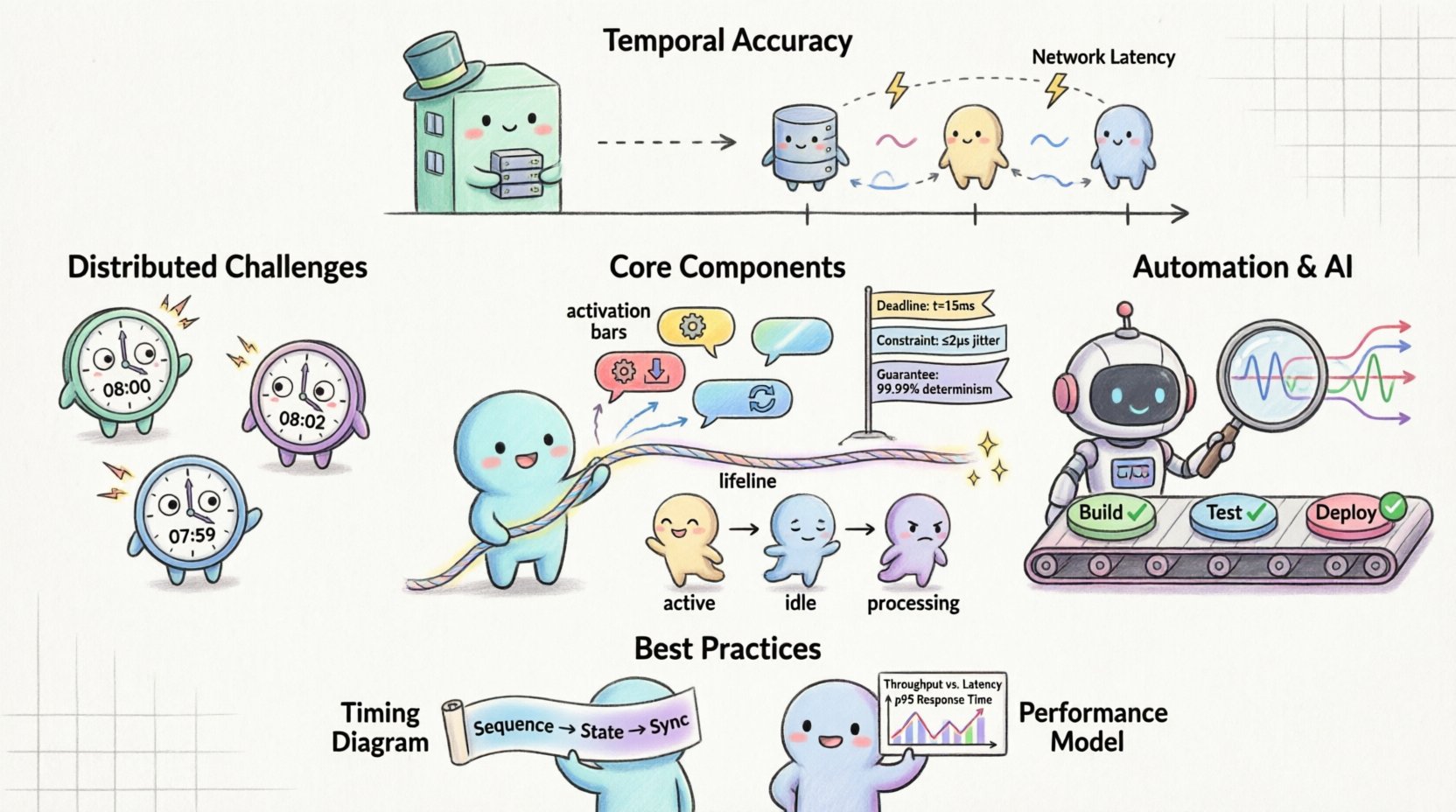
Understanding the Role of Timing in System Design ⏱️
At its core, a timing diagram depicts the state changes of objects or components within a defined time interval. Unlike sequence diagrams, which focus on the order of messages, timing diagrams emphasize the duration and timing constraints of interactions. In complex architectures, understanding these constraints is vital for ensuring reliability and performance.
- Temporal Accuracy: Ensures data arrives within acceptable latency windows.
- Resource Management: Helps visualize when resources are locked or released.
- Concurrency Control: Clarifies how parallel processes synchronize without conflict.
Modern applications often operate under strict Service Level Agreements (SLAs). A delay in one service can cascade, causing system-wide failures. Timing diagrams provide the blueprint needed to anticipate these bottlenecks before deployment.
The Shift from Monoliths to Distributed Systems 🌐
Historically, timing analysis was straightforward. In a monolithic application, components ran on the same machine or within the same process space. Network latency was negligible, and clock synchronization was trivial. Today, the landscape has changed dramatically.
When architecture moves to distributed environments, new variables enter the equation. The following factors complicate timing analysis:
- Network Latency: Variable packet travel times across geographically dispersed nodes.
- Clock Skew: Lack of perfect synchronization between independent servers.
- Asynchronous Processing: Events do not always trigger immediate responses.
- Eventual Consistency: Data states may take time to propagate across the system.
These factors make static timing diagrams less effective if they do not account for uncertainty. The future of timing modeling lies in probabilistic representations rather than deterministic lines.
Core Components of Modern Timing Diagrams 🛠️
To remain relevant, timing diagrams must incorporate specific elements that address contemporary architectural challenges. The following components are essential for accurate modeling.
1. Lifelines and Activation Bars
Lifelines represent the existence of a participant over time. Activation bars indicate when an object is performing an action. In modern diagrams, these should reflect:
- Microservice invocations.
- Database query execution windows.
- Background job processing intervals.
2. Time Constraints and Flags
Explicit markers for deadlines are crucial. A timing diagram should clearly show when a timeout occurs. This helps developers understand failure states. Common constraints include:
- Deadline: The absolute time by which an operation must complete.
- Jitter: The variation in timing between expected and actual events.
- Latency: The delay between request and response.
3. State Transitions
Objects change states based on time and input. A timing diagram visualizes these transitions along a timeline. For example, a session object might transition from Active to Idle after a specific duration.
| Component | Function | Relevance in Modern Architecture |
|---|---|---|
| Lifeline | Represents participant existence | Tracks microservice health over time |
| Signal | Indicates message transmission | Maps API call frequency and load |
| Constraint | Defines time limits | Enforces SLA compliance and timeouts |
| State | Shows internal condition | Visualizes processing stages (e.g., Queued, Processing) |
Challenges in Distributed Timing Analysis ⚠️
Designing timing diagrams for distributed systems introduces significant complexity. Engineers must navigate the lack of a global clock and the unpredictability of network conditions.
1. The Problem of Clock Synchronization
In a distributed environment, every node has its own internal clock. These clocks drift apart over time. Without synchronization, a timing diagram drawn on one server might not match the reality on another. Solutions often involve:
- Using logical clocks (e.g., Lamport timestamps).
- Implementing NTP (Network Time Protocol) for hardware alignment.
- Accepting partial ordering rather than total ordering.
2. Non-Deterministic Behavior
Traditional diagrams assume deterministic paths. However, modern systems often use retries, circuit breakers, and load balancing. These features introduce randomness. A single request might take 10 milliseconds or 10 seconds depending on network load.
To address this, diagrams should represent ranges rather than fixed points. Using shaded regions or dashed lines can indicate probability distributions of response times.
3. Handling Concurrency and Race Conditions
When multiple threads or services access shared resources, race conditions can occur. Timing diagrams help identify these risks by showing overlapping access periods. If two services require a lock simultaneously, the diagram highlights the potential for deadlock.
Automation and Integration with Observability 📊
Static diagrams created manually are prone to becoming outdated. The future of timing analysis involves integrating modeling directly with runtime observability.
1. Dynamic Diagram Generation
Instead of drawing diagrams by hand, systems can generate them from telemetry data. Continuous monitoring tools capture request traces and visualize timing relationships automatically. This approach ensures the documentation matches the actual system behavior.
- Trace Correlation: Links distributed traces to visual timelines.
- Anomaly Detection: Highlights when timing deviates from the baseline model.
- Real-time Updates: Diagrams update as the system scales or changes.
2. Integration with CI/CD Pipelines
Timing constraints should be validated during the deployment process. If a new release introduces latency that exceeds the defined timing diagram constraints, the pipeline can fail. This shifts the focus from reactive debugging to proactive prevention.
Key steps for integration include:
- Defining performance budgets in the design phase.
- Automating load testing against timing models.
- Generating reports that compare actual vs. modeled performance.
Best Practices for Effective Timing Documentation 📝
To maintain clarity and utility, engineers should adhere to specific practices when creating and maintaining timing diagrams.
1. Keep It Focused
Do not attempt to model every interaction in the system. Select critical paths that impact performance or safety. A diagram that covers the entire system often becomes unreadable and useless.
2. Use Standard Notations
Adhering to established standards ensures that team members can interpret the diagrams correctly. Common notations include:
- Rectangular regions for state periods.
- Vertical lines for message boundaries.
- Text boxes for specific timing constraints.
3. Document Assumptions
Every diagram relies on assumptions about the environment. Document these explicitly. For example, note if the timing assumes low network load or specific hardware capabilities. This prevents misinterpretation during troubleshooting.
4. Version Control Documentation
Just like code, diagrams should be versioned. Changes in architecture require updates to the timing models. Maintaining a history allows teams to understand how performance requirements evolved over time.
The Intersection of AI and Timing Modeling 🤖
Artificial intelligence is beginning to influence how software architecture is visualized and analyzed. Machine learning models can predict timing behavior based on historical data.
1. Predictive Modeling
AI can analyze past performance logs to forecast future timing scenarios. This allows architects to simulate stress conditions without deploying new infrastructure. The timing diagram becomes a predictive tool rather than just a descriptive one.
2. Automated Optimization
Algorithms can suggest architectural changes to improve timing. For instance, if a diagram shows a bottleneck at a specific service, the system might recommend caching or horizontal scaling.
3. Natural Language Processing
Developers can describe timing requirements in natural language. NLP models can convert these descriptions into formal timing diagrams. This lowers the barrier to entry for creating precise temporal models.
Performance Modeling vs. Timing Diagrams 📈
It is important to distinguish between performance modeling and timing diagrams. While related, they serve different purposes in the development lifecycle.
| Aspect | Timing Diagram | Performance Model |
|---|---|---|
| Focus | Event sequence and duration | Resource utilization and throughput |
| Granularity | Message level | System level |
| Output | Visual timeline | Metrics and graphs |
| Use Case | Design and debugging | Capacity planning |
Combining both approaches yields the most robust architecture. Use timing diagrams to understand flow and performance models to understand load.
Conclusion on Temporal Design 🎯
The future of timing diagrams lies in their integration with automated observability and their adaptation to distributed complexity. As systems become more asynchronous and decentralized, the ability to visualize time-dependent behavior is becoming a core competency for architects.
By focusing on probabilistic modeling, automation, and clear documentation practices, teams can ensure their systems remain reliable under pressure. The goal is not just to draw lines, but to build a mental model of the system’s temporal health.
Continuous refinement of these diagrams alongside code ensures that performance requirements are met throughout the software lifecycle. This disciplined approach to timing analysis supports the creation of resilient, high-performance software architectures.