

Beyond the Syntax: How Inheritance Solves Real Enterprise Architecture Problems
In the chaotic world of enterprise software development, code duplication is often the silent killer of maintainability. We’ve all been there: a junior developer copies a block of code from a “Customer” class to a “PremiumCustomer” class, only to realize three months later that a business rule has changed for both. The result? A cascade of bugs and a fractured codebase.
This is where the concept of Inheritance (or Generalization) transitions from a textbook definition to a critical architectural tool. In Visual Paradigm and C4 modeling, this is the mechanism that allows us to define taxonomic relationships, ensuring that specific entities inherit the features of their general counterparts. It represents the fundamental “is-a” relationship that underpins robust system design.
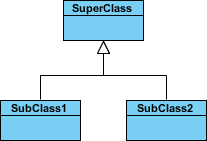
Core Insight: Inheritance is not just about code reuse; it is about semantic clarity. When you model SubClass1 and SubClass2 as specializations of SuperClass, you are telling your stakeholders that every instance of the specific class is an instance of the general class.
The “Is-A” Relationship in Action: A Retail Scenario
Imagine you are architecting an Order Management System (OMS) for a massive e-commerce platform. Your business requirements are clear: you have standard orders, but you also have “Express” orders and “Wholesale” orders. These are not just different; they are specific types of orders.
If you treat them as completely separate classes, you end up maintaining the same customer ID, shipping address, and payment gateway logic in three different places. Instead, you apply the Generalization pattern.
Visual Paradigm helps you visualize this hierarchy clearly. You define a SuperClass named Order. This class holds the common attributes: orderID, customerID, and totalAmount. Then, you create ExpressOrder and WholesaleOrder as SubClasses.
Because of inheritance, every ExpressOrder is an Order. It automatically inherits the ability to calculate totals and manage customer data. The specific class adds only what makes it unique, such as a priorityLevel for Express orders or a bulkDiscountRate for Wholesale orders.
Visualizing the Hierarchy: The Solid Line and Hollow Arrowhead
In your UML diagrams, the relationship between these classes is non-negotiable in its semantics. You will see a solid line connecting the child elements to the parent element. The key identifier is the hollow arrowhead.
Notice the direction: the arrow points from the child (the specific classifier) to the parent (the general classifier). This visual cue is the industry standard for denoting Generalization. It screams, “I am a specialized version of you.”
When you look at the diagram, you see SubClass1 and SubClass2 branching out from SuperClass. While the connectors might be drawn slightly differently depending on the layout engine in Visual Paradigm, they remain semantically equivalent. The architecture remains the same regardless of whether the lines are vertical or angled.
- The Arrowhead: A hollow triangle pointing to the parent signifies “Generalization.”
- The Line: A solid line indicates a structural, hard-coded relationship.
- The Direction: Always points from specific to general.
Handling Abstract Concepts: The Power of Italics
In real-world scenarios, not every class in your hierarchy needs to be instantiated directly. Consider a “Payment” system. You might have a general Payment class, but you would never create a generic payment. You only create CreditCardPayment, PayPalPayment, or BitcoinPayment.
Visual Paradigm provides a specific visual convention for this: Abstract Classes. When you mark a class as abstract, its name is displayed in italics. This is a crucial signal to the development team and the database architects.
It tells the team: “Do not try to instantiate this class. It is a blueprint. You must use SubClass1 or SubClass2.” This prevents runtime errors where the system tries to process a generic, undefined payment method.
Operational Scenarios: Why This Matters for Database Modeling
The impact of inheritance extends far beyond the Java or C# code. It directly influences your database schema design.
When you model the “Shapes” hierarchy (e.g., Circle, Rectangle, and Shape) in an enterprise context, you face a decision: do you use a single table with a discriminator column, or do you use table-per-class inheritance?
By clearly defining the Generalization relationship in your UML diagram using the hollow arrowhead, you provide the necessary context for the database engineer to choose the right strategy. They can see that Circle inherits Area and Perimeter from Shape, allowing them to optimize the SQL queries accordingly.
Conclusion: From Diagram to Deployment
Inheritance is the backbone of scalable architecture. It allows systems to evolve without breaking existing logic. By using Visual Paradigm to map out these taxonomic relationships, you ensure that your system is not just a collection of classes, but a coherent hierarchy that mirrors real-world business logic.
Whether you are designing a financial ledger, a healthcare patient management system, or a logistics tracking tool, remember the rule: if it is a type of something else, use the solid line with the hollow arrowhead. It is the simplest way to communicate the most complex structural truth of your application.