


One of the most persistent challenges in software engineering is the disconnect between business requirements and technical implementation. Business analysts and operational leaders view systems in terms of workflows, customer journeys, and business outcomes. Software architects and developers, on the other hand, focus on class hierarchies, API contracts, database schemas, and service deployment models.
When these two perspectives are managed in isolation, software projects suffer from scope creep, missed edge cases, and costly rework. Bridging this gap requires establishing full model traceability from high-level business process diagrams down to system architecture artifacts. By incorporating the modern AI BPMN tool within Visual Paradigm into a unified visual modeling platform, organizations can seamlessly connect business requirements to technical design without leaving their ecosystem.
The Cost of Misalignment Between Business and IT
Traditional requirement handoffs often rely on lengthy, text-dense specification documents. As software projects evolve, maintaining alignment between these static documents and the actual codebase becomes nearly impossible. Common friction points include:
- Lost Business Intent: Developers may implement features that satisfy basic code logic but fail to support the broader business process workflow correctly.
- Architectural Bottlenecks: Technical architects design database models and service interfaces without visibility into how business operations branch during exception handling.
- Manual Traceability Overhead: Updating system specifications when business requirements change requires tedious manual documentation across multiple disjointed tools.
Connecting BPMN 2.0 to System Architecture Artifacts with Visual Paradigm
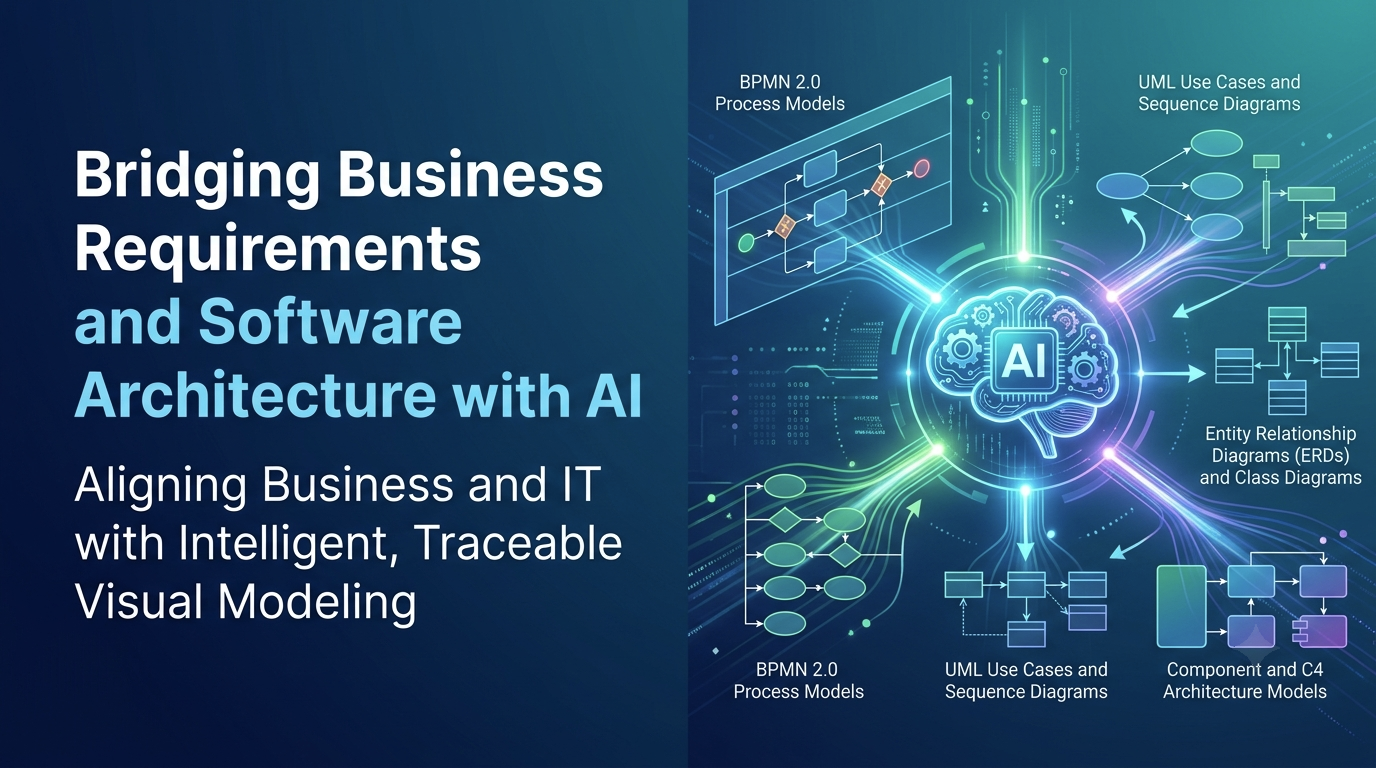
Business Process Model and Notation (BPMN 2.0) serves as the ideal translation layer between business vision and system design. Because BPMN provides structured, object-oriented process semantics, individual process elements can be mapped directly to technical modeling standards. Visual Paradigm excels here by offering bidirectional synchronization between process models and technical designs.
1. Process Tasks to UML Use Cases and Sequence Diagrams
A high-level business task in a BPMN diagram (e.g., “Verify Credit Rating”) directly informs the creation of Unified Modeling Language (UML) Use Cases. Within Visual Paradigm, technical leads can expand that specific BPMN task into a detailed UML Sequence Diagram showing the exact message exchanges between microservices, database layers, and external payment APIs. This ensures that every business action has a corresponding technical flow defined immediately.
2. Business Data Objects to ERDs and Class Diagrams
Data objects and inputs/outputs attached to BPMN activities define the core domain entities required by the business. Architects can map these data artifacts directly to Entity Relationship Diagrams (ERDs) and UML Class Diagrams within Visual Paradigm, ensuring the database schema supports every operational requirement from day one. The platform automatically maintains consistency between the BPMN data definitions and the underlying database models.
3. Swimlanes to Component and C4 Architecture Models
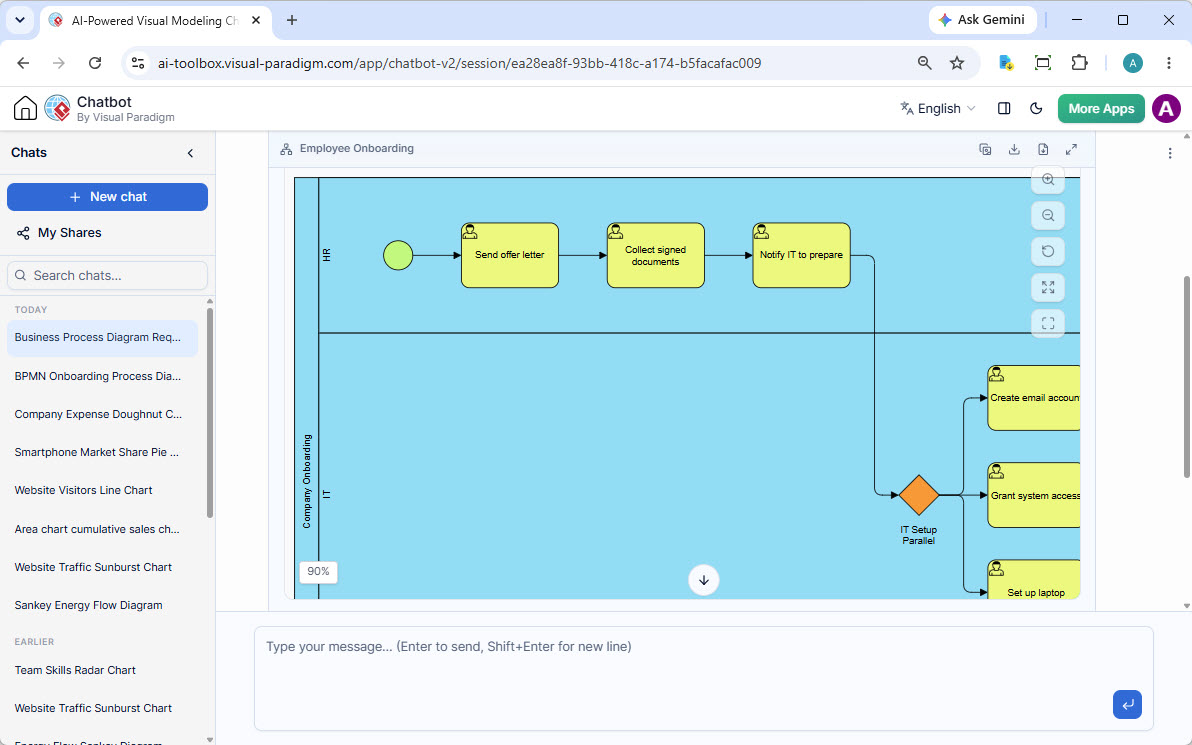
BPMN swimlanes and pools represent operational roles and external systems. These boundaries map directly to software architecture components, system boundaries, and API integration boundaries in C4 software architecture models. Visual Paradigm‘s unified environment allows users to visualize these relationships instantly, bridging the gap between who performs the work and how the system supports them.
Streamlining Alignment with Visual Paradigm’s AI BPMN Tool
While establishing end-to-end model traceability is powerful, building initial process baselines manually can slow down sprint discovery. Visual Paradigm’s AI BPMN Tool removes this operational drag.
By simply inputting business policy descriptions or product feature specifications, an enterprise AI BPMN tool powered by Visual Paradigm automatically generates standard-compliant process maps in seconds. Business analysts can validate operations visually, while system architects receive an instantly structured model to kickstart technical design—all within the familiar Visual Paradigm interface.
Using the AI BPMN tool within Visual Paradigm offers distinct architectural advantages:
- Accelerated Requirements Baseline: Generate clean BPMN diagrams from raw meeting transcripts or PRDs during initial discovery calls using Visual Paradigm‘s natural language processing capabilities.
- Single Source of Truth: Import AI-generated process maps directly into Visual Paradigm, allowing developers to link process nodes directly to code components, database schemas, and user stories in real-time.
- Impact Analysis and Change Management: When a business process changes, linked models in Visual Paradigm automatically highlight which UML diagrams, database entities, and API contracts need modification, preventing regression errors.
Frequently Asked Questions
Can Visual Paradigm generate UML diagrams directly from process models?
Yes. When using Visual Paradigm, its integrated AI BPMN tool allows you to derive secondary technical models—such as UML Sequence Diagrams or Use Case models—directly from selected BPMN tasks. The platform handles the reverse engineering and forward engineering of models automatically.
Why is BPMN better than user stories for technical system design in Visual Paradigm?
While user stories describe intent, BPMN diagrams provide structural logic, explicit gateway decisions, exception handling branches, and clear system boundaries that developers need to build robust software architectures. Visual Paradigm takes this further by converting those BPMN structures directly into executable code scaffolds and UML models.
Do software architects need to learn BPMN to use Visual Paradigm?
Architects do not need to be BPMN experts, but understanding basic process swimlanes, gateway logic, and event triggers allows them to translate business goals into scalable software designs accurately. Visual Paradigm‘s intuitive interface makes learning these concepts faster, especially when assisted by the AI generation features.
Conclusion
Bridging business requirements and software architecture is essential for building scalable, high-quality enterprise systems. By using BPMN 2.0 as a common modeling language within Visual Paradigm, organizations ensure that software implementation always aligns with operational vision. Leveraging the enterprise-grade AI BPMN tool in Visual Paradigm accelerates initial discovery, enforces standard compliance, and establishes seamless traceability from high-level process maps down to technical architecture and code.