
项目为何失败:现实世界项目崩溃案例研究分析

每个组织都梦想着完美执行。然而,现实往往呈现出不同的图景。从建筑到软件开发,各行各业的项目经常错过截止日期、超出预算或未能达成目标。理解项目为何失败不仅仅是一次学术练习;对于领导团队而言,这是一项至关重要的生存技能。

本分析深入探讨项目崩溃的内在机制。通过审视现实世界中的案例及其根本原因,我们可以识别出在灾难发生前就预示问题的模式。我们将超越表面症状,深入探究导致项目失控的根本结构性问题。
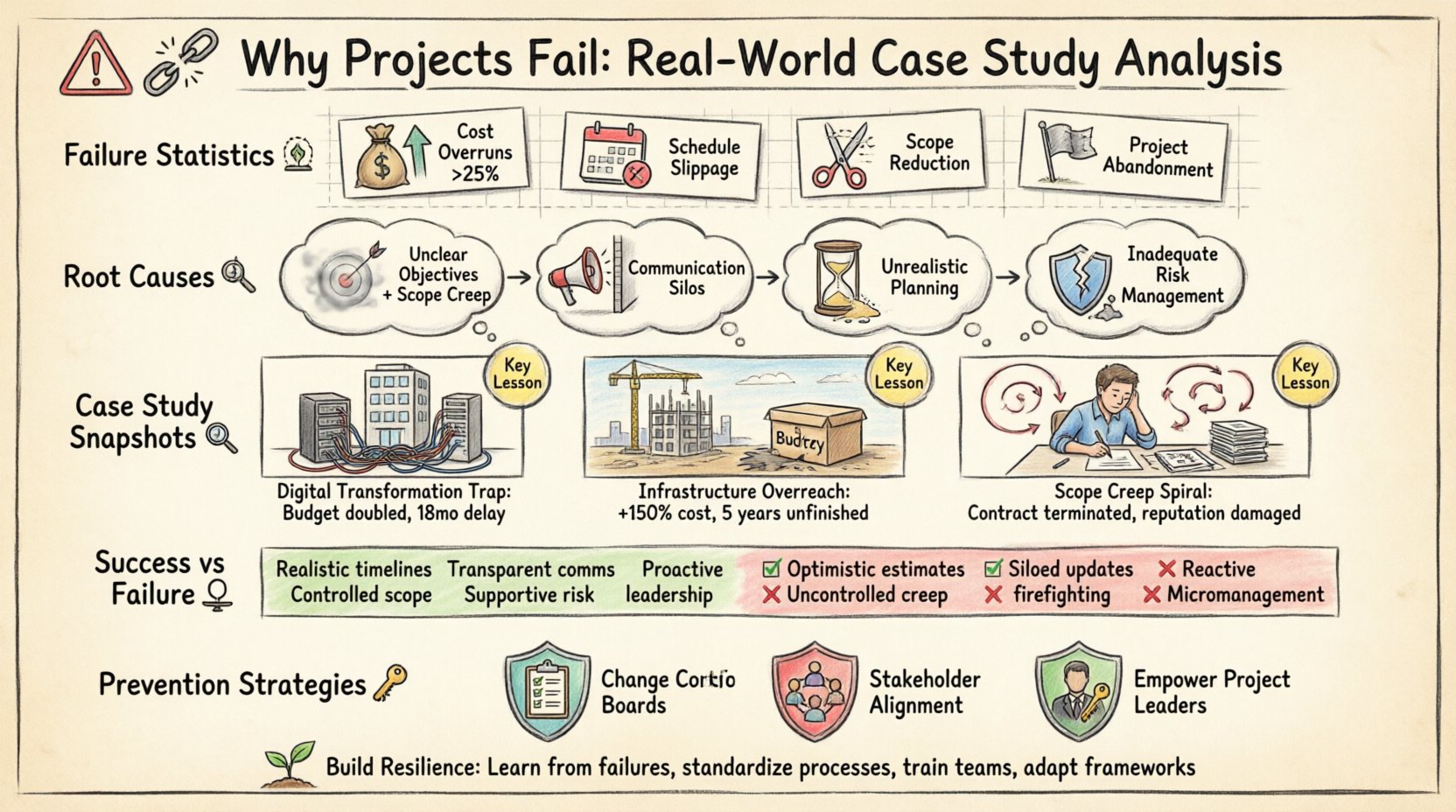
Hand-drawn infographic analyzing why projects fail: features failure statistics (cost overruns >25%, schedule slippage, scope reduction, abandonment), four root causes (unclear objectives/scope creep, communication silos, unrealistic planning, inadequate risk management), three real-world case studies (digital transformation trap, infrastructure overreach, scope creep spiral) with key lessons, success vs failure comparison table covering planning/communication/scope/risk/leadership/team factors, and five prevention strategies (change control boards, regular risk audits, stakeholder alignment workshops, empower project leaders), all illustrated with thick outline strokes in a sketchy hand-drawn aesthetic on 16:9 layout with parchment background and muted accent colors”/></figure>
</div>

<h2>The Statistics of Project Failure 📊</h2><p>Before diving into specific cases, it is essential to understand the landscape. Data consistently shows a significant portion of initiatives do not achieve their original goals. While definitions of “failure” vary, common metrics include:</p><ul><li><p><strong>Cost Overruns:</strong> Projects exceeding the allocated budget by more than 25%.</p></li><li><p><strong>Schedule Slippage:</strong> Deliverables arriving significantly past the agreed-upon deadline.</p></li><li><p><strong>Scope Reduction:</strong> Features or objectives being cut before final delivery.</p></li><li><p><strong>Abandonment:</strong> Projects halted entirely without completion.</p></li></ul><p>When we analyze these statistics, a clear picture emerges. Failure is rarely a singular event. It is usually the result of compounding errors, misaligned expectations, or a lack of governance. The following sections break down the primary drivers of these outcomes.</p><h2>Root Causes of Project Breakdowns 🕵️‍♂️</h2><p>Identifying the cause is the first step toward prevention. Most project failures stem from a combination of planning deficiencies and human factors. Below are the most frequent culprits.</p><h3>1. Unclear Objectives and Scope Creep 🧩</h3><p>Many projects begin with a vague vision. If the end goal is not defined with precision, the team lacks a North Star. As work progresses, stakeholders often request additional features or changes without understanding the impact on resources. This phenomenon, known as scope creep, dilutes focus and exhausts the budget.</p><ul><li><p><strong>Impact:</strong> Resources are spread too thin.</p></li><li><p><strong>Symptom:</strong> Meetings become endless discussions about “what ifs” rather than execution.</p></li><li><p><strong>Result:</strong> The core deliverable is never finished.</p></li></ul><h3>2. Communication Silos 📢</h3><p>Information flow is the lifeblood of any initiative. When departments operate in isolation, critical details get lost. A design team might build something the engineering team cannot implement, or a sales team might promise features that operations cannot support.</p><p>Breakdowns often happen because stakeholders are not informed about risks until it is too late. Transparency is often sacrificed for the sake of meeting short-term targets.</p><h3>3. Unrealistic Planning and Estimation ⏳</h3><p>Optimism bias is a common psychological trap. Teams tend to underestimate the time required for complex tasks while overestimating their own productivity. When initial plans ignore potential risks or dependencies, the schedule becomes fragile.</p><p>Once the first delay occurs, it creates a domino effect. Tasks that were scheduled for later get pushed, causing bottlenecks further down the line.</p><h3>4. Inadequate Risk Management 🛡️</h3><p>Projects operate in environments of uncertainty. If a team does not proactively identify potential risks (technical, financial, or personnel), they cannot prepare mitigation strategies. When an unexpected issue arises, the team reacts rather than responds, often making the situation worse.</p><h2>Case Study Analysis: Real-World Breakdowns 🏗️</h2><p>To illustrate these concepts, we examine three distinct scenarios. These cases represent anonymized examples drawn from various sectors to highlight universal principles.</p><h3>Case Study 1: The Digital Transformation Trap 💻</h3><p><strong>Context:</strong> A mid-sized logistics company attempted to replace its legacy tracking system with a new platform.</p><p><strong>The Goal:</strong> Automate inventory tracking and reduce manual data entry by 80% within six months.</p><p><strong>The Breakdown:</strong></p><ul><li><p><strong>Phase 1 (Initiation):</strong> Leadership approved the budget without consulting the floor staff who would use the system daily.</p></li><li><p><strong>Phase 2 (Planning):</strong> The timeline was set based on vendor promises rather than internal testing capabilities.</p></li><li><p><strong>Phase 3 (Execution):</strong> During integration, data migration failed repeatedly. The team spent months trying to fix data quality issues instead of building features.</p></li><li><p><strong>The Outcome:</strong> The project was delayed by 18 months. The budget doubled, and employee morale plummeted due to the new, flawed system.</p></li></ul><p><strong>Key Lesson:</strong> Technical capability does not equal operational readiness. User adoption must be part of the planning phase, not an afterthought.</p><h3>Case Study 2: The Infrastructure Overreach 🏗️</h3><p><strong>Context:</strong> A municipal government project to build a new public transit hub.</p><p><strong>The Goal:</strong> Construct a central station with integrated retail and parking facilities.</p><p><strong>The Breakdown:</strong></p><ul><li><p><strong>Scope Creep:</strong> During construction, local politicians added new requirements for aesthetics and additional amenities.</p></li><li><p><strong>Resource Strain:</strong> Material costs spiked unexpectedly. There was no contingency fund allocated for market volatility.</p></li><li><p><strong>Communication Gap:</strong> The construction manager knew about the delays but did not report them to the steering committee for fear of political backlash.</p></li><li><p><strong>The Outcome:</strong> The project remained unfinished for five years. The cost exceeded the initial estimate by 150%.</p></li></ul><p><strong>Key Lesson:</strong> Governance structures must protect the project from external scope changes without a formal change control process.</p><h3>Case Study 3: The Scope Creep Spiral 🌀</h3><p><strong>Context:</strong> A marketing agency developing a brand re-launch campaign.</p><p><strong>The Goal:</strong> Launch a new visual identity and website for a client within three months.</p><p><strong>The Breakdown:</strong></p><ul><li><p><strong>Lack of Prioritization:</strong> The client requested changes to the logo, color palette, and copy simultaneously.</p></li><li><p><strong>Team Fatigue:</strong> Designers were pulled into multiple revision loops, leading to burnout.</p></li><li><p><strong>Missed Deadlines:</strong> The website launch was pushed back three times.</p></li><li><p><strong>The Outcome:</strong> The client terminated the contract, citing poor delivery. The agency suffered reputational damage.</p></li></ul><p><strong>Key Lesson:</strong> “Yes” is the enemy of project success. Teams must have the authority to say no to changes that threaten the timeline.</p><h2>The Human Element: Leadership and Culture 👥</h2><p>Technology and processes are tools, but people drive the engine. A significant factor in project failure is the behavior of leadership and the culture of the organization.</p><h3>Micro-Management vs. Autonomy</h3><p>When leaders micromanage, they stifle innovation and slow down decision-making. Conversely, a complete lack of oversight can lead to drift. Successful projects require a balance where teams have autonomy to solve problems but are held accountable to clear milestones.</p><h3>Psychological Safety</h3><p>Teams need to feel safe admitting when they are behind schedule or when they made a mistake. If the culture punishes bad news, problems are hidden until they explode. A culture of transparency allows issues to be addressed early.</p><h2>Prevention Strategies and Mitigation 🛡️</h2><p>Knowing the causes allows for the creation of robust defense mechanisms. The following strategies can significantly reduce the risk of failure.</p><h3>1. Implement Change Control Boards</h3><p>Any request to change the scope, budget, or schedule should go through a formal review process. This ensures that stakeholders understand the trade-offs before agreeing to a change.</p><h3>2. Regular Risk Audits</h3><p>Risk management is not a one-time task. It should be a recurring agenda item in status meetings. Ask: “What could go wrong next week?” and “What do we need to mitigate it?”</p><h3>3. Stakeholder Alignment Workshops</h3><p>Before starting execution, bring all key parties together. Align on what “done” looks like. Document the requirements and get signatures. This creates a shared understanding and reduces ambiguity.</p><h3>4. Empower Project Leaders</h3><p>Assign authority to the project lead that matches their responsibility. They must have the power to reallocate resources and halt work if necessary to protect the project’s integrity.</p><h2>Comparative Analysis: Success vs. Failure Factors ⚖️</h2><p>To visualize the differences between projects that succeed and those that break down, consider the following comparison table.</p><table style=

因素

成功项目 ✅

失败项目 ❌

规划

现实的时间表并预留缓冲期

乐观估计且无缓冲期

沟通

透明且频繁的更新

信息孤岛、间歇性或隐藏的延迟

范围

严格控制变更

失控的范围蔓延

风险

主动的缓解计划

被动的救火式应对

领导力

支持且可接触

疏远或过度干预

团队

明确的角色与职责

所有权不明确

为未来举措构建韧性 🌱

失败常常是一位老师,但只有当我们倾听它所传授的教训时才是。组织必须从责备文化转向学习文化。当项目失败时,事后分析不应聚焦于谁犯了错误,而应关注是什么系统性漏洞导致了错误的发生。

韧性是通过以下方式建立的:

  • 标准化流程: 创建启动和规划的模板,以强制进行批判性思考。

  • 培训团队: 投资于项目管理方法和软技能的培训。

  • 回顾过往项目: 维护一个从以往成功与失败中汲取经验的资料库。

  • 调整框架: 乐于根据项目的具体特点调整方法。应根据适用性而非习惯选择敏捷、瀑布或混合方法。

项目治理的最终考量 🔍

最终,一个项目能否成功取决于其治理质量。这包括决策方式、资源分配以及进度衡量方式。如果没有强大的框架,即使是最有才华的团队也可能难以交付成果。

通过承认项目管理中的现实情况——不确定性、人为错误和外部压力——领导者可以建立更稳健的系统。目标并非完全消除失败(这是不可能的),而是尽量减少其发生频率和影响。

当团队以持续改进和诚实评估的心态对待工作时,他们便创造了一个成功成为大概率结果而非偶然事件的环境。分析过去的失败,为应对未来的挑战提供了路线图。