
AI-Driven Architecture: Bridging Human Intent with Diagram as Code
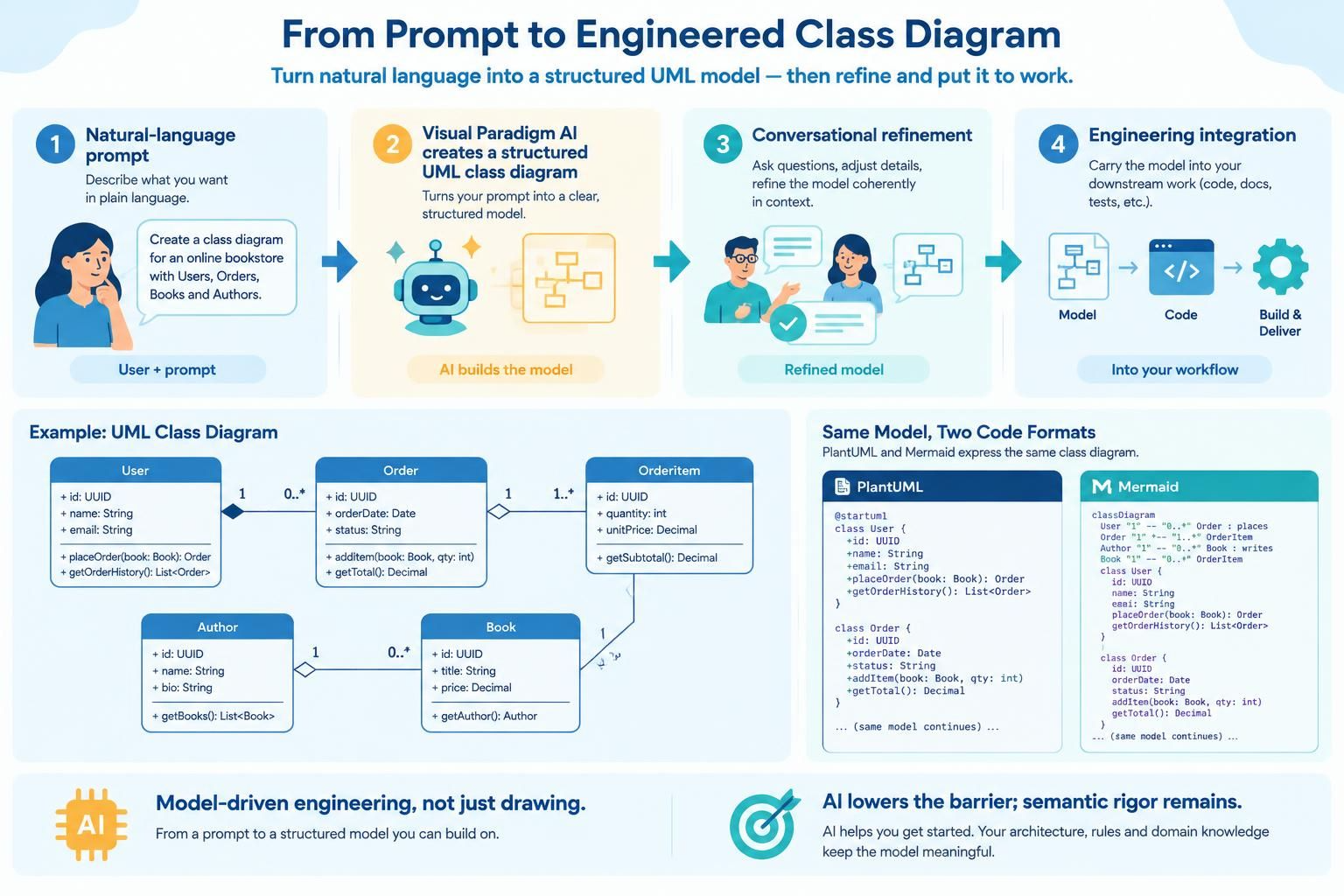
In the era of AI-driven development, a common question arises: Do we still need to draw class diagrams? Many assume that modern AI tools can instantly generate production-ready code, rendering manual architectural modeling obsolete. However, the reality is quite the opposite. Class diagrams are not merely “drawing exercises”; they are the critical bridge between human business logic and machine-executable code.
When using AI assistants to build software, the class diagram serves as the semantic contract. Without a structured model, AI generation becomes a “black box” where logic is hidden inside code, making maintenance and debugging difficult. This tutorial explores why the class diagram remains the cornerstone of modern system architecture, specifically when leveraging tools like Visual Paradigm to transform natural language into engineered reality.
1. The Shift from “Pictures” to “Metamodels”
Traditional UML tools often treated diagrams as graphical representations—essentially “pictures” of code. However, modern Model-Driven Engineering (MDE) treats the class diagram as a metamodel. This distinction is fundamental to understanding its relevance.
- Picture-Based Approach: A shape is just a shape. If you rename a class in one place, other diagrams do not update. The tool does not “understand” the relationship between the shapes.
- Model-Based Approach: Every class is an instantiable metaclass conforming to the UML 2.x specification. The tool understands that a
Memberclass is semantically linked to aBookclass via a specific relationship rule.
This distinction allows for Model-View Consistency. When you modify a model, changes cascade. Renaming a class in your architecture diagram automatically updates every other diagram, database schema, and generated code file referencing that class. This is impossible in pure drawing tools.
2. The AI Workflow: Conversational Modeling
AI assistants have transformed the creation of these models from a manual task into a conversational activity. Instead of dragging boxes and configuring properties, developers describe their domain in plain language.
Step 1: The Natural Language Prompt
The process begins by describing the system. For a library management system, a prompt might be:
“Generate a class diagram for a library system with Member, Book, Loan, and Fine. Include attributes, associations with multiplicities, and inheritance.”
Step 2: AI Generation & Semantic Validation
The AI does not just guess shapes; it generates a structured, semantically valid model. It understands UML rules, such as ensuring every class has at least one attribute or that relationships connect valid entities. It flags logical errors before they reach the codebase.
Step 3: Conversational Refinement
Once the initial draft is generated, the developer refines it conversationally:
- Cascade Renaming: “Rename ‘Member’ to ‘Patron’.” The AI updates the name and all associated references instantly.
- Encapsulation: “Add a ‘status’ attribute to Loan with getter and setter methods.” The AI regenerates the class compartment with the correct operations.
3. Why the Diagram Matters More Than Code
The true power of the class diagram lies in its role as the “source of truth.” While code can be generated from the model, the diagram holds the architectural intent.
1. Syntax Validation in Real-Time
The model engine checks your diagram against UML rules. It prevents anti-patterns like orphan classes (classes with no relationships) or empty compartments before you ever write a line of Java or C# code.
2. Downstream Engineering
A well-formed class model is a first-class citizen in the engineering pipeline. From the diagram, you can:
- Generate source code (Java, C#, C++).
- Produce database schemas (DDL) and ERDs.
- Generate ORM mappings (like Hibernate).
- Reverse-engineer existing databases back into the model.
3. Documentation & Communication
For technical writers and stakeholders, the class diagram provides a visual vocabulary. OpenDocs integration allows diagrams to live inside documentation, ensuring that the docs update automatically as the model evolves.
4. Practical Example: The Library System
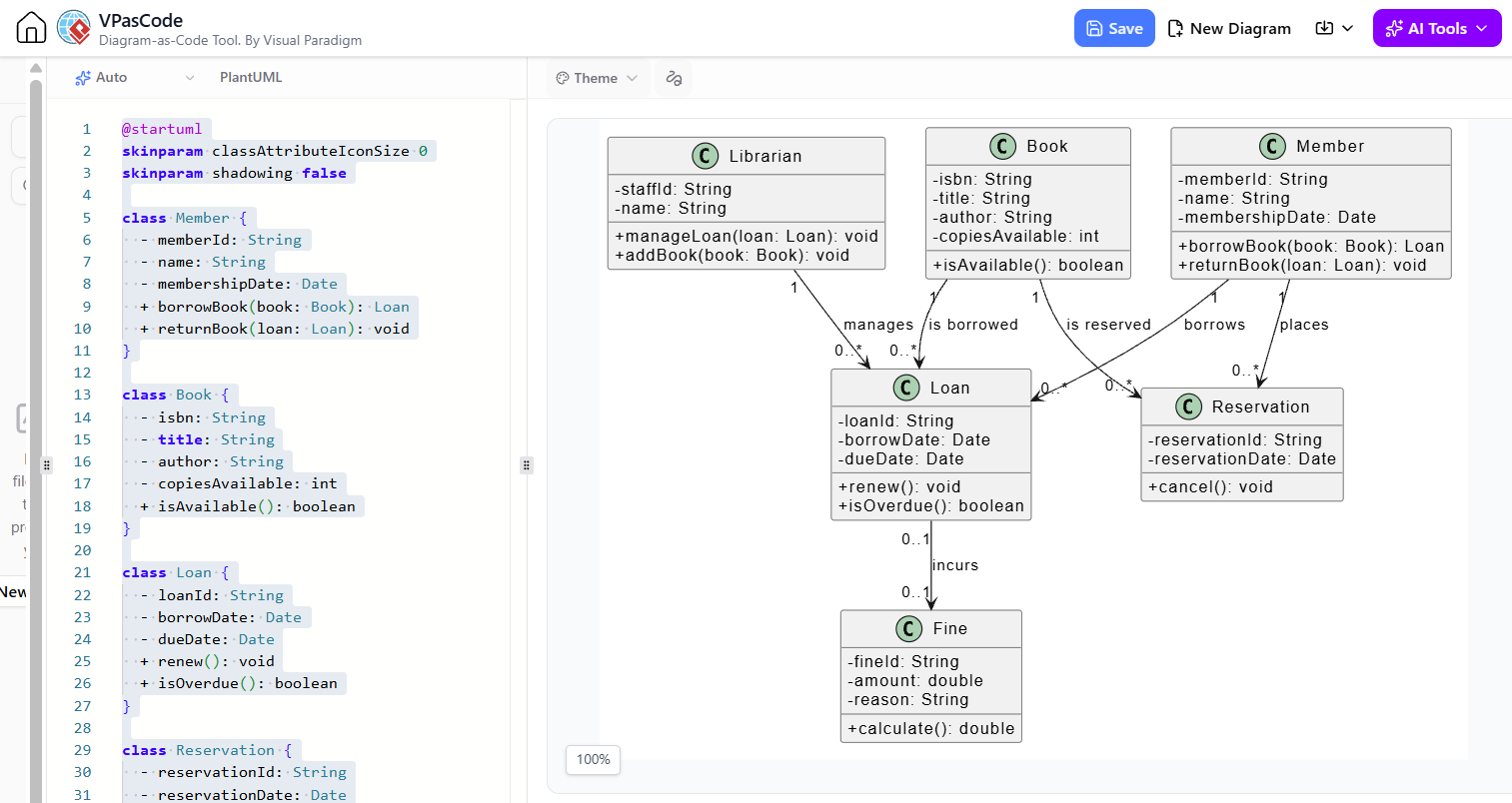
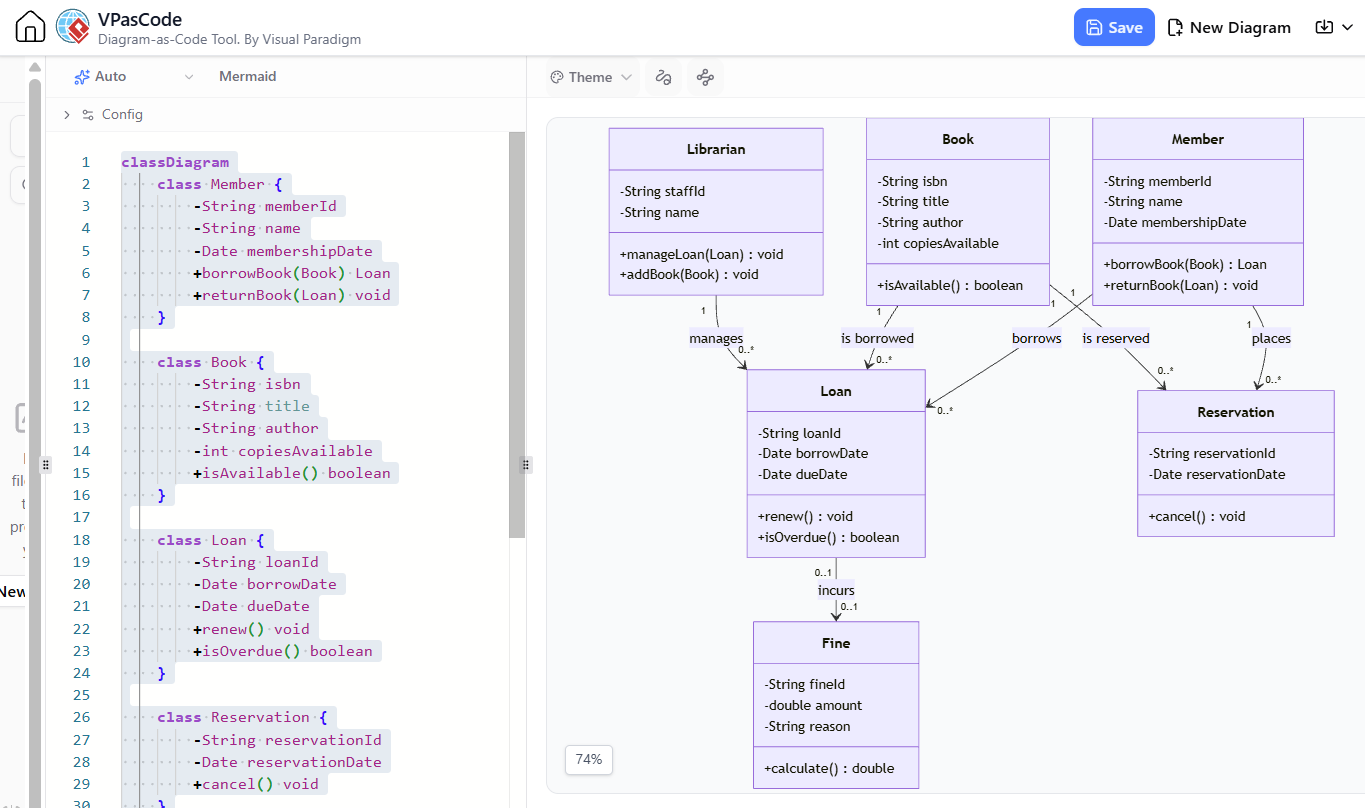
To illustrate how this model translates across different formats and tools, consider a standard Library Management System. Below is how the same domain is modeled in two popular text-based diagramming formats, demonstrating the consistency of the underlying model.
PlantUML Representation
@startuml
skinparam classAttributeIconSize 0
skinparam shadowing false

class Member {
  - memberId: String
  - name: String
  - membershipDate: Date
  + borrowBook(book: Book): Loan
  + returnBook(loan: Loan): void
}

class Book {
  - isbn: String
  - title: String
  - author: String
  - copiesAvailable: int
  + isAvailable(): boolean
}

class Loan {
  - loanId: String
  - borrowDate: Date
  - dueDate: Date
  + renew(): void
  + isOverdue(): boolean
}

class Reservation {
  - reservationId: String
  - reservationDate: Date
  + cancel(): void
}

class Librarian {
  - staffId: String
  - name: String
  + manageLoan(loan: Loan): void
  + addBook(book: Book): void
}

class Fine {
  - fineId: String
  - amount: double
  - reason: String
  + calculate(): double
}

Member "1" --> "0..*" Loan : borrows
Book "1" --> "0..*" Loan : is borrowed
Member "1" --> "0..*" Reservation : places
Book "1" --> "0..*" Reservation : is reserved
Librarian "1" --> "0..*" Loan : manages
Loan "0..1" --> "0..1" Fine : incurs
@endumlMermaid Representation
classDiagram
    class Member {
        -String memberId
        -String name
        -Date membershipDate
        +borrowBook(Book) Loan
        +returnBook(Loan) void
    }

    class Book {
        -String isbn
        -String title
        -String author
        -int copiesAvailable
        +isAvailable() boolean
    }

    class Loan {
        -String loanId
        -Date borrowDate
        -Date dueDate
        +renew() void
        +isOverdue() boolean
    }

    class Reservation {
        -String reservationId
        -Date reservationDate
        +cancel() void
    }

    class Librarian {
        -String staffId
        -String name
        +manageLoan(Loan) void
        +addBook(Book) void
    }

    class Fine {
        -String fineId
        -double amount
        -String reason
        +calculate() double
    }

    Member "1" --> "0..*" Loan : borrows
    Book "1" --> "0..*" Loan : is borrowed
    Member "1" --> "0..*" Reservation : places
    Book "1" --> "0..*" Reservation : is reserved
    Librarian "1" --> "0..*" Loan : manages
Loan "0..1" --> "0..1" Fine : incurs5. Strategic Benefits for Teams
For modern development teams, the relevance of class diagrams is tied to the specific benefits they offer across different roles:
- Software Architects: They use AI to rapidly generate candidate structures, critique them, and refine the architecture without starting from a blank canvas.
- Agile Teams: They translate user stories directly into engineering models during sprint design sessions, allowing the AI chatbot to accept natural-language requirements and return structured diagrams.
- Developers Learning UML: Tools with wizards provide educational tips at each stage, explaining why certain modeling choices are made, such as identifying nouns for classes.
- Database Designers: Class models flow directly into ERD generation and DDL scripts, ensuring the database schema stays synchronized with the live application logic.
6. Conclusion: Engineering Artifacts, Not Presentation Slides
The future of software development is not about abandoning diagrams for code; it is about treating diagrams as engineering artifacts. By leveraging AI to handle the syntax and initial generation, teams can focus on the semantics and logic of their system.
When you start with a prompt, refine conversationally, and import the model into a desktop workspace, you create a robust foundation for code generation, testing, and documentation. The AI lowers the barrier to entry, but the semantic rigor of the class diagram keeps the architecture meaningful.