
From Spark to Living Knowledge: Mastering the VP AI Ecosystem Pipeline
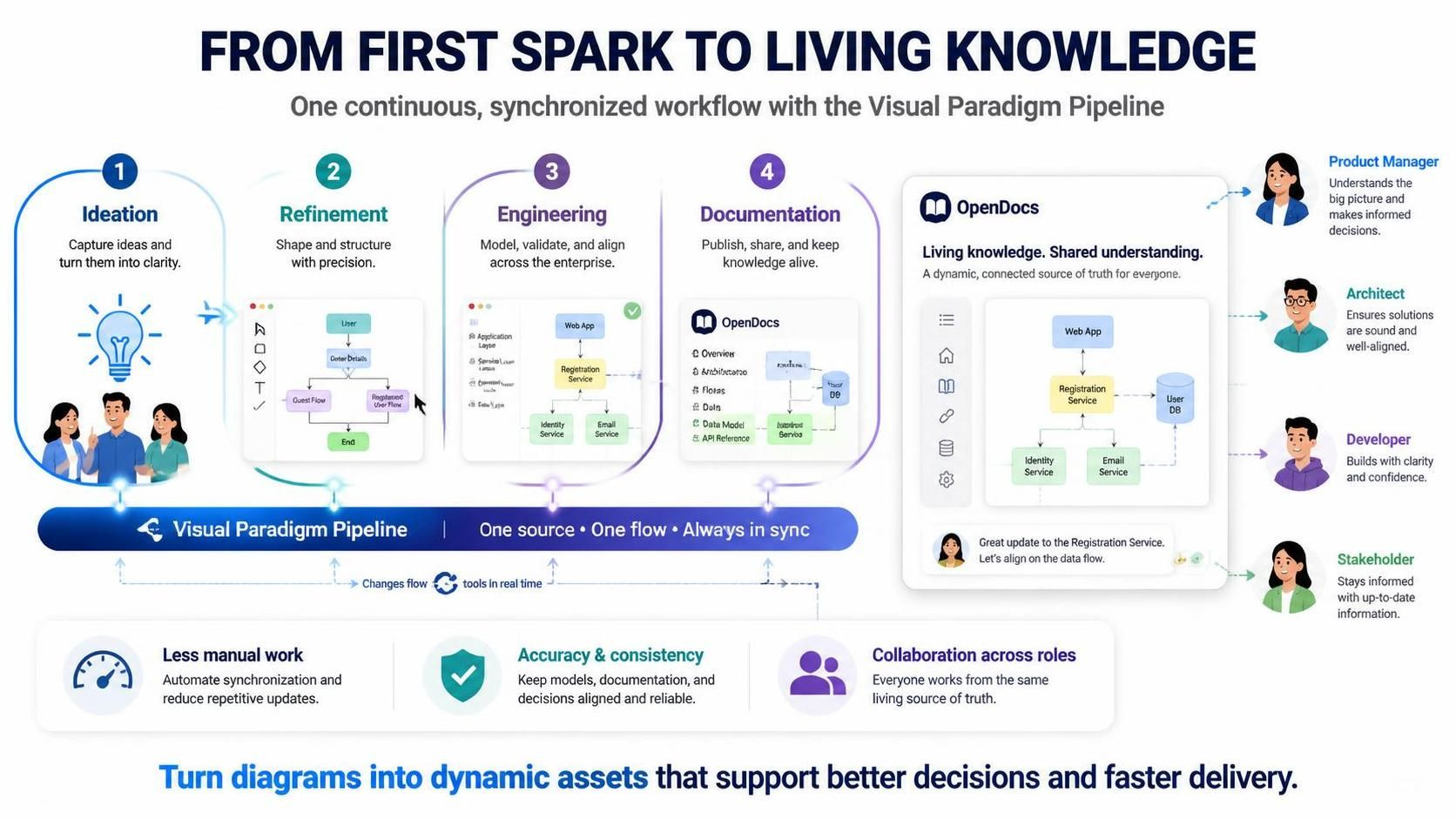
In the modern software development lifecycle, the gap between abstract ideas and executable code often leads to significant friction. Historically, diagrams were static artifacts created in isolation, requiring constant manual updates to stay relevant as the system evolved. Today, the paradigm has shifted towards “Living Knowledge”—a dynamic approach where diagrams serve as the central source of truth.
This tutorial explores the Visual Paradigm Pipeline, a transformative ecosystem designed to synchronize information from the initial spark of an idea to its final publication in OpenDocs. We will break down the four critical stages of this workflow: Ideation, Refinement, Engineering, and Documentation.
Stage 1: Ideation – Capturing the Spark
The journey begins in the Ideation phase. This is the “first spark” where concepts are raw and fluid. The goal here is not to build a complex database schema, but to capture ideas and turn them into clarity.
- The Goal: Transform abstract brainstorming into a structured concept.
- The Action: Teams capture high-level flows. In the Visual Paradigm ecosystem, this might involve sketching a basic context diagram or a simple user flow.
- The Value: By digitizing this early, teams ensure that the initial intent is preserved before it gets lost in translation.
Stage 2: Refinement – Shaping with Precision
Once an idea is captured, it moves to the Refinement phase. This stage focuses on “shaping and structuring with precision.” The raw concept is transformed into a detailed model.
In this stage, the workflow typically involves:
- Defining the Structure: Breaking down the user flow into specific components, such as “Guest Flow” and “Registered User Flow,” as seen in the workflow visualization.
- Adding Detail: Applying precise notation to ensure that logic is unambiguous. This is where the “spark” becomes a “blueprint.”
- Iterative Feedback: Refinement is rarely a linear path. The pipeline allows for rapid iteration, ensuring that the model remains aligned with the evolving requirements.
Stage 3: Engineering – Modeling and Validation
The Engineering phase is where the model becomes functional. This stage is about “modeling, validating, and aligning across the enterprise.” It bridges the gap between the design team and the development team.
Here, the abstract model is translated into technical specifications. The system validates the architecture against best practices. For example, a web application model is refined to ensure the “Registration Service” and “Identity Service” are correctly defined. This ensures that the code written by developers matches the architectural intent exactly.
The Engineering Workflow
The pipeline ensures that the engineering phase is not siloed. It utilizes a “One source • One flow • Always in sync” approach. This means that any change made in the model is immediately reflected in the engineering context, reducing the risk of version control errors.
Stage 4: Documentation – Publishing Living Knowledge
The final stage is Documentation, where the “Living Knowledge” is published. This is the transition from a technical model to a shared understanding for the entire organization.
The system publishes to OpenDocs, a dynamic platform that serves as a connected source of truth. Unlike traditional PDF documentation, OpenDocs allows stakeholders to interact with the data. If the model changes, the documentation updates instantly, ensuring that everyone—from Product Managers to Stakeholders—is looking at the same, up-to-date information.
Collaboration Across Roles
This pipeline is designed to facilitate collaboration across diverse roles:
- Product Managers: Understand the big picture and make informed decisions based on the latest data.
- Architects: Ensure solutions are sound and well-aligned with enterprise standards.
- Developers: Build with clarity and confidence, knowing the requirements are accurate.
- Stakeholders: Stay informed with up-to-date information without needing technical expertise.
Conclusion: Transforming Static Artifacts
The Visual Paradigm Pipeline represents a fundamental shift in how teams approach system architecture. By automating synchronization and reducing repetitive updates, it allows teams to focus on what matters most: decision-making and delivery. The result is a workflow where diagrams are no longer static documents, but dynamic assets that drive better outcomes.