

In the landscape of software development, a persistent challenge often arises not from the inability to write code, but from the inability to model the problem correctly. This is where Object-Oriented Thinking becomes the cornerstone of successful Object-Oriented Analysis and Design (OOAD). It is not merely a programming paradigm; it is a cognitive framework that shapes how we perceive complexity, structure data, and define behavior.
When developers approach a system with a procedural mindset, they often view data and functions as separate entities. Data flows from one function to another, changing state along the way. In contrast, object-oriented thinking encapsulates data and behavior together. This shift creates a model that mirrors the real-world systems we aim to represent, leading to more intuitive, maintainable, and robust architectures.
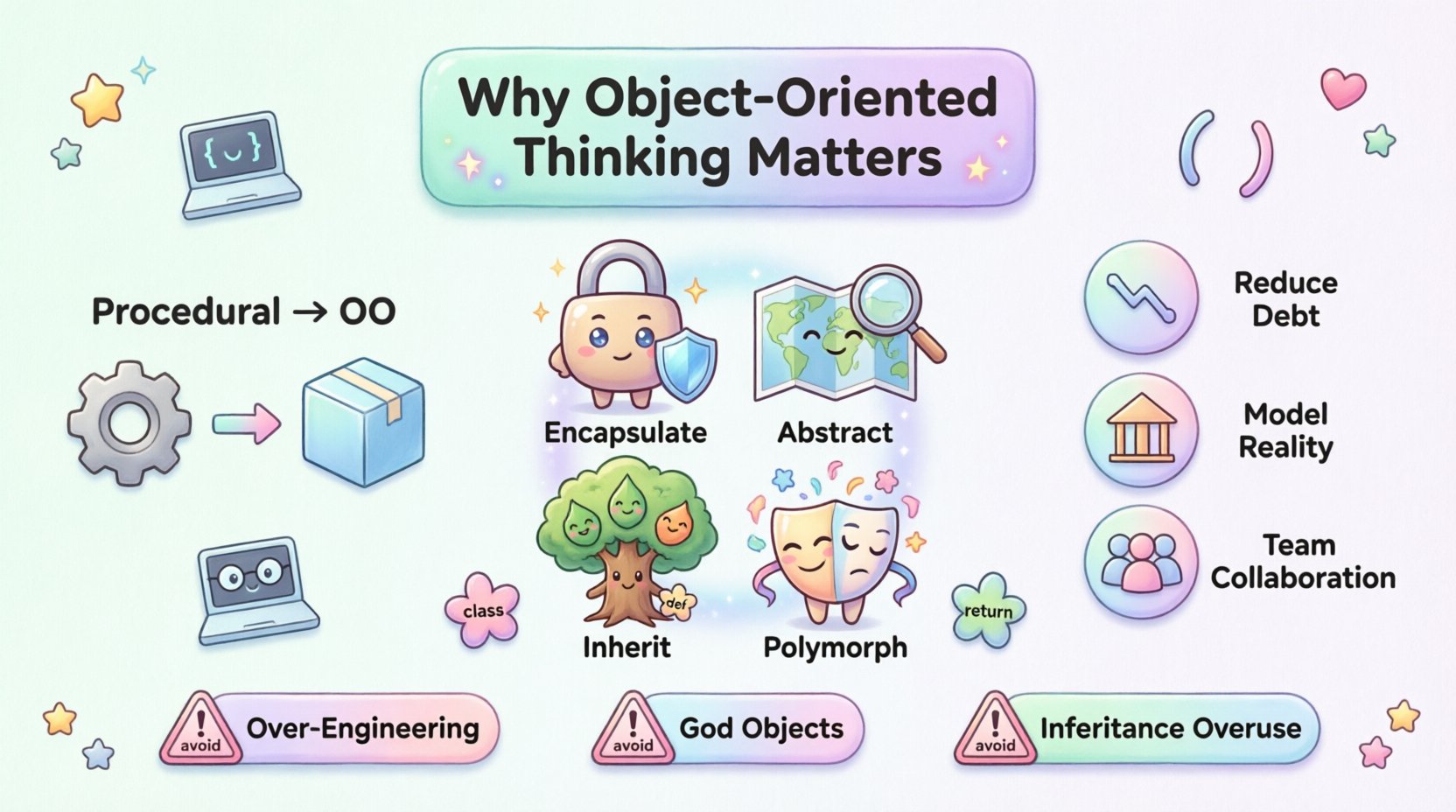
The Cognitive Shift: From Process to Entity ⚙️➡️📦
Traditional procedural programming focuses on the what to do. It lists steps: read input, calculate, write output. While effective for simple scripts, this approach fractures under the weight of complex business logic. Object-oriented thinking focuses on the who and the what it does.
- Procedural View: A function named
processOrdertakes customer data and calculates tax. - Object-Oriented View: An
Orderobject receives acalculateTaxmessage. It knows its own tax rules and state.
This distinction is vital for OOAD. When you analyze a system, you are identifying entities (nouns) and their interactions (verbs). By thinking in objects, you reduce the cognitive load required to understand the system’s flow. You stop tracing lines of code and start tracing the lifecycle of an entity.
The Four Pillars in Analysis and Design 🏛️
While often taught as coding concepts, these principles are fundamentally about design and modeling. Understanding them deeply allows architects to create systems that are easier to extend without breaking existing functionality.
1. Encapsulation: Controlling Complexity 🔒
Encapsulation is not just about hiding data. It is about defining boundaries. In analysis, it means identifying what information an entity owns and what it shares.
- Benefit: Prevents external code from relying on internal implementation details.
- Design Implication: If you change how a
BankAccountcalculates interest, the rest of the system remains unaware, provided the interface remains stable. - Thinking Pattern: “Does this object need to know how to calculate this, or should it delegate?”
2. Abstraction: Simplifying Reality 🗺️
Abstraction allows us to ignore irrelevant details and focus on essential characteristics. In OOAD, we use interfaces and abstract classes to define contracts without dictating implementation.
- Benefit: Decouples the client from the specific implementation.
- Design Implication: The
NotificationSystemdoes not need to know if a message is sent viaEmailorSMS. It only knows to send aNotification. - Thinking Pattern: “What is the minimal set of properties required for this interaction to occur?”
3. Inheritance: Modeling Hierarchies 🌳
Inheritance allows new classes to be derived from existing ones, promoting code reuse and establishing a clear taxonomy. However, in analysis, it is often better to view this as a relationship of specialization.
- Benefit: Reduces duplication by grouping common behaviors.
- Design Implication: A
Vehicleclass defines basic properties (speed, weight), whileCarandTruckinherit and specialize. - Thinking Pattern: “Is this a type of that?” If yes, inheritance may be appropriate.
4. Polymorphism: Flexible Behavior 🎭
Polymorphism allows objects of different types to be treated through a common interface. This is crucial for handling diverse scenarios without conditional logic bloating the code.
- Benefit: Enables open/closed design (open for extension, closed for modification).
- Design Implication: A
rendermethod behaves differently forTextversusImageobjects, but the caller simply invokesrender(). - Thinking Pattern: “Can I handle this variation uniformly without checking the type?”
Procedural vs. Object-Oriented Design ⚖️
To understand the impact of this thinking style, we must compare it against traditional procedural approaches. The table below highlights the differences in structure and maintenance.
| Aspect | Procedural Approach | Object-Oriented Approach |
|---|---|---|
| Data Handling | Data is global or passed through many functions. | Data is bundled with methods that operate on it. |
| Dependency | High coupling between functions and data. | Low coupling through interfaces and encapsulation. |
| Extensibility | Adding new features often requires changing existing code. | Adding new features often involves adding new classes. |
| Maintenance | Harder to trace state changes across function calls. | Easier to trace state within object lifecycle. |
| Testing | Requires setting up global state for function tests. | Objects can be instantiated and tested in isolation. |
Reducing Technical Debt 📉
One of the most significant benefits of adopting object-oriented thinking is the mitigation of technical debt. Technical debt accumulates when code becomes difficult to understand, modify, or extend without introducing new bugs.
1. Predictable State Changes
In procedural systems, a single variable can be modified by dozens of functions. Tracking the source of a bug requires searching through the entire codebase. In object-oriented systems, state changes are localized to the specific object. This makes debugging significantly faster and less invasive.
2. Clearer Contracts
Interfaces act as documentation. When a developer sees a method signature, they understand the expected input and output without reading the implementation. This clarity reduces the time required for onboarding new team members.
3. Isolation of Change
When requirements change, object-oriented thinking encourages creating new objects to handle the new logic rather than modifying existing ones. This adherence to the Open/Closed Principle ensures that stable code remains stable.
Modeling Real-World Systems 🏗️
The core strength of OOAD lies in its ability to map software structures to domain concepts. This is often referred to as Domain-Driven Design (DDD) alignment.
- Ubiquitous Language: The names of classes and methods should match the business vocabulary. If the business talks about
Shipment, the code should have aShipmentobject, notDataContainer3. - Aggregate Boundaries: Identifying which objects belong together ensures data consistency. For example, an
Orderand itsOrderItemsshould be managed as a single unit of consistency. - Value Objects: Distinguishing between entities (identified by ID) and value objects (identified by properties) helps in modeling immutable data correctly.
This modeling discipline prevents the “Anemic Domain Model” anti-pattern, where objects are reduced to mere data containers with no logic. By thinking in objects, we ensure that the behavior of the business rules lives alongside the data it governs.
Common Pitfalls to Avoid ⚠️
While powerful, object-oriented thinking can be misapplied. Understanding the limitations is just as important as understanding the benefits.
1. Over-Engineering
Creating deep hierarchies for simple problems adds unnecessary complexity. Not every class needs to be abstract. Sometimes, a simple function is better than a complex interface.
2. God Objects
An object that knows too much or does too much violates the Single Responsibility Principle. If an UserManager also handles database connections and email sending, it becomes difficult to test and maintain.
3. Inheritance Overuse
Inheritance creates tight coupling. If you need to change the parent class, all children are affected. Composition (having an object contain other objects) is often a more flexible alternative to inheritance.
4. Ignoring Domain Logic
Placing all logic in the database or in the presentation layer defeats the purpose of OOAD. The business rules must reside within the domain objects to ensure consistency.
The Impact on Team Collaboration 👥
Software development is a team sport. Object-oriented thinking standardizes how team members communicate about the system.
- Modularity: Teams can work on different objects simultaneously with minimal merge conflicts, provided interfaces are agreed upon.
- Onboarding: New developers can understand the system by reading the class diagram and entity relationships rather than digging through procedural flow charts.
- Refactoring: It is safer to refactor code when behavior is encapsulated. You can change the internal logic of an object without breaking the callers.
Integration with OOAD Phases 🔄
Object-oriented thinking permeates every phase of the analysis and design lifecycle.
Analysis Phase
Focus on what the system does. Identify use cases and actors. Define the core entities required to support these use cases. Ask: “What data does this actor manipulate?”
Design Phase
Focus on how the system does it. Define the interfaces, relationships, and patterns. Decide on the granularity of objects. Ask: “How do these entities interact?”
Implementation Phase
Focus on coding the design. Ensure the code reflects the design models. Keep the implementation close to the domain model.
Final Thoughts on Architectural Maturity 🎓
Moving from procedural to object-oriented thinking is a journey of architectural maturity. It requires discipline to resist the temptation of quick fixes that bypass encapsulation. It demands a commitment to modeling the domain accurately rather than forcing the code to fit the data.
When you think in objects, you are not just writing code; you are building a digital twin of a business process. This alignment ensures that the software evolves as the business evolves. It reduces the friction between business requirements and technical implementation.
By prioritizing encapsulation, abstraction, inheritance, and polymorphism, you create systems that are resilient to change. You build a foundation where new features can be added without compromising stability. This is the true value of Object-Oriented Analysis and Design.
Embrace the object mindset. Model the problem, not just the solution. Let the structure of your code reflect the structure of the world you are solving for. This approach leads to software that is not just functional, but enduring.