

In the landscape of Object-Oriented Analysis and Design (OOAD), few mechanisms are as fundamental yet nuanced as generalization hierarchies. These structures allow developers to model relationships between classes where one type inherits characteristics from another. By organizing software components into a tree-like structure, systems gain clarity, reusability, and a logical flow that mirrors real-world categorization. This article explores the mechanics, benefits, and pitfalls of implementing generalization hierarchies effectively.
Understanding the Core Concept 🧠
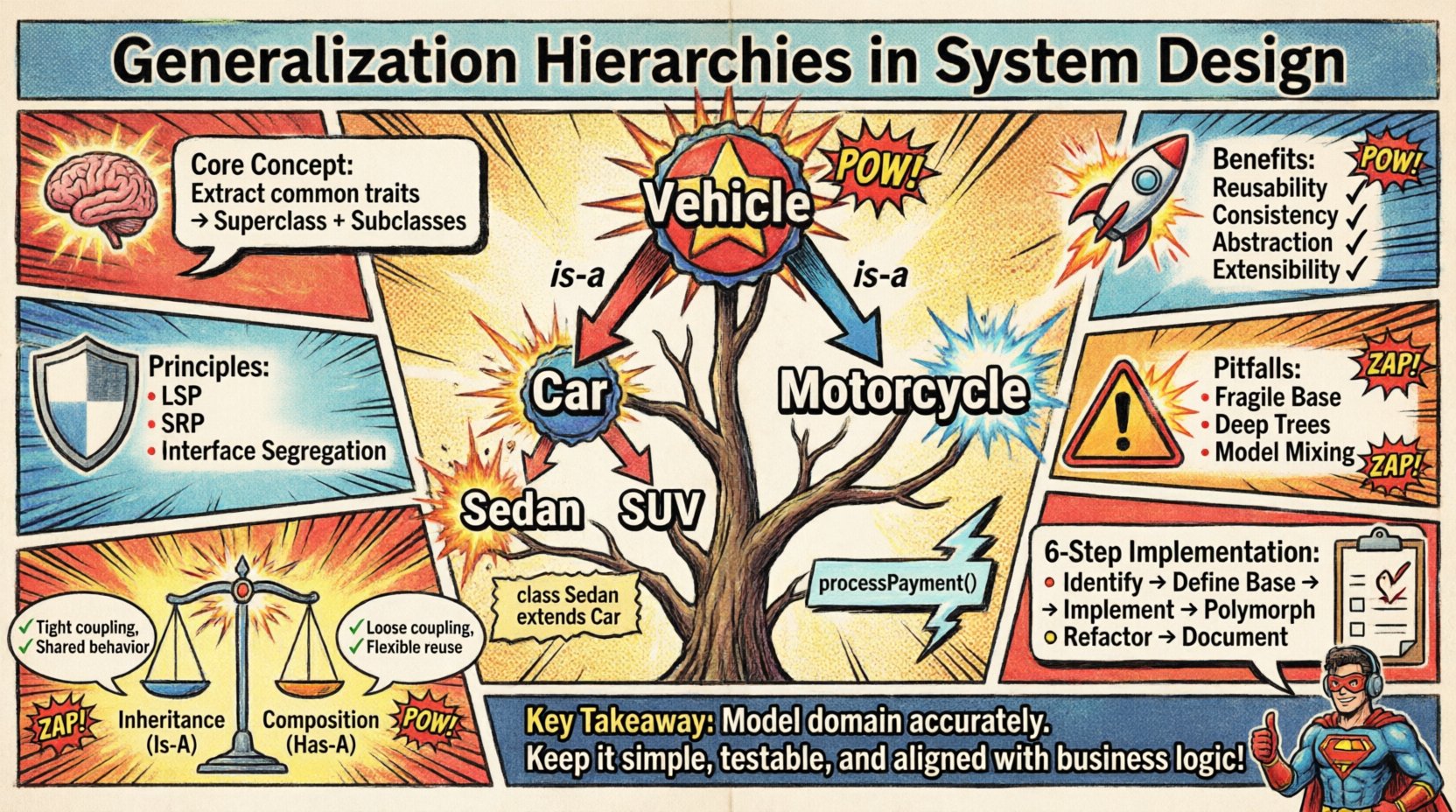
Generalization is the process of extracting common characteristics from a set of entities and grouping them under a superclass. The resulting entities are known as subclasses. This relationship is often described as an “is-a” relationship. For example, a Car is a Vehicle. A Sedan is a Car. This hierarchy allows the system to treat specific instances polymorphically.
When designing these hierarchies, the goal is to reduce redundancy. Instead of defining engineType, wheelCount, and speed in every single class, you define them once in the parent class. Subclasses automatically inherit these attributes unless they choose to override them.
Key Components of a Hierarchy
- Superclass (Base Class): The generalized type that contains shared attributes and methods.
- Subclass (Derived Class): The specialized type that inherits from the superclass and adds unique features.
- Inheritance: The mechanism by which the subclass acquires properties from the superclass.
- Polymorphism: The ability to treat objects of different subclasses as objects of the common superclass.
Why Use Generalization? 🚀
Implementing a well-structured hierarchy offers tangible advantages for maintainability and scalability. When a system grows, managing code duplication becomes a significant challenge. Generalization mitigates this through abstraction.
Primary Benefits
- Code Reusability: Common logic exists in one place. Changes propagate automatically to all subclasses.
- Consistency: Ensures that all derived types adhere to a common interface or behavior contract.
- Abstraction: Hides implementation details of the base class, allowing developers to focus on specific subclass functionality.
- Extensibility: New types can be added without modifying existing code, adhering to the Open/Closed Principle.
Designing the Hierarchy Structure 📐
Creating a hierarchy is not merely about grouping similar classes. It requires careful consideration of the depth and breadth of the tree. A flat hierarchy might be easier to understand, while a deep hierarchy can offer more granularity but risks fragility.
Levels of Abstraction
Consider a system modeling payment processing. You might start with a base class named PaymentMethod. Subclasses could include CreditCard, BankTransfer, and DigitalWallet. Each subclass implements a processPayment() method specific to its type, while the base class defines the contract.
- Level 1: Abstract concepts (e.g.,
EntityorComponent). - Level 2: Functional groups (e.g.,
PaymentMethod,ReportType). - Level 3: Specific implementations (e.g.,
CreditCard,InvoiceReport).
Limiting the number of levels prevents the hierarchy from becoming unwieldy. If you find yourself nesting classes deeper than three or four levels, it may be a signal to refactor.
Implementation Principles 🛡️
Simply writing inheritance code is not enough. Adhering to established design principles ensures that the hierarchy remains robust over time.
1. Liskov Substitution Principle (LSP)
This principle states that objects of a superclass shall be replaceable with objects of its subclasses without breaking the application. If a subclass changes the behavior of a method inherited from the parent in an unexpected way, it violates LSP.
- Violation Example: A
RectanglesubclassSquarewhere setting width changes height unexpectedly. - Correct Approach: Ensure behavior remains consistent. The subclass must honor the contract of the parent.
2. Single Responsibility Principle (SRP)
A class should have one reason to change. If a superclass accumulates too many responsibilities, subclasses inherit unnecessary complexity. Break down large classes into smaller, focused hierarchies.
3. Interface Segregation
Subclasses should not be forced to depend on methods they do not use. If a base class defines twenty methods but a subclass only needs five, consider using interfaces to define the specific contract for that subclass.
Common Pitfalls and Anti-Patterns ⚠️
While powerful, generalization hierarchies can lead to significant technical debt if misused. Recognizing these patterns early prevents future refactoring.
The Fragile Base Class Problem
When a base class changes, all subclasses may break. This is common when the base class holds implementation details rather than just an interface. Subclasses often rely on protected members or specific ordering of initialization.
- Solution: Favor composition over inheritance. Pass dependencies into the subclass rather than inheriting state.
- Solution: Use abstract classes for contracts and concrete classes for implementation.
Deep Hierarchies
A hierarchy with too many levels becomes difficult to debug. Tracing a method call through ten layers of inheritance obscures where logic actually resides.
- Solution: Flatten the hierarchy. Use mixins or traits where appropriate to share behavior without deep nesting.
- Solution: Review the domain model. Do all subclasses truly inherit from the same root?
Mixing Conceptual and Physical Models
Do not mix the conceptual model (what the domain is) with the physical model (how the database stores it). A BankAccount hierarchy might look different than a DBRecord hierarchy. Align your classes with domain logic first.
Comparison: Inheritance vs. Composition 🔄
One of the most debated topics in system design is whether to use inheritance or composition to achieve code reuse. While inheritance builds a “is-a” relationship, composition builds a “has-a” relationship.
| Feature | Inheritance | Composition |
|---|---|---|
| Relationship | Is-A (Strict hierarchy) | Has-A (Flexible usage) |
| Flexibility | Low (Compile-time binding) | High (Runtime flexibility) |
| Change Impact | High (Base change affects all) | Low (Swappable components) |
| Encapsulation | Weak (Protected members exposed) | Strong (Internal details hidden) |
| Use Case | True type relationships | Behavioral reuse |
For example, if you need a Car that has a Engine, composition is often better than inheriting Engine. However, if you need to treat all Engine types uniformly (e.g., ElectricEngine, GasEngine) within a Vehicle interface, inheritance might be appropriate.
Step-by-Step Implementation Guide 📝
Follow these steps to construct a robust generalization hierarchy without introducing unnecessary complexity.
- Identify Commonalities: Analyze the domain to find shared attributes and behaviors across entities.
- Define the Abstract Base: Create a class that defines the contract (interface) but may not implement all logic.
- Implement Concrete Classes: Create specific subclasses that implement the abstract methods.
- Apply Polymorphism: Write logic that accepts the base type but executes the subclass implementation dynamically.
- Refactor for Cohesion: Move functionality to the most appropriate level. If a method is only used by one subclass, move it there.
- Document Relationships: Clearly mark which methods are overridden and why.
Handling State and Initialization ⚙️
Managing state across a hierarchy requires discipline. The order of initialization matters. When a subclass constructor runs, the base class constructor runs first. This ensures the base state is ready before subclass logic executes.
However, calling virtual methods from constructors is dangerous. If the base class calls a method that is overridden in the subclass, the subclass implementation might run before the subclass is fully initialized. This can lead to null reference errors or inconsistent states.
- Rule: Avoid calling virtual methods in constructors.
- Rule: Initialize state in a dedicated
init()method called after construction. - Rule: Use final fields for constants that do not change during the lifecycle.
Advanced Patterns 🧩
As systems grow, standard inheritance may not suffice. Advanced patterns help manage complexity.
Mixins and Traits
When a class needs functionality from multiple unrelated sources, multiple inheritance can become messy (the “Diamond Problem”). Mixins or Traits allow a class to include specific methods without establishing a strict “is-a” relationship. This promotes horizontal reuse rather than vertical inheritance.
Abstract Factory
If your hierarchy involves creating families of related objects (e.g., UIComponents for Windows vs. UIComponents for Linux), use an Abstract Factory pattern. This encapsulates the creation logic behind the hierarchy, keeping the hierarchy clean and focused on behavior.
Testing Hierarchies 🧪
Testing inherited code requires specific strategies. You must test both the base class and the subclasses.
- Unit Tests: Test each subclass independently to ensure overrides work correctly.
- Integration Tests: Verify that the base class behaves correctly when used through the subclass interface.
- Regression Tests: Ensure that changes to the base class do not break existing subclasses.
Automated testing is critical here. Manual testing often misses edge cases introduced by polymorphism. Use mock objects to simulate the base class behavior when testing specific subclasses.
Final Considerations for Long-Term Maintenance 🔍
As the project evolves, the hierarchy will likely need adjustment. Documentation plays a vital role here. Every level of the hierarchy should have a comment explaining its purpose.
- Version Control: Track changes to the base class closely. Refactoring the parent is a high-risk operation.
- Code Reviews: Require extra scrutiny when adding new subclasses. Ensure they do not violate the Single Responsibility Principle.
- Deprecation: If a method in the base class is no longer used, deprecate it with a clear timeline for removal rather than deleting it immediately.
Generalization hierarchies are a cornerstone of object-oriented design. They provide structure and power when used correctly. However, they demand discipline. A well-architected hierarchy simplifies the system, while a poorly designed one creates a web of dependencies that is hard to untangle. By focusing on clarity, adherence to principles, and the strategic use of composition, developers can build systems that are both flexible and robust.
The goal is not to maximize the number of levels or the complexity of relationships. It is to model the domain accurately. When the code reflects the reality of the business logic, the hierarchy serves its purpose. Keep it simple, keep it testable, and keep it aligned with the core requirements of the system.