

In the complex ecosystem of system architecture and business process management, stability is paramount. Systems evolve. Requirements shift. New technologies emerge. Yet, without a fixed reference point, every modification risks introducing unintended consequences. This is where the Data Flow Diagram (DFD) baseline becomes essential. A baseline is not merely a snapshot; it is a contractual agreement on what a system currently does, serving as the foundation for measuring change impact. This guide explores the rigorous process of establishing, maintaining, and utilizing DFD baselines to manage change impact with precision.
Understanding the Role of Data Flow Diagrams 📊
A Data Flow Diagram visualizes how information moves through a system. It maps the interactions between processes, data stores, external entities, and data flows. Unlike a flowchart, which focuses on control logic, a DFD focuses on the movement and transformation of data. When a system is live, these diagrams represent the “truth” of the operational environment.
However, systems are rarely static. As organizations grow, the data entering, leaving, or transforming within the system changes. Without a controlled method to track these shifts, teams often find themselves navigating a maze of undocumented modifications. This leads to technical debt, security vulnerabilities, and operational inefficiencies. Establishing a baseline allows teams to distinguish between necessary evolution and accidental drift.
Why Baselines Are Critical for Change Management 🛡️
Change management is often viewed as a procedural hurdle. In reality, it is a risk mitigation strategy. When a stakeholder requests a new feature or a modification to an existing process, the question arises: “What breaks?” A DFD baseline answers this by providing the pre-change state against which the post-change state is compared.
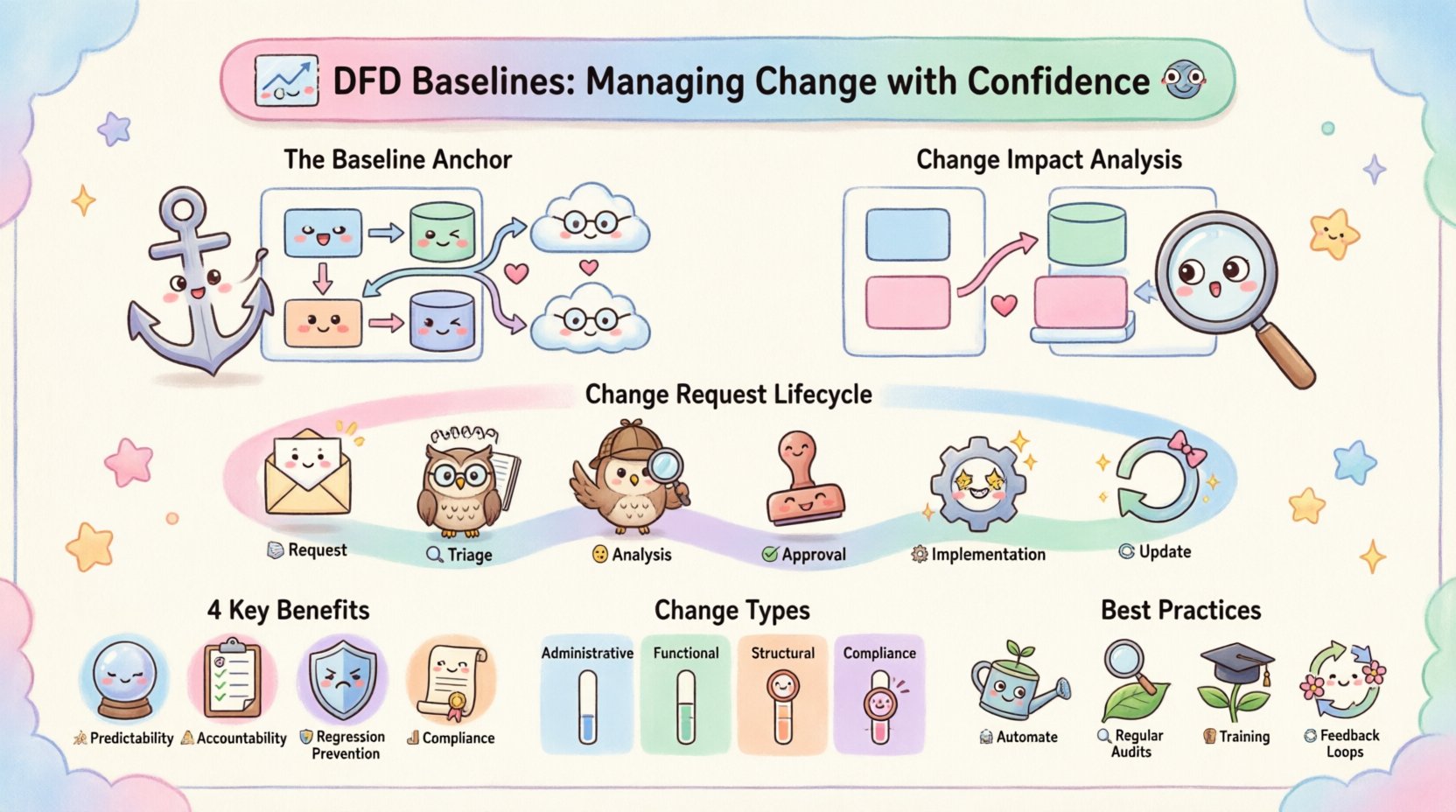
Consider the following benefits of maintaining strict DFD baselines:
- Predictability: Teams can forecast downstream effects of upstream changes.
- Accountability: There is a clear record of who authorized what change and when.
- Regression Prevention: Modifications can be tested against the original logic to ensure core functions remain intact.
- Compliance: Auditors require evidence of how systems have evolved over time.
Without these baselines, change becomes reactive rather than proactive. The organization spends resources fixing problems caused by undocumented changes rather than building new value.
Establishing the Initial Baseline 📝
Creating a baseline is a deliberate act. It requires agreement from key stakeholders that the current state of the DFD accurately reflects the system. This is not about perfection; it is about agreement.
Steps to Create a Baseline
- Inventory Existing Processes: Document every process currently active in the system. Ensure all data stores and external entities are accounted for.
- Validate Accuracy: Walk through the diagram with subject matter experts. Confirm that the data flows match actual system behavior.
- Version Control: Assign a unique version identifier to the diagram. This could be a semantic version (e.g., v1.0.0) or a date-based identifier.
- Formal Approval: Obtain sign-off from the governance board or project leads. This transforms the diagram from a draft to a baseline.
- Archiving: Store the approved diagram in a secure repository accessible to all relevant teams.
Once approved, this version becomes the “source of truth.” Any deviation requires a formal process to update the baseline.
The Change Request Lifecycle 🚨
When a change is proposed, it enters a structured lifecycle. This process ensures that no modification occurs without analysis. The lifecycle generally follows these stages:
- Request Submission: A stakeholder submits a request detailing the desired change.
- Initial Triage: Project managers determine if the request is feasible and aligns with strategic goals.
- Impact Analysis: This is the core phase where the DFD baseline is utilized.
- Approval/Denial: A decision is made based on the analysis.
- Implementation: Developers and analysts execute the approved changes.
- Baseline Update: The DFD is revised to reflect the new state.
Conducting Impact Analysis 🧐
Impact analysis is the act of determining how a specific change affects the broader system. Using the DFD baseline as a reference, analysts trace the flow of data to identify dependencies. This process is often more detailed than simple code review because it addresses business logic and data integrity.
When analyzing a change, consider the following dimensions:
- Data Integrity: Does the change alter the structure or content of data stored in the system?
- Process Logic: Does the sequence of operations change?
- External Interfaces: Does the change affect how the system talks to outside entities?
- Performance: Will the new flow introduce bottlenecks?
- Security: Does the change expose sensitive data to new risks?
Types of Changes and Their Impact
Not all changes carry the same weight. Categorizing changes helps prioritize resources. The table below outlines common change types and their typical impact levels.
| Change Type | Scope | Impact Level | Analysis Required |
|---|---|---|---|
| Administrative | Internal configuration or user roles | Low | Minimal review of affected data flows |
| Functional | New features or modified business rules | Medium | Full DFD comparison and regression testing |
| Structural | Database schema or infrastructure changes | High | Architectural review and stakeholder sign-off |
| Compliance | Regulatory or security mandates | Critical | Audit trail and legal review required |
Tracing Data Dependencies 🔗
The most powerful aspect of a DFD baseline is its ability to trace dependencies. When a change is proposed to a specific process, the baseline allows analysts to see where that data originates and where it goes next.
For example, if a process modifies customer address data, the baseline reveals:
- Which other processes read this address?
- Does this address flow into a reporting store?
- Are there external entities that receive this data?
This traceability prevents the “butterfly effect,” where a small change in one corner of the system causes a failure in another. By visualizing the flow, teams can identify these connections before implementation begins.
Updating the Baseline Post-Change 🔄
Once a change is implemented, the baseline must be updated. An outdated baseline is worse than no baseline at all, as it creates a false sense of security. The update process involves:
- Documenting the Delta: Clearly note what has changed from the previous version.
- Version Increment: Update the version number to reflect the new state.
- Communication: Notify all stakeholders of the change. This ensures everyone is working from the same understanding of the system.
- Validation: Ensure the updated diagram matches the deployed system.
This step closes the loop. It ensures that the documentation remains a living artifact that accurately represents the system.
Common Pitfalls in Baseline Management ⚠️
Even with a solid process, teams often stumble on common errors. Being aware of these pitfalls helps in avoiding them.
1. Over-Engineering the Baseline
A baseline does not need to capture every minute detail of the system. If the diagram is too granular, it becomes difficult to read and maintain. Focus on the logical flows that matter for decision-making and impact analysis. High-level diagrams often suffice for strategic changes.
2. Infrequent Updates
Waiting years to update a baseline renders it useless. Changes should be integrated into the baseline as they are deployed. Delaying updates creates a gap between reality and documentation.
3. Ignoring the “Why”
A baseline tracks the “what” and “how”. It does not always capture the “why”. However, context is vital for understanding impact. Always accompany the diagram with a brief rationale for the process design. This helps future teams understand the intent behind the data flows.
4. Lack of Access Control
Baselines should be protected from unauthorized edits. Only designated roles should be able to modify the baseline. This prevents accidental overwrites or unauthorized changes that could destabilize the system.
Communication Strategies for Change 📢
Technical changes often fail due to communication gaps. A DFD baseline is a communication tool. It translates complex system logic into a visual language that business stakeholders can understand.
When presenting change impact:
- Use Visuals: Show the “Before” and “After” diagrams side-by-side.
- Highlight Differences: Use color coding or annotations to mark the specific areas of change.
- Explain Risks: Clearly articulate what could go wrong if the change is not managed correctly.
- Define Scope: Explicitly state what is included and excluded from the change.
This transparency builds trust. Stakeholders are more likely to approve changes when they understand the implications clearly.
Integrating with Broader Governance Frameworks 🏛️
DFD baselines do not exist in a vacuum. They are part of a larger governance framework that includes configuration management, release management, and security protocols.
Alignment with these frameworks ensures consistency:
- Configuration Management: The DFD baseline should be treated as a configuration item. Changes to the diagram must follow the same change control procedures as code.
- Release Management: Baseline updates should be included in release notes. This ensures that deployment teams know the system architecture has shifted.
- Security Protocols: Any change affecting data flows must undergo a security review. The baseline helps identify data exposure risks.
The Cost of Inaction 💰
Why invest time in maintaining DFD baselines? The cost of ignoring them is often higher than the cost of maintaining them. Without baselines:
- Onboarding Time Increases: New team members struggle to understand the system without documentation.
- Bug Fixing Slows Down: Engineers spend excessive time tracing data flows manually.
- Integration Fails: Connecting with other systems becomes risky without clear interface definitions.
- Technical Debt Accumulates: Undocumented shortcuts and hacks pile up, making future changes impossible.
Investing in baseline management is an investment in long-term maintainability. It reduces the friction of change over time.
Best Practices for Sustainable Baseline Management 🌱
To ensure long-term success, adopt these best practices:
- Automate Where Possible: Use tools that can automatically generate diagrams from code or configuration files where applicable.
- Regular Audits: Schedule periodic reviews to ensure baselines match the current system state.
- Training: Ensure all team members understand how to read and interpret DFDs.
- Retention Policy: Define how long old baselines are kept. Some may be needed for historical reference or legal compliance.
- Feedback Loops: Encourage feedback from developers and analysts on the baseline process to improve it continuously.
Conclusion on Change Management 🏁
Managing change impact is not about stopping progress; it is about ensuring progress is sustainable. Data Flow Diagram baselines provide the necessary structure to navigate change with confidence. They transform uncertainty into measurable risk.
By establishing clear baselines, conducting thorough impact analyses, and maintaining open communication, organizations can evolve their systems without compromising stability. The effort required to maintain these baselines pays dividends in reduced errors, faster development cycles, and higher system reliability. In an environment where change is the only constant, the baseline is the anchor that keeps the ship on course.
Adopting this disciplined approach to DFD management is a strategic advantage. It signals a commitment to quality and transparency. As systems grow in complexity, the value of a well-maintained baseline grows exponentially. Start today by reviewing your current diagrams. Establish your baseline. Prepare for the future.