


Project management is a discipline often misunderstood by those outside the profession. Too often, decision-makers and teams operate under outdated assumptions that can hinder performance, waste resources, and frustrate stakeholders. The industry has evolved significantly over the last few decades, yet many core beliefs remain stuck in the past. Understanding the difference between fiction and fact is essential for building resilient teams and delivering value.
This guide explores the most persistent misconceptions surrounding project execution. By separating fact from fiction, you can adopt strategies that align with modern realities. We will examine common narratives, analyze why they persist, and provide the truth behind the noise. Whether you are managing a small team or overseeing large-scale initiatives, clarity is your most valuable asset. Let’s dive into the details.
1. Myth: Agile Means No Planning 📝
One of the most pervasive misunderstandings in the industry is the belief that adopting an agile approach eliminates the need for rigorous planning. This assumption suggests that flexibility equals a lack of structure. In reality, agile methodologies require a different *type* of planning, not less of it. The difference lies in the timing and the granularity of the work.
Traditional planning often attempts to predict every step months in advance. This works for construction or manufacturing where materials are fixed, but it fails in software or creative development where requirements shift. Agile planning is iterative. It focuses on the immediate future while maintaining a clear vision for the long term. Here is the reality:
High-Level Roadmaps: Teams still define the overall vision and major milestones months before execution begins.
Iterative Sprints: Detailed planning happens in short cycles, typically one to four weeks, allowing for adjustments based on feedback.
Backlog Refinement: Requirements are continuously groomed and clarified before work begins, ensuring clarity when the task starts.
Adaptability: Plans are treated as living documents. If market conditions change, the plan changes with them.
When teams skip planning entirely, they often end up with technical debt and misaligned expectations. Proper agile planning involves frequent collaboration between stakeholders and the delivery team to ensure alignment without over-constraining the process.
2. Myth: More Resources Mean Faster Completion ⏰
There is a common intuition that if a project is behind schedule, adding more people will fix it. This logic seems sound on the surface: more hands on deck should equal more progress. However, this concept ignores the complexity of human interaction and communication overhead. This myth is famously associated with Brooks’ Law.
Adding manpower to a late project often makes it later. The reasons are rooted in the time required for integration and communication. New team members need to be onboarded. They need to understand the context, the architecture, and the current state of the work. Existing team members must stop their current tasks to train the newcomers. This creates a temporary dip in productivity.
Consider the communication channels. If you have a team of five, there are ten possible communication paths. If you add one person, the number of paths jumps significantly. As the team grows, the complexity of coordination increases exponentially. Instead of blindly adding headcount, consider these alternatives:
Remove Blockers: Identify what is actually slowing the team down and eliminate those specific obstacles.
Optimize Processes: Review workflows to ensure there is no unnecessary friction or waiting time.
Focus on Quality: Sometimes, rushing leads to rework, which takes more time than doing it right the first time.
Scope Adjustment: If the deadline is immovable, negotiate a reduction in scope rather than stretching the team.
3. Myth: Scope Creep is Always Negative 📏
Many project managers are taught to treat any change to the scope as a failure. They view scope creep as a disease that must be cured immediately. While uncontrolled growth is detrimental, some scope expansion is a natural and healthy part of development. Projects are rarely static environments; they exist within a changing business landscape.
The goal is not to prevent *all* changes, but to manage them intentionally. Sometimes, a stakeholder discovers a better way to solve the problem mid-project. Ignoring this discovery because “the plan said no” is a missed opportunity. The issue arises when changes happen without assessment.
Effective scope management involves:
Impact Analysis: Before accepting a new request, evaluate the effect on time, budget, and quality.
Trade-off Decisions: If a new feature is added, something else must be removed or the timeline extended. This forces a conscious decision.
Change Control Board: A formal group reviews significant changes to ensure they align with strategic goals.
Transparency: Stakeholders must understand the cost of every change.
By distinguishing between malicious scope creep and beneficial evolution, teams can remain flexible without losing control.
4. Myth: Communication Requires Constant Meetings 🗣️
In an attempt to ensure alignment, some organizations schedule back-to-back meetings. The assumption is that if everyone is talking, everyone is informed. This approach leads to meeting fatigue and reduces the time available for actual work. Deep work is essential for complex problem-solving, and constant interruptions destroy focus.
Modern project management values asynchronous communication. This means sharing information when the receiver is ready, rather than demanding immediate attention. Tools like dashboards, documentation, and status reports allow team members to stay updated without sitting in a conference room.
A balanced communication strategy includes:
Defined Cadence: Hold meetings only when necessary, such as for decision-making or brainstorming.
Written Records: Decisions made in meetings should be documented and shared for reference.
Status Updates: Use automated tools or brief written reports to track progress without verbal updates.
Office Hours: Instead of all-hands meetings, designate specific times for questions and collaboration.
Respecting attention spans and allowing for uninterrupted work periods often leads to higher quality output than constant verbal coordination.
5. Myth: On-Time and On-Budget Equals Success 💰
Traditionally, success was measured strictly by whether a project finished within the allocated time and budget. While these constraints are important, they are not the only indicators of value. A project can be delivered on time and on budget but still fail to meet user needs or business objectives.
If a team builds exactly what was requested, but the market has moved on, the project has failed despite meeting the constraints. Success is better defined by value delivery and adoption. Did the solution solve the problem? Did it improve efficiency? Was it used by the intended audience?
Shift the focus to value-based metrics:
User Adoption: Are people actually using the deliverable?
Business Impact: Did the project generate revenue or reduce costs?
Customer Satisfaction: What is the feedback from the end users?
Team Health: Is the team sustainable, or are they burned out from the delivery pressure?
Rigid adherence to budget and schedule at the expense of value is a false victory. Flexibility in delivery ensures the final product actually serves its purpose.
6. Myth: The Project Manager is the Boss 👔
Historically, project managers were viewed as commanders who assigned tasks and enforced deadlines. This hierarchical view is outdated in modern knowledge work. Team members are professionals who possess deep expertise in their specific domains. The project manager’s role is to facilitate, remove obstacles, and enable the team to do their best work.
This is often referred to as servant leadership. The manager serves the team by ensuring they have the resources, information, and support they need. This approach fosters ownership and accountability within the team.
Key responsibilities of a facilitator include:
Shielding the Team: Protecting the group from external distractions and unnecessary interruptions.
Removing Blockers: Identifying impediments to progress and resolving them quickly.
Facilitating Collaboration: Ensuring the right people are talking to each other.
Coaching: Helping team members grow and improve their processes.
When the team feels empowered rather than managed, engagement and productivity tend to increase significantly.
7. Myth: Tools Fix Broken Processes 🛠️
Organizations often purchase expensive software suites hoping that the technology will solve their workflow problems. However, a tool cannot fix a broken process. If the underlying methodology is flawed, automating it simply results in faster execution of the wrong things.
Software should support a clear strategy, not replace it. Before implementing any system, organizations must define their workflows, roles, and communication protocols. The tool should be selected based on how well it fits the existing process, not the other way around.
Consider these steps before adopting new technology:
Map Current State: Understand how work actually gets done today.
Define Desired State: Determine what the workflow should look like for efficiency.
Identify Gaps: Find where the current process fails.
Select Support: Choose a tool that bridges the gap between the current and desired states.
Technology is an enabler, not a cure-all. Process improvement must come from human insight and organizational change management.
Summary of Myths vs. Reality
To make these concepts easier to recall, here is a summary table comparing common myths against the operational reality.
Myth | Reality |
|---|---|
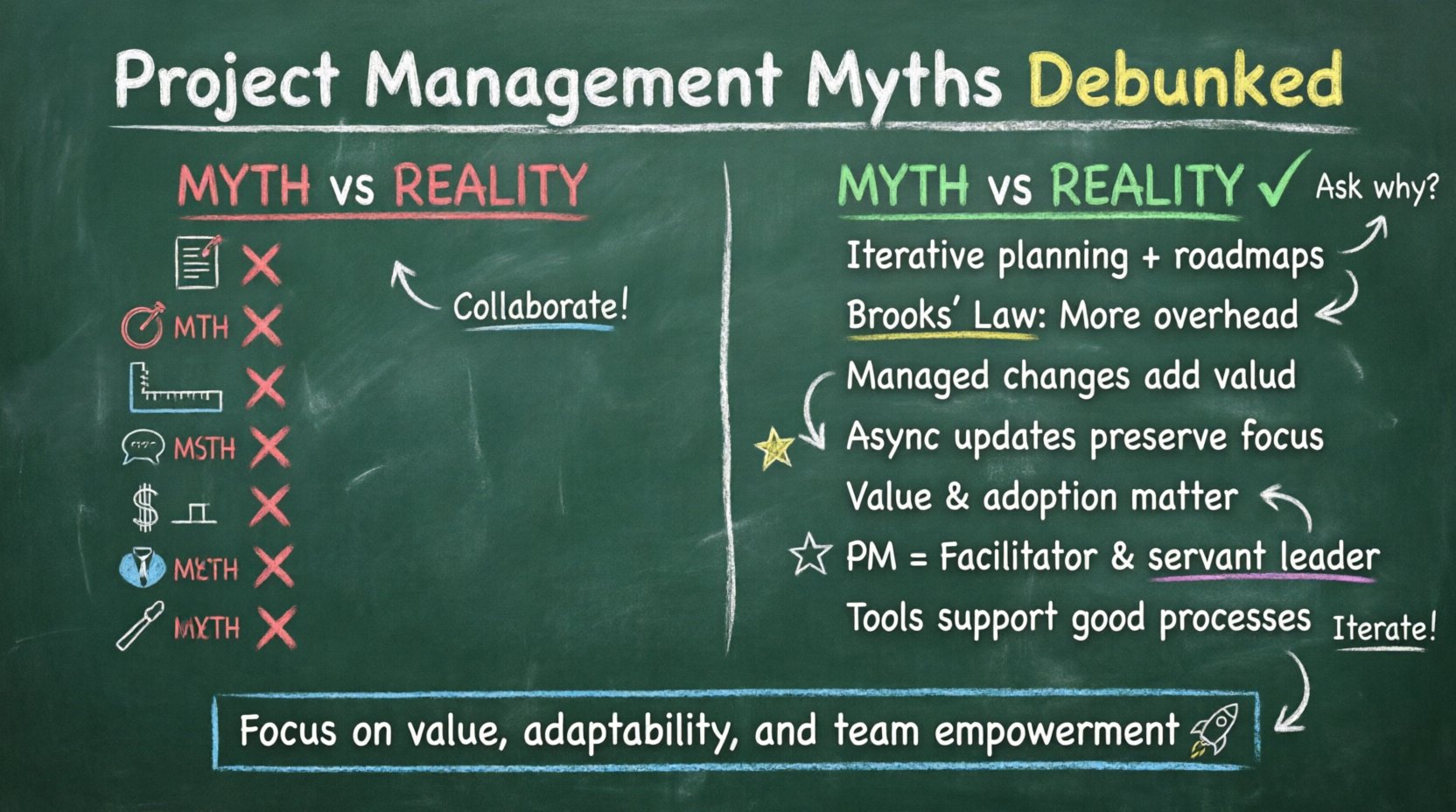
Agile means no planning. | Agile requires iterative, frequent planning. |
More people speed up work. | Adding people increases communication overhead (Brooks’ Law). |
Scope creep is always bad. | Managed changes can improve value and adaptability. |
Meetings are the best communication. | Asynchronous communication preserves deep work time. |
Success = On Time & On Budget. | Success = Value Delivery & User Adoption. |
PM is the team boss. | PM is a facilitator and servant leader. |
Tools fix processes. | Tools support defined processes; they do not create them. |
Final Thoughts on Project Management Truths 🚀
Adopting these truths requires a shift in mindset. It is not about abandoning structure, but about applying it with nuance. Projects are complex systems involving people, technology, and business goals. Rigid rules often fail to account for the dynamic nature of work.
By questioning the standard advice and focusing on evidence-based practices, teams can build more resilient workflows. The goal is to create an environment where work flows smoothly, stakeholders are informed, and value is delivered consistently. This requires continuous learning and a willingness to adapt as the landscape changes.
Remember that every project is unique. The best approach is often a hybrid one, blending the best of traditional planning with the flexibility of modern methods. Stay curious, stay adaptable, and focus on the outcome rather than just the output. With the right perspective, project management becomes a strategic advantage rather than a bureaucratic hurdle.
Related posts:
 Project Management 101: A Beginner’s Quick Start Guide to Leading Projects with Confidence
 What Project Managers Actually Do: A Real-World Component Breakdown for Aspiring Leaders
 The Project Management Lifecycle Explained: A Comprehensive Walkthrough from Start to Finish
 7 Common Project Management Mistakes That Derail Teams (And How to Avoid Them)