


In the fast-paced world of project management, time is the most scarce resource. Teams often find themselves trapped in meetings that consume hours without delivering tangible progress. The daily stand-up meeting is a specific mechanism designed to counter this trend. It is a ritual, not a status report. Its purpose is synchronization, transparency, and alignment. When executed correctly, it serves as the heartbeat of an agile workflow, ensuring every team member knows where the project stands and what obstacles lie ahead.
Many organizations struggle to make this practice stick. They turn it into a management reporting session or a place where deep technical debates derail the schedule. This guide explores the true function of the daily stand-up, how to structure it for maximum efficiency, and the common mistakes that undermine its value. We will look at the mechanics of effective team communication and how to maintain momentum without burnout.
What is a Daily Stand-Up? 💬
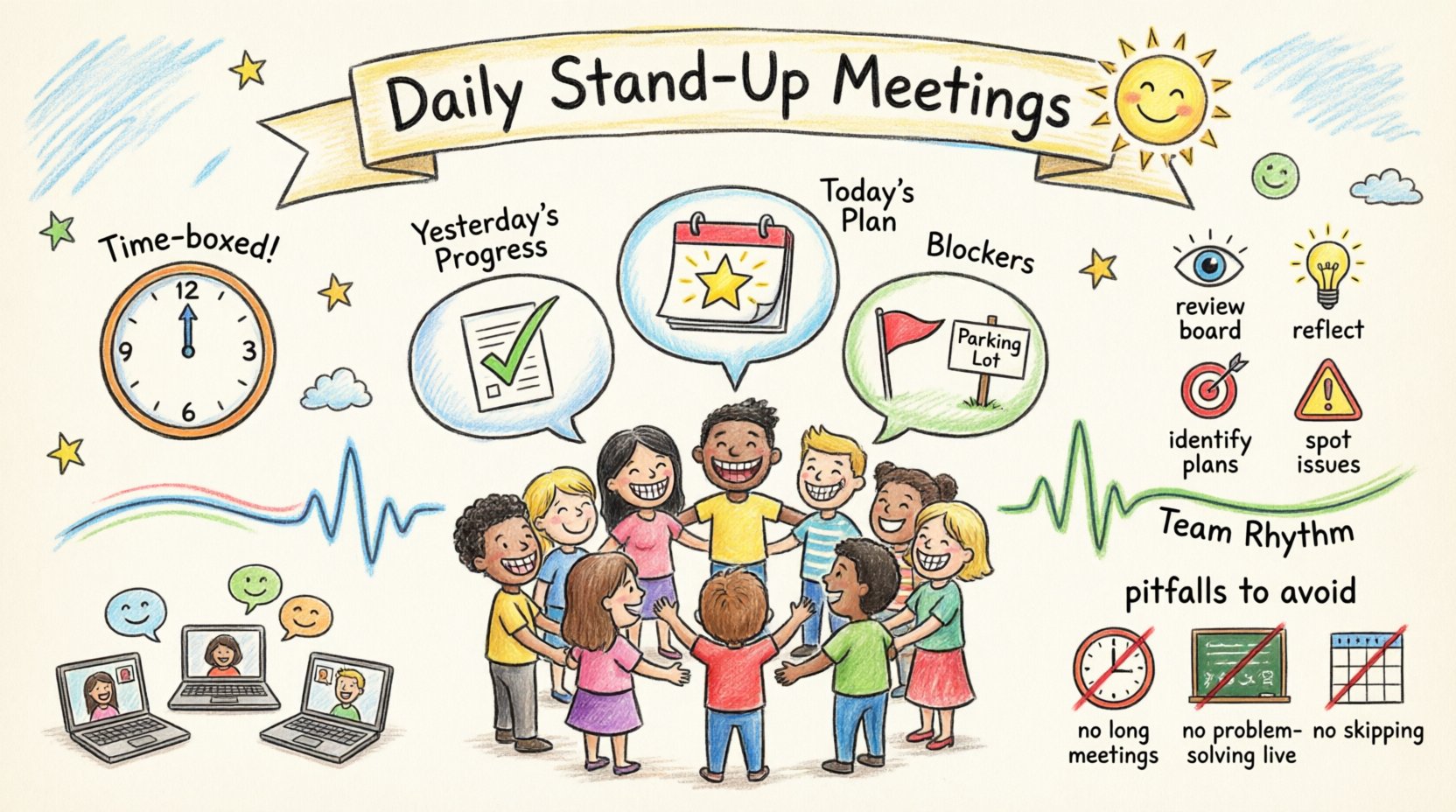
A daily stand-up, often referred to as a daily scrum, is a short, time-boxed meeting held by the development team. The term “stand-up” implies that participants should remain standing, which physically discourages the meeting from dragging on. The primary goal is not to solve problems in the meeting, but to identify them and schedule time for resolution elsewhere.
It is distinct from a status update. In a status update, a manager asks for information. In a stand-up, the team members share information with each other to coordinate their work for the day. It is a collaborative event, not a hierarchical one.
Key Characteristics:
Frequency: Every working day, usually at the same time.
Duration: Typically 15 minutes maximum.
Participants: The development team and the Scrum Master. Product Owners may attend if they need clarity, but they do not drive the discussion.
Location: A dedicated space, whether physical or virtual.
The Core Objectives 🎯
Why do teams dedicate time to this specific ritual? It is not just about ticking a box in a project plan. There are psychological and operational reasons for holding these sessions.
1. Transparency and Visibility
Every member of the team needs to know what others are working on. If Developer A is waiting on Designer B, Designer B needs to know that immediately. This visibility prevents silos where work gets stuck because someone forgot to communicate a delay.
2. Identifying Blockers
The most critical function of the meeting is surfacing impediments. If a team member cannot proceed due to a technical dependency, a missing resource, or an unclear requirement, this is the moment to raise it. The goal is to remove the blocker as quickly as possible, not to discuss the solution in front of the whole group.
3. Re-commitment to Goals
Teams often drift from their sprint goals. A daily check-in reminds everyone of the current priority. It aligns individual tasks with the broader project objectives, ensuring that effort is directed where it matters most.
Preparing for the Meeting 🛠️
A successful stand-up begins before the clock starts ticking. Preparation reduces the cognitive load during the meeting itself. When team members come prepared, the meeting stays within the time limit and focuses on coordination rather than information gathering.
Pre-Meeting Checklist
Review the Board: Look at the current task board or backlog. Know what items are in progress and what is next.
Reflect on Progress: Have a clear answer on what was accomplished since the last meeting.
Identify Plans: Know what specific tasks you intend to tackle today.
Spot Issues: Have any blockers ready to share? Do not wait until the meeting to think about them.
When participants arrive without preparation, the meeting often turns into a brainstorming session to figure out what everyone is doing. This wastes valuable time and frustrates attendees.
Running the Meeting: The Standard Format 📜
The most common structure involves three specific questions. While some teams adapt this, the core intent remains the same: yesterday, today, and blockers. This structure keeps the conversation focused and prevents rambling.
1. What did I do yesterday?
This establishes context. It is not a detailed report of every line of code written or every email sent. It is a summary of progress toward the goal. For example, “I completed the login API integration” is better than “I fixed a bug in the login function and then refactored the header.”
2. What will I do today?
This sets the expectation for the day. It helps the team understand who is working on what. If two people are working on the same component, they can coordinate to avoid conflicts. It also allows others to offer help if a task looks overwhelming.
3. Are there any blockers?
This is the most important question. If the answer is no, the meeting moves on. If the answer is yes, note it down and move on. Do not solve it now. Schedule a separate time with the relevant people to discuss the solution.
Roles and Responsibilities 👥
Clear roles ensure the meeting stays on track. While everyone participates, the facilitation duties are usually specific.
Role | Responsibility | Key Action |
|---|---|---|
Team Member | Report status and blockers | Speak clearly and concisely |
Facilitator | Keep time and focus | Interrupt tangents politely |
Scrum Master | Remove impediments | Follow up on blockers post-meeting |
Product Owner | Clarify requirements | Answer questions if asked |
The facilitator does not necessarily have to be the Scrum Master. In some teams, the role rotates to encourage ownership. The goal is to ensure no single person dominates the conversation.
Handling Blockers and Issues ⚠️
When a blocker is raised, the natural instinct is to solve it immediately. This is the most common trap. If you start debugging a code issue or debating a design choice during the stand-up, the meeting will exceed its time limit. Other team members lose focus, and the meeting loses its value.
The “Parking Lot” Technique
If a discussion arises, move it to a “parking lot.” This means noting the topic for later discussion. For example: “This looks like a dependency issue. Let’s talk about this after the meeting with the backend lead.”
This approach respects the time of the whole group while ensuring the issue is still addressed. The facilitator should ensure these parking lot items are actually discussed later.
Remote and Distributed Teams 🌍
Modern project management often involves remote workers. The principles of the stand-up remain the same, but the medium changes. Video conferencing tools introduce latency and distractions that do not exist in a physical room.
Virtual Best Practices
Camera On: Seeing faces helps build rapport and keeps people engaged. It reduces the feeling of isolation.
Mute When Not Speaking: Background noise disrupts the flow. Ensure everyone mics are muted unless they are talking.
Visual Board: Share your screen with the task board. Everyone needs to see the same view to avoid confusion about task status.
Chat Option: Some teams prefer typing updates in a chat channel if video is unreliable. This allows for an async stand-up.
Time Zones
If the team spans multiple time zones, a single synchronous meeting might be impossible. In this case, consider an asynchronous approach. Team members post their updates in a shared channel by a specific time. This ensures everyone can read updates at their convenience without forcing someone to wake up at 3 AM.
Common Pitfalls to Avoid 🚫
Even with the best intentions, teams can drift into habits that make the stand-up ineffective. Recognizing these patterns is the first step to fixing them.
Pitfall | Impact | Correction |
|---|---|---|
Management Reporting | Team feels watched, not supported | Focus on peer-to-peer sync, not manager updates |
Too Long | Loss of focus, fatigue | Enforce the 15-minute time box strictly |
Solving Problems Live | Wasted time for others | Move discussions to a breakout session |
Skipping Days | Loss of rhythm and momentum | Treat the meeting as a non-negotiable ritual |
Passive Silence | Unclear status | Encourage every member to speak |
Measuring Effectiveness 📊
How do you know if the stand-up is working? It is not about counting how many words were spoken. It is about the outcome of the day.
Velocity Stability: If the team consistently completes planned work, the coordination is likely working.
Blocker Resolution Time: If blockers are identified and removed quickly, the process is effective.
Team Sentiment: Do people feel energized or drained after the meeting? A good meeting should leave the team feeling aligned, not exhausted.
Attendance: Are people consistently present and prepared?
If the team feels the meeting is not adding value, they should pause and review the format. Agile methodologies are designed to be adaptable. If the stand-up is no longer serving the team, it is acceptable to change it.
Adapting the Process 🔄
No two teams are identical. A software development team might have different needs than a marketing team. The framework should serve the people, not the other way around.
Walking the Board
Some teams prefer to physically walk around the task board or move sticky notes as they speak. This visual cue helps everyone track the flow of work. It adds a kinetic element that can break the monotony of standing in a circle.
Circle of Communication
In a physical office, standing in a circle ensures everyone can see and hear everyone else. In a remote setting, the “circle” is the video grid. Ensure the layout is visible to all participants.
Frequency Adjustments
While “daily” is the standard, some teams find two meetings a week sufficient during stable phases. However, during high-intensity periods or critical releases, daily synchronization is usually required. Trust the team to decide the cadence that fits their workflow.
Final Thoughts on Team Alignment 🤝
The daily stand-up is a tool for collaboration. It is not a surveillance tool for management. When the team owns the meeting, they own the process. The goal is to create an environment where communication is open, obstacles are removed quickly, and the team moves forward with clarity.
Implementing these practices takes discipline. It requires a facilitator who is willing to be firm on time and a team willing to be concise. Over time, the habit forms, and the meeting becomes a natural part of the workday. The result is a smoother workflow, fewer misunderstandings, and a team that moves as a single unit.
Start by focusing on the basics. Keep it short. Keep it focused. Keep it human. The rest will follow.
Related posts:
 Project Management 101: A Beginner’s Quick Start Guide to Leading Projects with Confidence
 What Project Managers Actually Do: A Real-World Component Breakdown for Aspiring Leaders
 The Project Management Lifecycle Explained: A Comprehensive Walkthrough from Start to Finish
 7 Common Project Management Mistakes That Derail Teams (And How to Avoid Them)