


The landscape of project delivery is undergoing a seismic shift. For decades, the role was defined by rigid timelines, strict budgets, and the command-and-control mentality of the waterfall era. Today, aspiring leaders face a different horizon. It is a landscape where adaptability is the primary currency, and the ability to navigate ambiguity is more valuable than adherence to a static plan.
As we move forward, the question is no longer just about how to deliver a project on time, but how to deliver value in a world of rapid change. This guide explores the critical shifts defining the future of the discipline, offering a roadmap for those stepping into leadership roles. We will examine the evolution of methodologies, the integration of intelligence, the necessity of human connection, and the strategic alignment required to succeed.
🔄 The Evolution of Methodologies: Beyond Binary Choices
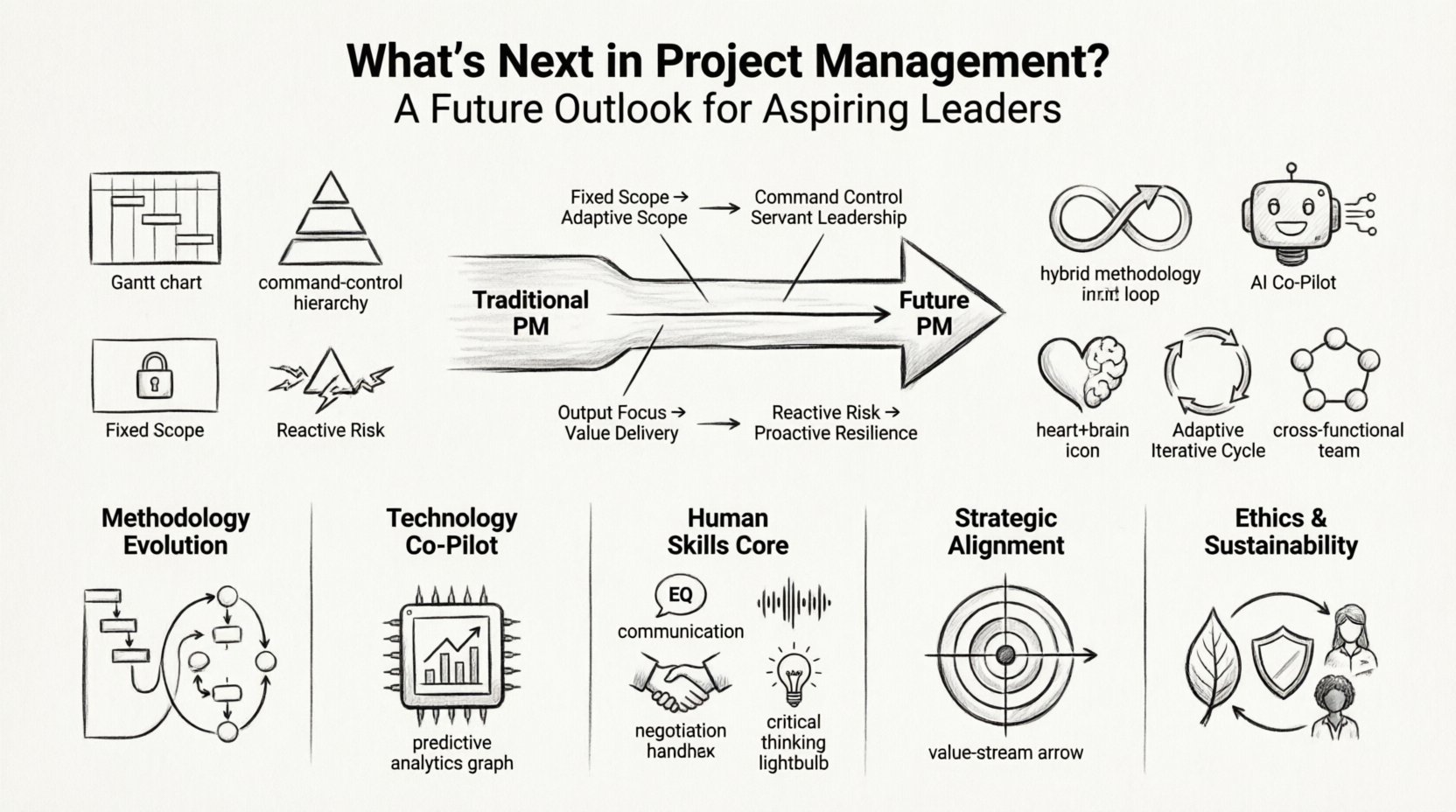
The debate between traditional and agile approaches is fading. In the future, leaders will not choose one over the other; they will synthesize them. The future is hybrid, adaptive, and context-dependent. Rigid adherence to a single framework often leads to friction when projects encounter real-world complexity.
Hybrid Frameworks: Combining the predictability of traditional planning with the flexibility of iterative delivery.
Outcome over Output: Shifting focus from “did we finish the tasks?” to “did we achieve the business goal?”
Fluid Governance: Moving away from gatekeeper committees to empowered teams with clear boundaries.
This shift requires a leader who can read the room and the data. Some initiatives require heavy upfront definition, while others need rapid prototyping. The modern professional must be versatile enough to apply the right structure at the right time.
🤖 Technology and Intelligence: The New Co-Pilot
Technology is not just a support function; it is a foundational element of modern delivery. However, the narrative is shifting from manual data entry to automated insights. Artificial intelligence is not replacing the project manager; it is removing the administrative burden to allow for strategic thinking.
Key Technological Shifts
Predictive Analytics: Using historical data to forecast risks before they materialize.
Automation of Routine: Automating status reporting, resource allocation, and schedule updates.
Data-Driven Decision Making: Relying on real-time metrics rather than gut feeling or delayed reports.
Collaboration Platforms: Centralized hubs that connect remote teams seamlessly across time zones.
When implementing new systems, the focus should remain on the human workflow. Technology should serve the team, not dictate it. The goal is to reduce cognitive load so that leaders can focus on problem-solving and stakeholder management.
🧠 The Human Element: Skills That Matter Most
As machines take over calculation and scheduling, the value of purely human skills increases. The future leader is part strategist, part psychologist, and part diplomat. Technical proficiency is the baseline; emotional intelligence is the differentiator.
Core Competencies for the Future
Emotional Intelligence (EQ): Understanding team dynamics, managing conflict, and recognizing burnout before it impacts delivery.
Negotiation and Influence: Securing resources without direct authority and managing stakeholder expectations.
Communication Clarity: Translating complex technical details into business value for executive sponsors.
Change Management: Guiding teams through transitions without losing momentum or morale.
Critical Thinking: Analyzing problems holistically rather than reacting to symptoms.
These skills cannot be automated. They require experience, empathy, and a genuine understanding of human behavior. A leader who masters these areas will find themselves indispensable, regardless of how advanced the technology becomes.
📊 Traditional vs. Future-Focused Project Management
To visualize the shift, consider the comparison below. This table highlights the transition from legacy expectations to modern requirements.
Dimension | Traditional Approach | Future Outlook |
|---|---|---|
Planning | Fixed scope defined at the start | Adaptive scope defined iteratively |
Leadership Style | Command and Control | Servant Leadership |
Success Metric | Budget and Schedule adherence | Value delivery and customer satisfaction |
Team Structure | Departmental silos | Cross-functional, autonomous squads |
Risk Management | Reactive mitigation | Proactive prevention and resilience |
Technology Role | Recording tool | Strategic enabler and analyst |
🌍 Strategic Alignment and Business Value
Project management is no longer a back-office function. It sits at the heart of organizational strategy. Leaders must understand the broader business context to prioritize effectively. A project that is delivered on time but does not generate value is a failure, regardless of the process followed.
Portfolio Management: Ensuring the right projects are selected to meet organizational goals.
Value Stream Mapping: Identifying where value is created and where waste occurs.
Stakeholder Engagement: Continuous dialogue to ensure alignment with shifting business needs.
ROI Focus: Measuring the return on investment throughout the lifecycle, not just at the end.
Aspiring leaders should position themselves as business partners. This involves asking “why” before asking “how.” It requires a deep dive into the financial and strategic implications of every decision made.
🛡️ Ethics, Sustainability, and Responsibility
The future of delivery includes a heavy emphasis on ethics and sustainability. Organizations are under scrutiny to ensure their projects do not harm the environment or society. This adds a new layer of complexity to planning and execution.
Environmental Impact: Considering the carbon footprint of project resources and delivery methods.
Data Privacy: Ensuring all information handling complies with regulations and ethical standards.
Inclusive Practices: Building teams and products that serve diverse populations.
Transparency: Being open about risks, delays, and resource usage.
Leaders must champion these values. They act as the conscience of the project, ensuring that efficiency does not come at the cost of integrity.
🛤️ Career Pathways and Growth
For those entering the field, the path is less linear. Specialization is valuable, but breadth is increasingly necessary. The generalist who understands technology, people, and strategy will thrive. Continuous learning is not optional; it is a requirement for longevity.
Steps to Prepare
Build a T-Shaped Skill Set: Deep expertise in one area, broad knowledge across many.
Seek Diverse Experiences: Work on different types of projects to build versatility.
Network Actively: Connect with peers and mentors to exchange knowledge.
Stay Curious: Read industry literature and stay updated on emerging trends.
Reflect and Iterate: Regularly review personal performance and adjust development plans.
The journey is ongoing. There is no final destination where one stops learning. The most successful professionals are those who remain students of their craft, constantly refining their approach based on new information and experiences.
🌟 Final Thoughts on the Horizon
The trajectory of the profession points toward a more integrated, intelligent, and human-centric practice. The tools will change, the methodologies will evolve, but the core mission remains the same: to bring order to chaos and create value for people.
Aspiring leaders should embrace the uncertainty. It is in the unknown that innovation happens. By focusing on skills that machines cannot replicate, maintaining a strategic mindset, and adhering to ethical standards, you will be well-positioned for the years ahead. The future belongs to those who can navigate change with confidence and purpose.
Start building these capabilities now. The demand for high-caliber leaders is growing, and the opportunity to shape the future of delivery is open to those ready to step up.
Related posts:
 Project Management 101: A Beginner’s Quick Start Guide to Leading Projects with Confidence
 What Project Managers Actually Do: A Real-World Component Breakdown for Aspiring Leaders
 The Project Management Lifecycle Explained: A Comprehensive Walkthrough from Start to Finish
 7 Common Project Management Mistakes That Derail Teams (And How to Avoid Them)