


Enterprise Architecture is often described as a complex web of interconnected systems, processes, and strategies. However, the true complexity lies not in the technology itself, but in the communication required to manage it. When a Chief Financial Officer speaks the language of ROI, and a Lead Developer speaks the language of microservices, the gap can become unbridgeable. This is where ArchiMate Viewpoints become essential. They serve as the structured lenses through which different parts of the organization can view the architecture without losing context or clarity.
Aligning diverse stakeholder perspectives is not about simplifying the truth; it is about presenting the truth in a way that is relevant to the observer. A Viewpoint defines the conventions for constructing and using a particular type of View. It specifies the audience, the concerns, and the modeling notations required to address those concerns effectively. By implementing a robust set of Viewpoints, organizations can ensure that every stakeholder sees the architecture in a manner that supports their decision-making process.
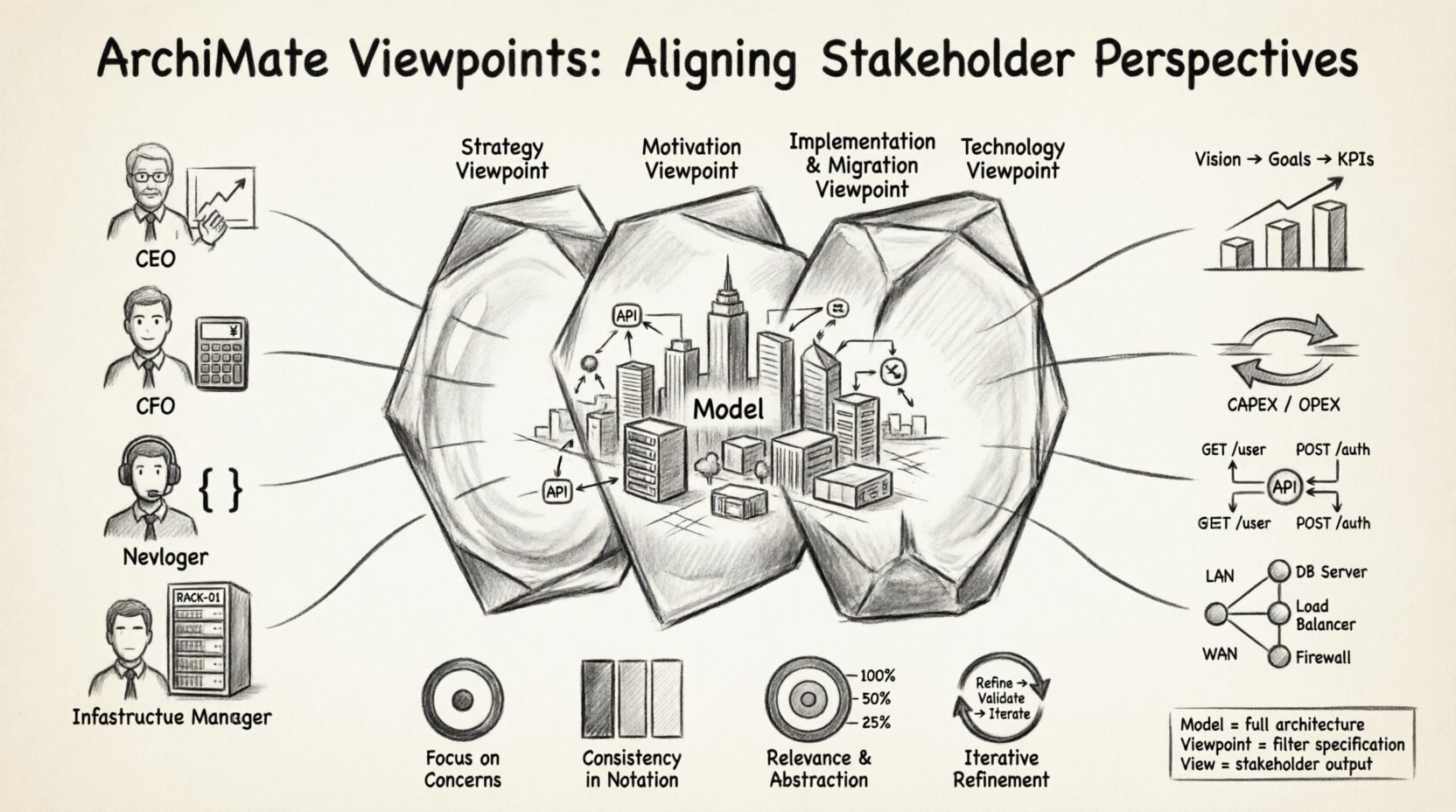
Understanding the Core Concepts: Viewpoint, View, and Model 🧩
To appreciate the function of a Viewpoint, one must distinguish it from related terms within the ArchiMate framework. These terms are often used interchangeably in casual conversation, but they hold distinct technical meanings that dictate how information is structured.
- Model: This is the comprehensive representation of the enterprise architecture. It contains all the information, concepts, and relationships. It is the single source of truth that holds the entire picture together.
- View: A View is a specific presentation of the Model. It is what a stakeholder actually sees on their screen or in a document. A View filters the Model to show only what is relevant to a specific concern.
- Viewpoint: The Viewpoint is the specification that defines how a View is created. It dictates the notation, the conventions, the scope, and the audience for that View.
Think of the Model as the raw data of a city. The View is the map you hold while driving. The Viewpoint is the legend and scale used to create that map. Without the Viewpoint, the map might show everything, making it impossible to read, or it might show nothing relevant to the driver. The Viewpoint ensures the map is useful for the specific task at hand.
Identifying and Mapping Stakeholder Concerns 📊
The first step in designing effective Viewpoints is identifying who the stakeholders are and what they care about. Different roles within an organization have different mandates, risks, and goals. A successful architecture practice maps these concerns to specific Viewpoints.
| Stakeholder Role | Primary Concerns | Recommended Viewpoint Focus |
|---|---|---|
| Chief Executive Officer (CEO) | Strategic alignment, market position, long-term viability | Strategy and Implementation Viewpoint |
| Chief Financial Officer (CFO) | Cost efficiency, investment returns, budget allocation | Business Capability and Cost Viewpoint |
| Business Process Owner | Process efficiency, handoffs, customer experience | Business Process Viewpoint |
| Application Architect | System integration, data consistency, service interfaces | Application Interaction Viewpoint |
| Infrastructure Manager | Performance, availability, security, hardware resources | Technology Infrastructure Viewpoint |
| Compliance Officer | Regulatory adherence, audit trails, risk management | Security and Compliance Viewpoint |
By categorizing stakeholders this way, architects can avoid the common pitfall of creating a single, monolithic diagram that attempts to satisfy everyone. Instead, they create a suite of Viewpoints, each tailored to a specific group. This reduces cognitive load for the stakeholder and increases the likelihood that the architecture will be understood and utilized.
Design Principles for Effective Viewpoints 🛠️
Creating a Viewpoint is an act of design. It requires discipline to ensure that the resulting Views are consistent, maintainable, and valuable. There are several principles that guide this process.
1. Focus on Concerns, Not Just Layers
ArchiMate is built on layers such as Business, Application, and Technology. However, a Viewpoint should not simply be defined by a single layer. A strategic Viewpoint might combine elements from the Business and Strategy layers to show how a business goal drives a specific capability. The Viewpoint should be defined by the question it answers, not just the layer it resides in.
2. Consistency in Notation
When a stakeholder receives a View, they need to understand the symbols immediately. If one Viewpoint uses a specific color for a Business Actor and another Viewpoint uses a different color for the same concept, confusion arises. Viewpoints must enforce strict rules regarding notation, color coding, and layout to ensure visual consistency across the architecture repository.
3. Relevance and Abstraction
A Viewpoint determines the level of abstraction. For a high-level executive, the Viewpoint should abstract away technical details like server names or database schemas. For a developer, the Viewpoint might require specific interface definitions. The Viewpoint must dictate the granularity of the information presented.
4. Iterative Refinement
Viewpoints are not static artifacts. They evolve as the organization changes. A Viewpoint that worked well five years ago might need adjustment if the business strategy shifts. Regular reviews of the Viewpoint definitions ensure they remain relevant to current stakeholder needs.
Standard Viewpoint Patterns and Applications 📌
While custom Viewpoints are often necessary, there are established patterns within the ArchiMate framework that serve as a starting point. Utilizing these standard patterns can accelerate the adoption of architecture practices.
The Strategy Viewpoint
This Viewpoint connects the external environment to internal capabilities. It typically includes elements from the Strategy and Business layers. It is used to show how business drivers influence the realization of business capabilities. It helps answer the question: “Why are we building this?”
- Key Elements: Goals, Principles, Drivers, Capabilities.
- Audience: Leadership, Strategy Teams.
The Business Process Viewpoint
This Viewpoint focuses on the flow of activities. It is crucial for understanding how value is delivered to customers. It maps the interactions between Business Actors and Business Functions.
- Key Elements: Processes, Actors, Services, Interactions.
- Audience: Process Owners, Operations Managers.
The Application Interaction Viewpoint
For technical teams, understanding how applications communicate is vital. This Viewpoint shows the interfaces and data flows between Application Components. It helps identify integration points and dependencies.
- Key Elements: Application Components, Interfaces, Data Objects.
- Audience: Software Architects, Developers.
The Technology Infrastructure Viewpoint
This Viewpoint details the physical and logical infrastructure required to run the applications. It includes nodes, devices, and communication paths.
- Key Elements: Nodes, Devices, System Software, Networks.
- Audience: Infrastructure Managers, DevOps Teams.
Implementation Challenges and Solutions 🚧
Implementing a Viewpoint strategy is not without its difficulties. Organizations often encounter resistance or confusion during the rollout. Understanding these challenges allows for proactive mitigation.
Challenge: Analysis Paralysis
Architects may spend too much time designing perfect Viewpoints before any value is delivered. This can stall progress.
- Solution: Adopt a pragmatic approach. Start with the most critical stakeholder groups. Deliver value quickly, then refine the Viewpoints based on feedback.
Challenge: Lack of Adoption
Stakeholders may ignore the Viewpoints if they do not see them as useful or if they are too difficult to read.
- Solution: Involve stakeholders in the design of their Viewpoints. Ensure the output format matches their existing reporting habits. Provide training on how to interpret the diagrams.
Challenge: Inconsistency Across Teams
Different teams may create their own versions of similar Viewpoints, leading to conflicting information.
- Solution: Establish a central governance body responsible for maintaining Viewpoint standards. Use a shared repository to ensure everyone accesses the same source of truth.
Challenge: Keeping Content Up to Date
Architecture models can become stale quickly if not maintained.
- Solution: Integrate Viewpoint updates into the project lifecycle. Require architecture reviews at key milestones to ensure the Viewpoints reflect the current state of the enterprise.
Integrating Viewpoints with Governance Frameworks 🏛️
Viewpoints do not exist in a vacuum. They must be supported by governance processes. Governance ensures that the Viewpoints are followed and that the architecture remains aligned with business objectives.
- Review Cycles: Establish regular intervals for reviewing Viewpoint effectiveness. Are stakeholders still using them? Do they answer the right questions?
- Change Management: When the enterprise architecture changes, the Viewpoints must be updated to reflect those changes. This requires a clear process for triggering updates.
- Training and Support: Provide resources to help stakeholders understand the Viewpoints. Documentation, workshops, and office hours can facilitate this understanding.
Governance also involves defining the roles and responsibilities. Who is responsible for maintaining the Business Viewpoint? Who is responsible for the Technology Viewpoint? Clear ownership ensures accountability.
Measuring the Success of Viewpoint Alignment 📈
How do you know if your Viewpoint strategy is working? Quantitative and qualitative metrics can help track progress.
Qualitative Metrics
- Stakeholder Feedback: Regular surveys asking if the architecture information is clear and useful.
- Decision Speed: Does having a specific Viewpoint reduce the time it takes to make architectural decisions?
- Conflict Reduction: Are there fewer disputes regarding the architecture because everyone is looking at the same focused view?
Quantitative Metrics
- Viewpoint Usage: How often are specific Viewpoints accessed or referenced in meetings?
- Update Frequency: How often are the underlying models updated to reflect current state?
- Defect Rate: Are there fewer errors in implementation due to misunderstood architecture?
The Future of Viewpoint Design 🌐
As technology evolves, so too must the Viewpoints. The rise of cloud computing, microservices, and AI introduces new complexities that standard layers may not fully capture.
- Dynamic Environments: In agile environments, architecture changes frequently. Viewpoints must be lightweight and easily updated.
- Data-Centric Architectures: As data becomes a primary asset, Viewpoints focusing on data lineage and governance will become more critical.
- Automation: The ability to generate Views automatically from the Model reduces the burden on architects and ensures consistency.
Architects must remain flexible. The Viewpoint is a tool, not a constraint. If a Viewpoint no longer serves the stakeholder, it should be modified or retired. The goal is always clarity and alignment.
Conclusion 🎯
ArchiMate Viewpoints are more than just diagrams; they are the communication protocol for enterprise architecture. They bridge the gap between the technical reality of the systems and the strategic reality of the business. By carefully designing Viewpoints that address specific stakeholder concerns, organizations can foster better collaboration, reduce risk, and accelerate transformation.
The path to alignment is not about forcing everyone to see the same thing. It is about ensuring everyone sees the right thing. With a disciplined approach to Viewpoint design, governance, and maintenance, architecture becomes a shared asset that drives value across the entire enterprise. The effort invested in defining these Viewpoints pays dividends in reduced miscommunication and more effective decision-making.
Start by identifying your key stakeholders. Understand their concerns. Design the Viewpoints that address those concerns. Test them in real scenarios. Iterate based on feedback. This cycle creates a living architecture practice that supports the organization today and tomorrow.