
Mastering BPMN Foundations: Pools, Lanes, and Collaboration Flows with Visual Paradigm
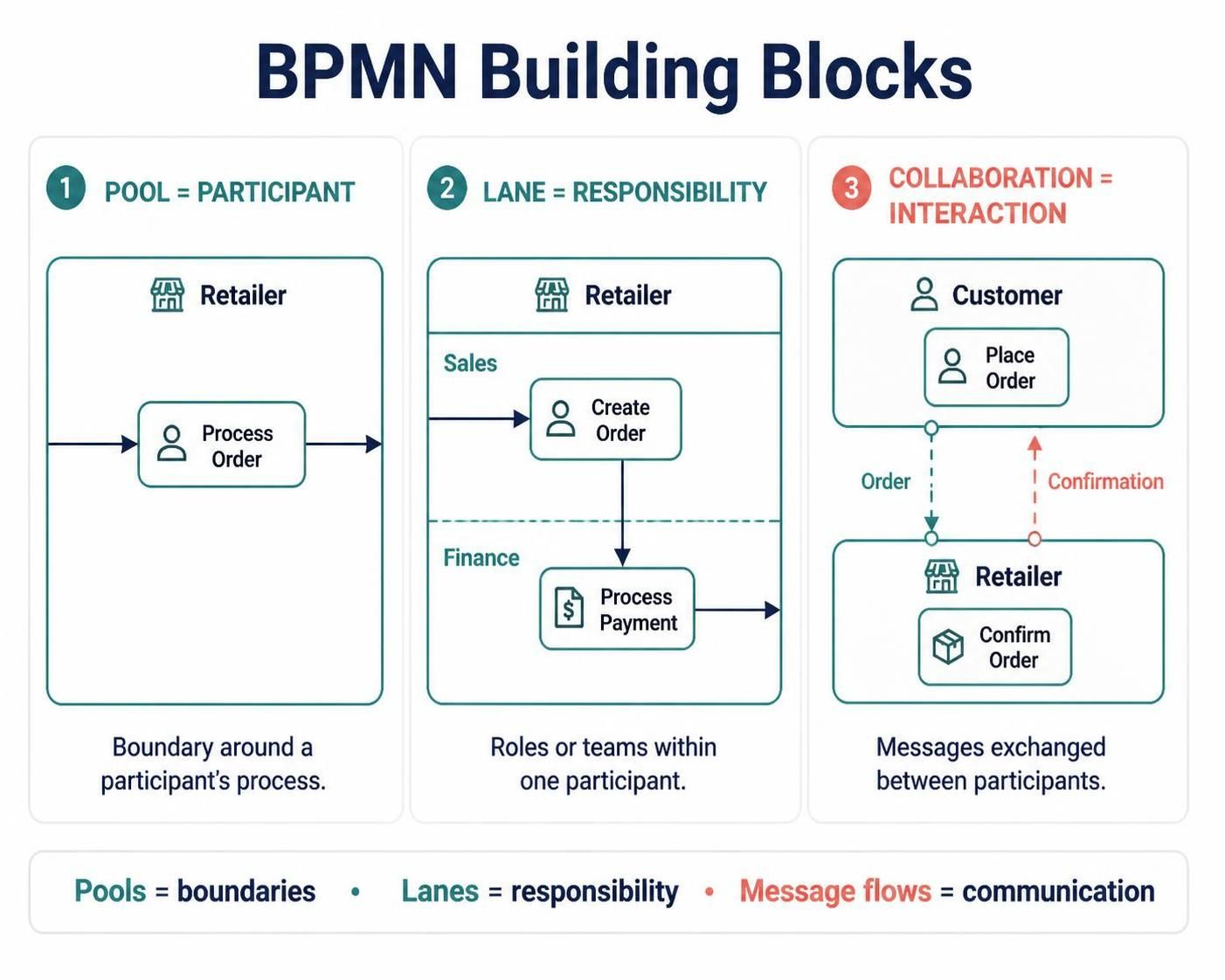
Business Process Model and Notation (BPMN) is the global standard for business process modeling. However, beginners often struggle with the distinction between the container of a process and the internal actors within it. Understanding the core building blocks—Pools, Lanes, and Collaborations—is the first step toward creating clear, professional process maps.
In this tutorial, we will deconstruct these three critical concepts using the architecture of Visual Paradigm, a leading BPMN modeling tool. By the end of this guide, you will understand how to define system boundaries, assign organizational responsibilities, and model inter-participant communication.
1. The Pool: Defining the System Boundary
The Pool is the most fundamental container in a BPMN diagram. It represents a Participant—an entity that is capable of starting and completing a business process. This entity can be an organization (like a “Retailer” or “Bank”), a customer, a supplier, or even an external system.
When you create a Pool, you are essentially drawing a line in the sand. You are defining the boundary of that specific participant’s process. Everything inside the pool belongs to them; everything outside does not.
- Visual Representation: A large rectangle with a title (e.g., “Retailer”).
- Function: It encapsulates the internal flow of activities for that specific entity.
- Key Rule: A single pool contains a single process flow. If you see two flows inside one box, they belong to the same entity.
In Visual Paradigm, you can visualize a Pool as a collapsed box containing a high-level view, or expanded to show the detailed sequence flow of tasks. The Pool is the “container” that separates your internal logic from the outside world.
2. The Lane: Assigning Responsibility
Once you have a Pool, the next question is: Who is doing what? This is where the Lane comes into play. Lanes subdivide a Pool to show the roles, teams, departments, or systems responsible for specific activities.
Lanes are the organizational chart of your process. They organize activities horizontally or vertically within the Pool. Crucially, lanes do not create separate participants. They are merely internal divisions of the single Pool entity.
Consider a “Retailer” Pool. It is one legal entity. However, inside that entity, the “Sales” team takes an order, and the “Finance” team processes the payment. In BPMN, you would draw two Lanes within the single Retailer Pool to represent this separation of duty.
- Vertical Lanes: Often used to represent departments (e.g., Sales, Finance, Shipping).
- Horizontal Lanes: Often used to represent system roles or distinct user types.
- Swimlanes: When flows cross from one lane to another, it indicates a handoff of responsibility within the same participant.
3. Collaboration: Modeling Interactions
Business rarely happens in isolation. A “Retailer” needs to interact with a “Customer.” A “Supplier” needs to talk to a “Warehouse.” This interaction is modeled using a Collaboration diagram, which involves multiple Pools.
When you have two or more Pools on a diagram, you are moving from a single-process view to a Collaboration Diagram. This view is essential for understanding end-to-end workflows that span across different organizations or systems.
The bridge between these Pools is the Message Flow. Unlike standard sequence flows (which stay inside a Pool), Message Flows travel between Pools. They represent the exchange of information, such as an “Order” sent from a Customer to a Retailer.
Pro Tip for Modeling: You can choose to show a participant’s process in detail (expanded Pool) or collapse it to show only its interaction with others. If the internal details of the “Customer” aren’t relevant to your specific process, collapse their Pool to a single rounded rectangle to focus on the message exchange.
Summary of Core Concepts
To summarize the architecture of a BPMN diagram, remember this simple shorthand:
- Pools = Boundaries: They separate different participants (e.g., Retailer vs. Customer).
- Lanes = Responsibility: They organize tasks within a single participant (e.g., Sales vs. Finance).
- Message Flows = Communication: They show the interaction between different participants.
By correctly utilizing these three building blocks in Visual Paradigm, you ensure your diagrams are not just visually appealing, but semantically accurate and ready for implementation.