
From Sketch to UML: AI-Powered Diagram Evolution with VPasCode
In the realm of software development and system architecture, the documentation process is often the first victim of time constraints. We begin with a high-level vision, sketching out simple flowcharts to capture the essence of a process. However, as the project matures, these casual sketches must evolve into rigorous, formal specifications—such as a UML Activity Diagram—to satisfy architectural standards and stakeholder expectations.
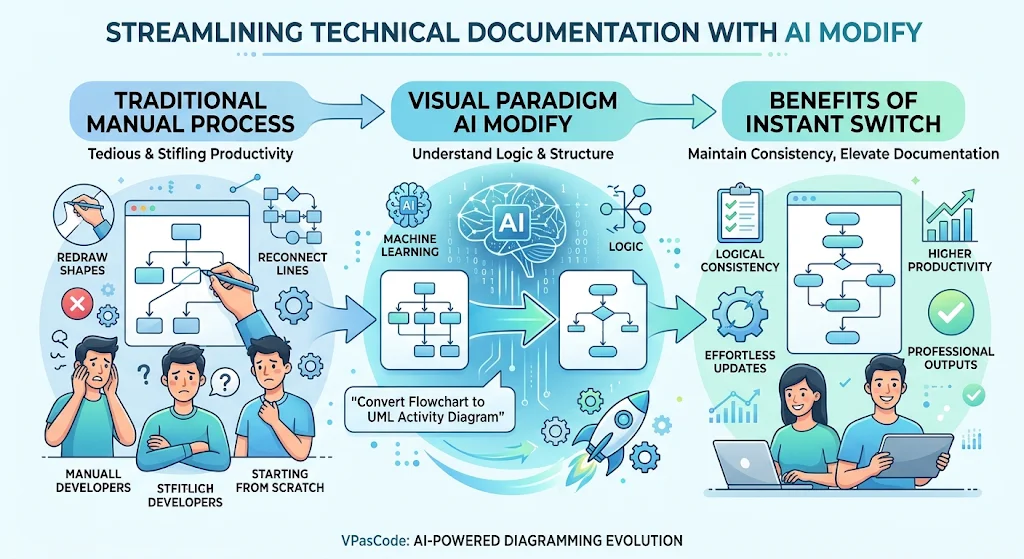
Historically, this transition has been a significant bottleneck. The traditional workflow required developers to abandon their initial tools, manually redraw every shape, and painstakingly reconnect every line. This “manual reconstruction” not only stifled productivity but often led to abandoned documentation updates.
Enter the era of AI-driven modeling with Visual Paradigm’s VPasCode. This guide explores how Artificial Intelligence has revolutionized the transition between diagramming standards, allowing you to switch from a casual flowchart to a formal UML specification instantly, preserving the underlying logic of your system.
The Challenge of Manual Documentation
Before understanding the solution, we must appreciate the friction of the traditional method. When a development team moves from a brainstorming phase to a formal design phase, the diagrammatic representation must change to reflect the increased complexity and rigor.
The Pain Points:
- Redrawing Shapes: The visual language changes. A simple “Start” node in a flowchart might need to become a specific initial node in a UML diagram, complete with specific styling rules.
- Reconnecting Lines: Logic that was implied in a rough sketch must be made explicit in a formal diagram. This often involves adding decision diamonds, merge nodes, or activity boundaries.
- Starting from Scratch: Often, developers feel it is faster to delete the old diagram and start a new one, losing the context and history of the previous iteration.
The Solution: AI Modify and VPasCode
Visual Paradigm’s integration of VPasCode with AI Modify changes the paradigm entirely. Instead of treating diagrams as static images, the system treats them as structured data that can be understood, parsed, and regenerated.
The core concept relies on the AI’s ability to perform Logical Analysis. When you ask the system to modify a diagram, it does not simply “swap the skin” of the diagram; it analyzes the flow of control and the data dependencies to ensure the new diagram is logically consistent with the original.
How the Transformation Works
The process of converting a casual flowchart into a formal specification involves several logical steps handled by the AI engine:
- Input Interpretation: The AI reads the current diagram code (generated by VPasCode) and understands the sequence of operations.
- Logic Extraction: It identifies the start point, decision points, parallel processes, and the end point. It understands that a diamond shape represents a condition, regardless of the diagram type.
- Standard Mapping: It maps the extracted logic to the syntax rules of the target diagram type. For example, it knows how to translate a standard “decision” into a UML Activity Node.
- Regeneration: The system generates new code that renders the target diagram, maintaining the flow but updating the visual representation.
Practical Example: Natural Language Modification
The power of VPasCode lies in its natural language interface. You do not need to be a coding expert to perform complex transformations. You simply describe the desired change.
Imagine you have a simple flowchart describing a “User Login Process.” You realize that for the security team, you need a formal UML Activity Diagram. In the past, this would take hours. Now, it takes seconds.
The Prompt
To achieve this transformation, you would simply provide a prompt to the AI Modify feature:
"Convert this Flowchart to a UML Activity Diagram"The system interprets this intent, analyzes the flowchart code, and generates the corresponding UML code. The result is a diagram that looks professional and adheres to UML standards, yet represents the exact same logic as your initial sketch.
Key Benefits of Instant Switching
The shift from manual to AI-modified diagramming offers three distinct advantages for technical documentation:
- Logical Consistency: Because the AI understands the logic, it ensures that no arrows are lost and no steps are skipped during the transition. The “truth” of the diagram remains intact.
- Effortless Updates: If you need to change a process later, you can do so in the source code or via a prompt, and the AI will re-render the diagram instantly.
- Higher Productivity: Developers spend less time drawing and more time designing. The documentation becomes a living artifact that evolves with the code.
Conclusion
The future of system architecture is dynamic. The rigid boundaries between “rough sketches” and “formal specifications” are dissolving thanks to AI. By leveraging tools like Visual Paradigm’s AI Modify, teams can maintain high-quality documentation that keeps pace with the fast-paced world of software development. Instead of fighting the drawing tools, you can focus on the logic that drives your system.