
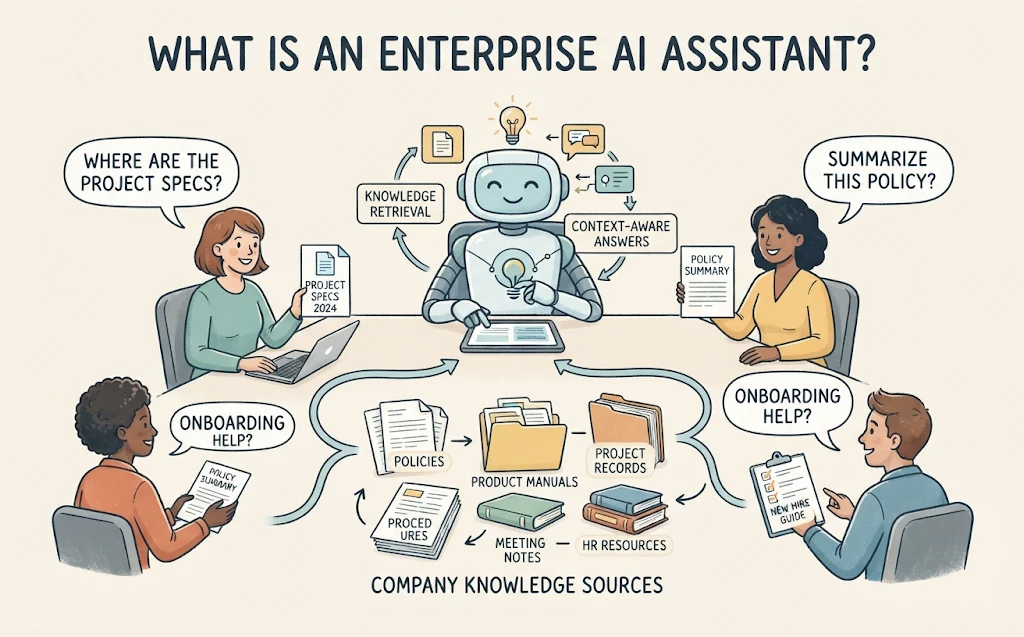
Employees often spend a surprising amount of time looking for information, asking colleagues for clarification, reviewing documents, and preparing routine work. A company may already have extensive documentation, established procedures, and years of project experience, yet employees can still struggle to find the information they need when they need it.
An enterprise AI assistant offers a way to make this information easier to access. Rather than functioning only as a general-purpose chatbot, it can be configured to help employees work with an organization’s own knowledge, documents, and business processes.
But what exactly is an enterprise AI assistant? How is it different from the AI chatbots people already use, and what can it realistically do for a business?
What Is an Enterprise AI Assistant?
An enterprise AI assistant is an AI-powered application designed to help employees perform work-related tasks and access information within an organization. Employees can interact with it using natural language, asking questions, requesting explanations, summarizing documents, or seeking help with specific activities.
Unlike a general-purpose AI assistant that primarily responds using its underlying model’s general knowledge and the information supplied by the user, an enterprise AI assistant can be connected to selected corporate knowledge sources. These may include:
- Company policies and internal guidelines.
- Product documentation and technical specifications.
- Project records, meeting notes, and decision logs.
- Business procedures and operational manuals.
- Training materials and employee resources.
- Reports, proposals, and other organizational documents.
When appropriately configured, the assistant can retrieve relevant information from these sources and use it to provide more context-aware responses.
The idea is to give employees a convenient way to interact with company knowledge without having to know exactly where every document is stored or which colleague might have the answer.
How Is an Enterprise AI Assistant Different from a General AI Chatbot?
At first glance, an enterprise AI assistant may look similar to a familiar AI chatbot. Both typically provide a conversational interface where users enter questions and receive responses.
The more important difference is the context in which they operate.
General-purpose AI chatbots
General-purpose AI chatbots are designed to handle a wide variety of questions and tasks. They can explain concepts, draft content, summarize text, brainstorm ideas, and assist with many other activities.
However, they do not automatically know an organization’s internal policies, project history, product decisions, or operating procedures. Employees must provide relevant information themselves, or use a service that supports an appropriate way to connect external information.
Enterprise AI assistants
An enterprise AI assistant can be configured around an organization’s working environment. It may connect to selected internal knowledge sources, follow reusable instructions, and support tasks relevant to particular teams or business functions.
For example, an employee might ask a general chatbot to explain a company’s expense reimbursement process. The chatbot can explain common expense management practices, but it cannot reliably describe that particular company’s rules unless the relevant information is provided.
An enterprise AI assistant connected to the organization’s approved policy documents can instead retrieve the relevant internal guidance and use it to formulate an answer.
This distinction is important: an enterprise assistant is not necessarily a different kind of AI model. It is an AI application configured to work within a particular organizational context.
What Can an Enterprise AI Assistant Do for Employees?
The value of an enterprise AI assistant comes from helping employees interact with information and complete work more efficiently. Its capabilities depend on the connected knowledge sources, available tools, and configuration, but several functions are particularly useful across different business environments.
1. Answer Questions About Company Knowledge
Employees frequently need answers to questions about internal procedures, company policies, product information, and project decisions.
An enterprise AI assistant connected to relevant company documents can help answer questions such as:
- What is the procedure for requesting a new software license?
- Which guidelines should we follow when preparing a customer proposal?
- What were the main decisions made during the previous project review?
- Where can I find the latest technical specifications for this product?
Instead of manually searching through multiple documents, employees can ask questions in ordinary language and receive responses based on the information available to the assistant.
This is particularly useful for organizations with large document collections or employees who frequently need information maintained by other departments.
2. Summarize and Explain Complex Documents
Not every employee is familiar with every document they encounter. A technical specification may be difficult for a business stakeholder to understand, while a lengthy policy document may contain more detail than someone needs for a particular task.
An AI assistant can help make such information more accessible by summarizing documents, explaining terminology, extracting important points, or reorganizing content for a particular audience.
For example, a project manager could ask the assistant to summarize a technical report into a short management briefing. A new employee could request a plain-language explanation of an internal procedure.
This does not eliminate the need to read original documents when accuracy and detail matter. It gives employees a convenient starting point for understanding the material.
3. Help Employees Prepare Work Documents
Many workplace documents follow recurring patterns. Employees may regularly prepare meeting summaries, project updates, internal announcements, business reports, and proposals.
An enterprise AI assistant can help create initial drafts using relevant source material and reusable instructions.
For example, employees might ask it to:
- Turn meeting notes into a structured summary.
- Prepare a project status report using collected updates.
- Create an initial draft of a procedure based on existing guidelines.
- Summarize several documents into a management briefing.
- Rewrite technical information for a non-technical audience.
Organizations can also establish standardized prompts for recurring tasks. This helps employees produce documents with a more consistent structure and reduces the effort required to start from a blank page.
4. Support New Employee Onboarding
New employees need to learn how an organization works. They must become familiar with internal policies, team responsibilities, tools, procedures, and the background behind ongoing projects.
An enterprise AI assistant can serve as an additional resource during this learning process. New employees can ask questions about documented procedures and request explanations of unfamiliar concepts without having to locate every relevant document themselves.
For example, a new team member might ask:
- What are the main responsibilities of this department?
- Which documents should I read to understand this project?
- What steps are involved in our customer handover process?
- What terminology is commonly used in our product documentation?
This can make organizational knowledge easier to access and reduce the burden on experienced colleagues who otherwise need to answer the same introductory questions repeatedly.
It should complement, rather than replace, formal training, mentoring, and direct communication with colleagues.
5. Help Employees Understand Project History
Business projects often generate large amounts of information over time. Requirements change, decisions are revised, stakeholders raise concerns, and teams document important discussions.
When this information is scattered across meeting notes, reports, and project documents, understanding the history behind a particular decision can be difficult.
An enterprise AI assistant connected to relevant project records can help employees investigate questions such as:
- Why was a particular requirement introduced?
- What alternatives were discussed before the current approach was selected?
- Which stakeholder raised a concern about the proposed design?
- What issues were still unresolved at the end of the previous project phase?
This can be especially useful when new employees join an existing project or when responsibilities are transferred between teams.
The assistant should make it possible to explore available project information more conveniently, while employees should still verify important conclusions against the original records.
6. Identify Information That Needs Attention
Corporate knowledge does not always remain consistent. Different documents may contain conflicting requirements, outdated procedures, or information that has not been updated after a business decision.
An enterprise AI assistant can help employees investigate these situations by comparing related information and highlighting possible inconsistencies.
For example, an employee might ask it to compare two versions of a procedure, identify requirements that appear to differ between project documents, or locate meeting notes that mention an unresolved issue.
These capabilities can help teams identify information that needs review. They should not be treated as automatic proof that a document is incorrect, because apparent differences may have legitimate explanations, such as different dates, project scopes, or departments.
What Makes an Enterprise AI Assistant Effective?
Simply providing employees with an AI chat interface does not automatically create a useful enterprise assistant. Its effectiveness depends on several important factors.
Access to Relevant Company Knowledge
An assistant can only provide organization-specific answers when it has access to suitable information. Businesses should identify the documents and knowledge sources that employees need and establish a practical way to keep them organized and updated.
Some solutions use retrieval-augmented generation (RAG) to retrieve relevant information from external knowledge sources and provide it as context to the AI model when answering a question.
This approach can help an AI assistant respond using company information without requiring the organization to train a new foundation model from scratch. The usefulness of the answers still depends on retrieval quality, document quality, and the way the system is configured.
Clear Access Permissions
Not every employee should have access to every company document. Human resources records, financial information, customer materials, and confidential project documents may have different access requirements.
An enterprise AI deployment should consider how permissions are managed across connected knowledge sources. The assistant should not expose information to users who are not authorized to access it.
Useful Instructions and Reusable Prompts
Different teams may need different kinds of assistance. A project manager may want structured progress reports, while a business analyst may need help organizing requirements.
Reusable prompts and task-specific instructions can help employees obtain more consistent results. They can also make it easier to introduce AI into recurring business activities without expecting every employee to become an expert at prompt writing.
Human Review and Accountability
AI-generated answers and documents can contain mistakes, omit important qualifications, or misunderstand the available context.
Employees should remain responsible for reviewing important outputs, especially when they relate to legal matters, financial decisions, customer commitments, regulatory requirements, or operational procedures.
A good enterprise AI assistant supports employees rather than replacing their professional judgment.
What Should Businesses Consider Before Introducing One?
Before adopting an enterprise AI assistant, organizations should consider more than the conversational interface. The following questions can help decision-makers evaluate whether a solution is suitable.
- Knowledge integration: Can the solution work with the documents and knowledge sources the organization actually uses?
- Deployment: Can it be deployed in a way that meets the organization’s infrastructure and data-handling requirements?
- Access control: Can the organization manage which employees can access particular information?
- Ease of use: Can employees interact with the assistant without extensive technical training?
- Task support: Does it help employees complete useful work, rather than simply answer general questions?
- Administration: Can the organization maintain its knowledge sources, prompts, and configuration over time?
- Training and support: Is there guidance to help employees adopt the system and use it responsibly?
Businesses should also evaluate the complete data flow. The term “private AI” does not automatically mean that every component runs on the organization’s own physical servers. Some solutions use self-hosted infrastructure, while others connect to external AI providers through organization-managed accounts and endpoints. The actual privacy and security arrangements depend on the selected architecture, configuration, access controls, and provider terms.
Enterprise AI Assistants as Part of a Wider Knowledge Environment
An AI assistant becomes more useful when it is part of a wider environment for managing and working with organizational knowledge.
Consider a company that maintains project notes, technical documents, business procedures, and system diagrams. Employees may need to ask questions about this information, but they may also need to create new documents, update specifications, or communicate processes visually.
A conversational assistant can help retrieve and explain information, while complementary tools can support the creation and maintenance of business deliverables.
For example, a business analyst might use an AI assistant to explore project requirements, a documentation tool to prepare a specification, and a diagramming tool to represent the process or system being discussed.
This creates a more complete workflow: employees can move from accessing existing knowledge to analyzing it and producing useful new work.
Putting an Enterprise AI Assistant into Practice
Businesses interested in this approach do not necessarily need to build an AI platform from the ground up. They can start by identifying their knowledge-management needs and selecting a solution that provides the necessary software, deployment options, and implementation support.
Visual Paradigm’s Private AI solution for enterprise knowledge is one example of an offering designed around this broader approach. It brings together several complementary tools:
- NotesKeep: A knowledge repository for organizing corporate notes, documents, and other reference materials.
- AI Chatbot: A conversational interface for asking questions and obtaining context-aware assistance using selected knowledge sources.
- OpenDocs: A tool for creating, organizing, and sharing documentation and reports.
- Diagram Editing Tool: A visual modeling environment for creating and refining diagrams that communicate systems, processes, and ideas.
The offering also includes implementation services such as software and infrastructure setup, live online team training, and ongoing technical support.
Organizations can explore self-hosted deployment on on-premises or dedicated cloud GPU infrastructure, or connect the tools to a cloud AI provider using their own account and endpoint credentials. The appropriate option depends on the organization’s requirements and available infrastructure.
Rather than treating an AI assistant as an isolated chatbot, this approach connects conversational AI with the tools employees use to organize knowledge and produce business deliverables.
Conclusion
An enterprise AI assistant can become a valuable workplace resource when it helps employees access company knowledge, understand documents, prepare routine deliverables, and explore project information.
Its greatest advantage is not simply that employees can ask an AI questions. It is that the assistant can be configured to work within the organization’s own knowledge environment, making AI more relevant to everyday business activities.
Successful adoption requires more than choosing an AI model. Businesses need suitable knowledge sources, appropriate access arrangements, practical workflows, employee guidance, and a clear approach to human review.
With these elements in place, an enterprise AI assistant can help turn existing organizational knowledge into something employees can actively use in their daily work.
Frequently Asked Questions
What is the difference between an enterprise AI assistant and an AI chatbot?
An AI chatbot is a conversational interface that allows users to interact with an AI system. An enterprise AI assistant is designed for organizational use and can be connected to company knowledge, configured for business tasks, and managed according to workplace requirements. The terms can overlap, but an enterprise assistant typically has a broader organizational purpose.
Can an enterprise AI assistant answer questions using internal company documents?
Yes, provided the solution is connected to suitable internal knowledge sources and configured to retrieve relevant information. Some systems use retrieval-augmented generation to supply relevant document content as context when generating answers.
Does an enterprise AI assistant require a company to train its own AI model?
No. Many enterprise AI solutions use existing AI models and connect them to organizational knowledge sources. This allows businesses to provide company-specific context without necessarily developing or training their own foundation model.
Can small and medium-sized businesses use enterprise AI assistants?
Yes. The concept is relevant to organizations of different sizes. A smaller business might begin with a focused collection of internal documents and a few common employee tasks, while a larger organization may require more extensive knowledge integration, access controls, and deployment planning.
Is an enterprise AI assistant secure?
Security depends on the system’s architecture, deployment, access controls, data-handling practices, and the terms of any external AI provider. Businesses should evaluate these factors rather than assume that a solution is secure simply because it is described as private or enterprise AI.
Can an enterprise AI assistant replace a company’s knowledge management system?
Usually, it is better understood as an additional way to access and work with organizational knowledge. A knowledge management system still provides the underlying content, structure, and maintenance processes. The AI assistant makes that information easier to explore and use.