
Architecting Microservices with UML: A VPasCode Component Diagram Tutorial
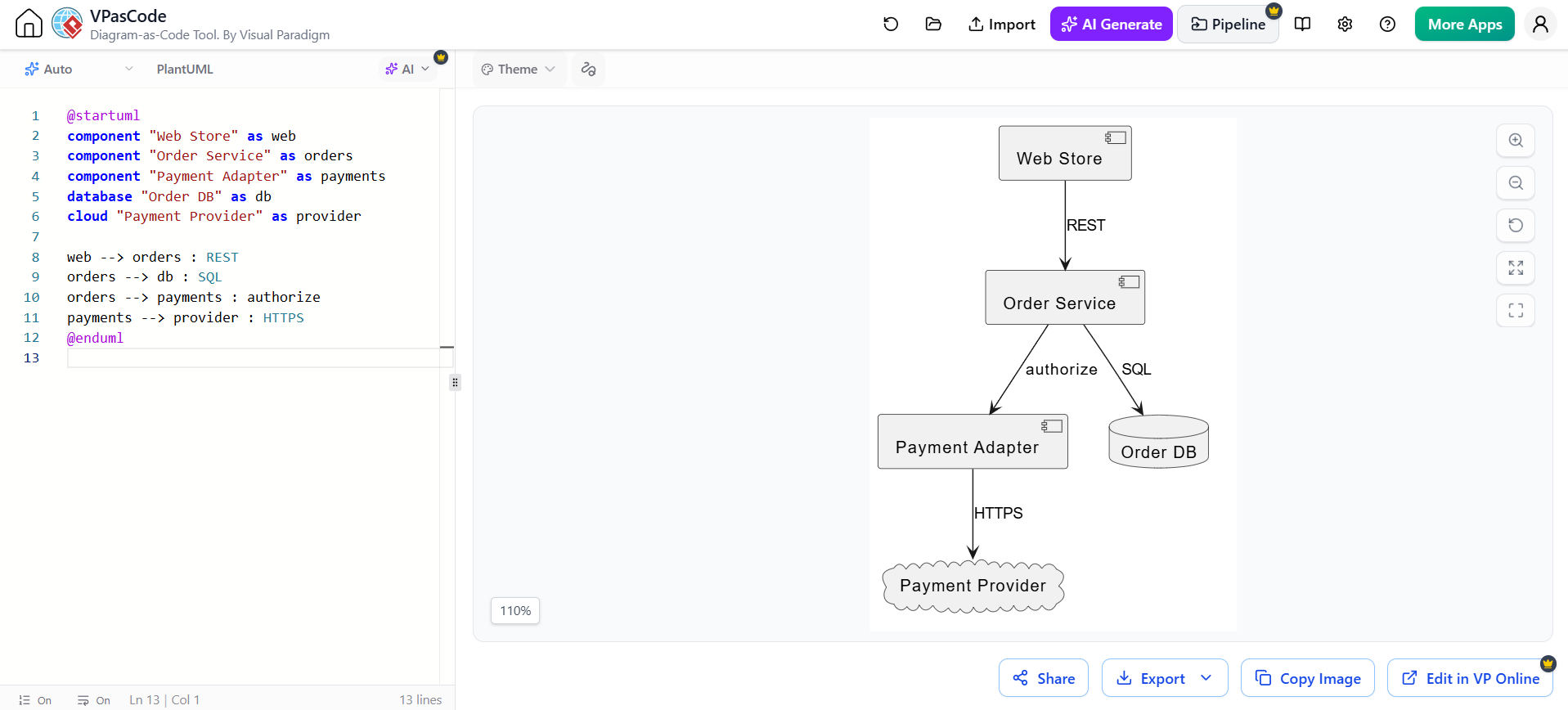
In modern software engineering, communicating the architecture of a distributed system is just as critical as writing the code itself. This tutorial explores how to effectively model a system using Component Diagrams with VPasCode, Visual Paradigm’s powerful diagram-as-code tool. We will dissect a specific example of an online order processing system, demonstrating how to define deployable parts, their dependencies, and the protocols that bind them together.
Understanding the Component Diagram
A component diagram is a type of UML diagram that shows deployable or replaceable software parts and their dependencies. Unlike a class diagram which focuses on internal structure, a component diagram is used to communicate the application architecture and integration boundaries. It abstracts the implementation details to show how different services—such as a web store, an order service, and a database—interact.
Step-by-Step: Modeling the “Web Store” System
Using the VPasCode interface, we can define the architecture of an e-commerce platform. Let’s break down the code snippet that generates the diagram shown in the context.
1. Defining System Components
The first step in VPasCode is declaring the structural elements. We define the “Web Store” as the entry point, the “Order Service” as the logic processor, and the “Payment Adapter” as the connector to external services.
@startuml component "Web Store" as web
component "Order Service" as orders
component "Payment Adapter" as payments
Here, we use the component keyword followed by the display name and an alias (like as web). The alias is crucial for referencing these components in relationships later. Notice the use of the Component stereotype, which typically renders as a rectangle with a small icon indicating a software module.
2. Modeling Infrastructure and External Dependencies
Systems rarely exist in a vacuum. We need to account for persistent storage and third-party services. VPasCode allows us to use specialized stereotypes to visually distinguish between internal components and external infrastructure.
database "Order DB" as db
cloud "Payment Provider" as provider- Database: Using the
databasekeyword automatically renders a cylinder shape, standard for SQL data stores. - Cloud: The
cloudstereotype is used for external entities, such as a Payment Provider, often represented with a cloud-like shape to indicate it is outside the local network.
3. Defining Communication Protocols
The most vital part of a component diagram is the dependency. It answers the question: “How does component A talk to component B?” In our diagram, we define specific protocols to clarify the nature of the interaction.
web --> orders : REST
orders --> db : SQL
orders --> payments : authorize
payments --> provider : HTTPS
The syntax source --> target : protocol creates a directed arrow. The label on the arrow (e.g., : REST) specifies the communication protocol or interface. This level of detail is essential for developers to understand integration requirements without reading the source code.
Advanced Modeling Concepts
When modeling complex systems, it is important to distinguish between the interface a component provides and how it consumes data. In this tutorial example:
- REST (Representational State Transfer): Used between the Web Store and Order Service, indicating a stateless HTTP-based interaction.
- SQL (Structured Query Language): Used between the Order Service and the Database, indicating direct data manipulation.
- HTTPS (HyperText Transfer Protocol Secure): Used for the external payment transaction, highlighting the need for encryption when communicating with third-party providers.
By visualizing these boundaries, architects can identify potential bottlenecks, security risks (like unencrypted external calls), or tightly coupled dependencies.
Conclusion
The example provided demonstrates a classic microservices or layered architecture pattern. By leveraging VPasCode, developers can iterate on their architectural designs quickly using code, ensuring that the documentation remains synchronized with the system’s evolution. Whether you are planning a new monolith or refactoring into microservices, this diagrammatic approach provides the clarity needed to build robust software systems.